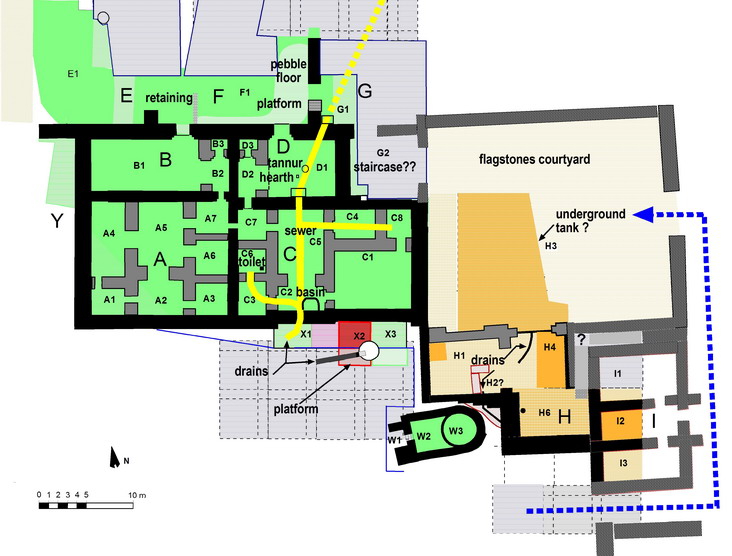
We can at present identify two wings. One (in green above) is the service wing, which was bordered in the north by a large courtyard of which we have exposed only a small portion. The other wing (in yellow) is the one which I called it the "formal" wing and which we assume was used as the royal residence. The floor of the latter are about 2m higher than those of the former. Back to top
Sectors
The articulation of space clearly shows that the service wing included four sectors, of which the to the north can be shown to have had a clear function: Sector B for storage and sector D or the kitchen. The function of Sector C is uncertain, even though it is well preserved. A plausible hypothesis is that it was the royal wardrobe. Sector A is completely eroded, except for the walls' foundations and lower courses.
In the formal wing we have distinguished two sectors. The reception suite (H) includes a beautiful stone paved courtyard, and two rooms that may have served as the antechamber through which the king would pass from his private quarters to the courtyard. Another suite of three rooms opens to the eastern part of the formal wing, and may have flanked the access corridors (in blue – but this is very tentative). Back to top
Rooms
The service wing (the only one completely excavated) has a total of 22 rooms (though two of these, A5 and C5, are most likely to have been small courtyards). The arrangement of the space is rather symmetrical, albeit not with a perfect mirror image effect. Back to top
Walls
For a description of all the walls of the Palace, with photographic documentation and conservation reports, see section "CONSERVATION" in the bottom-left side bar. Back to top