Definition
Universal codes
Features
1. Surfaces
2. Buildup
3.
Fill, dumping collapse
4. Installations
5.
Other features
Items
1.
Metal
2.
Stone
3.
Clay
4.
Organic
5.
Other items
Alphabetical list of codes
for features and items
Incidentals Ware or material
Contact association
Shape for ceramic vessels
View range
View orientation
17.1
Introductory
A lexicon has been defined (12.4) as the
list of attribute states or variants, i.e., the specific information that fills
a given roster slot (attribute argument or variable). The term “lemma” (plural
“lemmata”) refers to the concrete lexical item(s).
The list is open ended, and as such it is
susceptible of additions at any time. Thus, whether or not or a lexical entry
“earring” for the roster slot B10=“definition” is present in our lexicon, or a
lexical entry “green” for the roster slot K5=“color,” and whether or not it has
been used in the past, it can be introduced at will the first time it becomes
pertinent. It is important that in such cases a precise definition be given
within the record itself: this is done by using the category –rd “roster
definition” under incidentals (17.4 (4)).
In this perspective, a formal listing of
lexical entries would seem unnecessary. If that is not so, and if I undertake
to give just such a list in this chapter, it is for two major reasons.
(1) In most cases where a lexical entry is
expected, there is a correlative need for sorting. Thus, for example, it is
obviously desirable to sort the entries for the roster slot “definition” in
such a way that we have all ceramic vessels together, all seal impressions
together, and so on. A uniformity of lexical entries is expected to make such
sorting possible: it would not work to call the same type of object “ceramic
vessel” or “pottery item,” “seal impression” or “rolling,” and so on.
The simplest function of a lexical list
is, therefore, to provide consistency in the use of appellations for distinct
phenomena. In the input phase, it will also serve as a list of abbreviations,
or codes, that can be more easily utilized in a uniform manner. Just as we saw
in the case of the roster (16.1), this aspect of the current presentation is of
no concern to a normal user of the system, since in the display version as
embodied in the browser edition all abbreviations are resolved, and thus no
knowledge of the codes is expected.
(2) More important is the conceptual
dimension of the lexicon. Terms like “floor” and “fill” appear at first to have
an evident meaning – the first term referring to a walking surface, and the
second to material deposited within a given space. But closer inspection will
reveal great variations. These have to be spelled out, and this goes to the
core of the conceptual dimension of the lexicon. What is important in this
endeavor is not so much to canvass a dictionary for definitions and
paraphrases, but to articulate the variations into structured sets, where the
definitions arise from contrasts among the members of the set. This I seek to
do, to a limited extent and only for some basic categories, in this chapter.
The individual lexical items given below reflect different degrees of specificity, and no attempt is made to provide a finer hierarchy in this regard within each of the categories. It is also important to note that the record may well reflect successive moments through which different, and progressively higher, degrees of specificity are ascertained and assigned to the data. At Mozan, this has often been the case, for instance, in the case of cl “clay lumps.” It was imperative, when collecting them in the field, that no attempt be made to determine whether they were sealings, and if so whether they were impressed with the rolling of a seal, for to attempt even a modicum of cleaning before they had become dry might seriously jeopardize their integrity. But after cleaning in the laboratory, such determination could, and would, be made. We estimate that we have collected some 10,000 cl clay lumps, of which only about 2,000 turned out to be sl “sealings,” of which again only some 1,600 bore a si “seal impression,” and a few even turned out to be tablet fragments. Progressively finer descriptions were then possible, e.g., as to iconography, epigraphic content, etc.
17.1 Simple and complex lemmata
A simple lemma
is based on a single set
of parameters that is used to define a variant within a variable, e.g., “brown”
within the variable “color.” With greater precision, a lemma may be based on
the use of standards (e.g., the Munsell variant “5YR8/2" within the
variable “color”; see below, 20, for a discussion of standards).
A complex lemma is a combination of simple lemmata and is used in the same way to define a set of variants within a variable. thus, a ceramic “ware” is set of pertinent attributes for matrix, inclusions, manufacturing technique and measurements, each of which is defined separately as a simple lemma.
17.2
Current version
The current version is indicated by a code
that relates the lexicon to the roster, thus
LZmr-003 is the 3rd version of the lexicon applicable to the main
roster, LZca-002 is the 2nd version of the lexicon applicable to the Ceramic
Analysis roster.
17.3
Back to top
17.4 Universal codes
17.5
Back to top
Variants for variable B10 = df: Definition
These codes are also
applicable to A5=sp specific label (in which case they are preceded by a
circumflex), and M1, M2 or M3 generic and specific function.
It must be stressed that the
lexicon is an open system (17.1), so that features that occur rarely may be
named in an ad hoc fashion as necessary. For instance, such entries as “pile of
bricks” may be used for a stack of brocks ready for use in constructing a wall.
The only two constraints are that initial hyphen is
reserved for incidentals, and that the maximum length allowed is 20 characters.
Labels
that are more specifically typological are given in italics at the end of each
group of definitions. These typological definitions may be given under B10, in
addition to the more generic definition. Thus something defined first as co
“collapse” may also be defined as bf “brickfall.” Conversely, if a wall has
(even just partly) collapsed into an open pit, then the typological definition
as “brickfall” would accompany the emplacement definition f2 “fill in secondary
context.” In addition, the qualification bf “brickfall’ may also be entered
under A5, if distinct brickfalls are numbered sequentially, and under M1 as a
determination as to primary function.
In some cases, a typological
definition that includes a higher degree of specificity may apply to more than
one type of material – for instance, a sculpture may be in stone or bronze. For
this reason, it is advisable, though it is not strictly required by the system,
to give in every case the more generic definition, e.g., ma “metal artifact” as
well as sc “sculpture.” (In the topical lists given below, a term like
“sculpture” may accordingly be entered twice, under ma “metal artifacts” and
under la “lithic artifacts.) A more precise definition of the type of ware or
material (e.g., arsenical bronze) will be found under the roster slot K3=wm
“ware or material.”
Back
to top
(1) Features (stationary elements)
The main criterion for sorting
the different types of features is the manner of alignment of the components of
any given feature. Accordingly, four types can be distinguished.
1. Surfaces: the alignment is along a single plane.
2. Buildup: this refers to the inert, i. e. gradual and unintentional,
buildup that occurs on top of a surface, and which is characterized by the
horizontal alignment of inclusions, each of which tends also to have a
horizontal angle of repose.
3. Fill: this refers to a dumping or collapse that results in the random
alignment of inclusions. The term “fill” refers, strictly speaking, to a
situation whereby the material “fills” a given space that is bounded, as is the
case with discards dumped into a pit or walls collapsed inside a room. The
category, however, subsumes also cases when the material is not bounded, but
has piled up without containment, as with a brickfall that took place onto an
open space.
4. Installations: this refers to the ordered organization of components,
such as the bricks within a wall.
Note that, for ease of reference, the descriptive terms are taken from
the depositional, rather than the emplacement, aspect that characterizes the
feature – thus “fill” instead of something like “amorphous amassment.”
1.
Back to top
Surfaces
sf subfloor:
hard layer, suitable for compaction and/or additional cover on top; it may at
times be inferred to have resulted from the leveling of a pre-existing collapse
fa floor,
type a (plastered or lined)
fb floor,
type b (highly compacted)
fc floor,
type c (medium compacted)
fd floor,
type d (compacted naturally)
pv pavement
in general (floor defined structurally by distinct surface elements, generally
a finished cover or a coating laid on prepared surface)
pa pavement,
type a: coating (heavier than fa: cement, bitumen)
pb pavement,
type b: large components (flagstones, bricks or tiles)
pc pavement,
type c: small components (pebbles, sherds)
2.
Back to top
Buildup
a accumulation:
gradual buildup, generally bounded by walls or abutting at least one wall.
Depositionally, an accumulation may be inferred to have occurred through two
major processes. (1) Occupation is the process resulting from human
activities, whereby debris (including artifactual fragments such as sherds, and
organic material such ash) comes to be embedded and compacted into a coagulated
layer. (2) Sedimentation refers
to the precipitation of natural material, such as dust, windblown sand or
organic particles.
aa accumulation,
type a: occupation immediately above floor surface, with sherds lying perfectly
flat on the surface, vessels sitting upright, large pot smashes suggesting that
the original ceramic vessel broke in place, etc. This is what is generally
referred to as a “living floor,” and it is of particular importance for stratigraphic
considerations
ab accumulation,
type b: accumulation above accumulation, without distinct floor surface
underneath, but well defined in terms of layering of matrix and distribution of
inclusions
ac accumulation,
type c: not above floor, e.g. abandonment
ad accumulation,
type d: natural accumulation (i.e., sedimentation)
ba band
(horizontal deposit with sharp lower and merging upper boundaries)
ly layer ((horizontal deposit with sharp
lower and upper boundaries)
l lens, same as accumulation, but not abutting
any walls
la lens type a (same criteria as for as
accumulation a)
lb lens type b (same criteria as for as
accumulation b)
lc lens type c (same criteria as for as
accumulation c)
ld lens type d (same criteria as for as
accumulation d)
ts topsoil:
this is generally a band or layer
lm laminations:
a special kind of lens of type d, characterized by the even horizontal layering
of very uniform soil, with an even layering and a sharp horizontal face, giving
the appearance of compaction, but in fact quite brittle; it may be inferred
that it was produced by the settling of water dripping from above (as with a
light rain) after which it was left to dry without disturbances
mud a
special kind of lens, similar to a
lamination but with greater compaction, for which one may infer that it was
produced by a sizeable downpour, such as heavy rain, rather than by a light
drizzle
3.
Back to top
Fill, dumping, collapse
fi fill in general: soil matrix with inclusions
not laid horizontally, at least not uniformly so (e.g., sherds or bones with
different and sharp “angles of repose”), often contained within a bounded space,
from which one can infer intentional and one-time dumping
f1 fill in primary context (e.g., within a
foundation trench)
f2 fill in secondary context (e.g., discard
within a pit originally meant for storage)
co collapse: uniform matrix (e.g., bricks), with
individual inclusions showing similar “angle of repose” (so as to suggest disaggregation
of a built-up installation during collapse), often not contained within bounded
space; it may be inferred that the collapse happened through intentional
destruction by human agents of preexisting installations, or through erosion
due to natural agents (especially rain and wind)
bf brickfall
(specific collapse)
rf roofing
material (specific collapse)
or organic
refuse or midden (specific dump)
4.
Back to top
Installations
is installation in a general sense: a discrete
whole whose component parts are ordered according to a structured organization,
from which one can infer that it was set up intentionally to serve as a
specific functional aggregate (13.4)
bp brick pile: the individual bricks are laid
side by side, often set on their narrow side and leaning on each other, without
the cohesion resulting from mortar binding
bu burial
(not built up, see gv, hb)
gv grave
( built up, see bu,hb)
hs house
bn bin
ki kiln
he hearth
ov oven
st-is stone
installation (isolated large stones, threshold, steps)
ta tannur
(bread oven)
5.
Back to top
Other features
ia item aggregate (e.g., vessels on floor)
vm a layer defined volumetrically rather than through identifiable boundaries, e.g., when removing baulks without distinguishing predefined features
mx mixed features – e.g. when collapsing eroded sides of sections, resulting in a mix from all the various portions of the section
Back to top
(2) Items (movable elements)
The main criterion for sorting the various
types of artifacts is the ware or material of the specific item. This is in
some respects analogous to the criterion used for features, in that the
definition is based on the consistency of the item and on the identification of
traits that are apparent even at a low level of specificity.
1.
Back to top
Metal
ar arrowhead
ax ax(head)
sh spearhead
je jewelry
item
pi pin
spoon
sc sculpture
2.
Back to top
Stone
ls lithic specimen (e.g., an unworked pebble)
bd bead
bl blade
mace
pol polisher or burnisher
ds door socket
sc sculpture
se seal
3.
Back to top
Clay
cv ceramic vessel
cl clay lump (and possible tablet)
kw kiln
waste: vitrified, amorphous matter from ceramic kiln (cf. kwr, slag)
kwr kiln
waster: misshapen or molten ceramic piece(s) or fragment(s). The difference
between kw and kwr is significant, for a waster (kwr) retains at least
partially the shape of the object that had been initially intended, and as such
it qualifies as a proper artifact
bo bowl
(rim/height: 3/1)
bt bottle
(rim/height: 1/5)
di dish
(small platter)
ds door socket
go goblet
(proportions as for small jar)
ja jar
(rim/height: 1/3)
po pot
(rim/height: 1/1)
pl platter
(rim/height: 5/1)
bk brick
si seal
impression: refers to the impression left by a seal (the seal itself may be
reconstructed as a “trace,” see 13.3)
sl sealing:
refers to the object used to seal an opening (generally a container or a door),
whether it has been sealed with a seal or not
fg figurine
sb sling ball
wh wheel
4.
Back to top
Organic
ba bone artifact
cs carbon
ash
awl
board (as on back of sealings)
hb human body (see bu, gv)
in inlays (generally made of
shell or mother-of-pearl)
ro root
peg
5.
Back to top
Other items
e epigraphic: refers
to anything with writing on it, e.g., a sherd, a seal, a seal impression
t tablet:
refers to an object shaped for writing, whether in fact epigraphic or
anepigraphic
17.6
Back to top
(3) Combined alphabetical list for features and items
a accumulation: gradual buildup, bounded by walls or abutting at least one wall
aa accumulation, type a: above floor surface (“living floor”)
ab accumulation, type b: above accumulation
ac accumulation, type c: not above floor, e.g. abandonment
ad accumulation, type d: natural accumulation (i.e., sedimentation)
ar arrowhead
ash
awl
ax ax(head)
ba band (horizontal deposit with sharp lower and merging upper boundaries)
baf bone artifact
bd bead
be bench
bf brickfall
(specific collapse)
bk brick
bl blade
bin bin
bo bowl (rim/height: 3/1)
board (as on
back of sealings)
bone bone
bp brick pile
bt bottle
(rim/height: 1/5)
bu burial
(not built up, see gv, hb)
ca clay
artifact
cb carbon
cl clay lump (and possible tablet)
co collapse (not contained within bounded space)
cr corridor
cv ceramic vessel
d doorway
di dish
(small platter)
ds door socket
e ensemble
ep epigraphic:
refers to anything with writing on it
f floor surface in general
f1 fill in primary context (e.g., within a foundation trench)
f2 fill in secondary context (e.g., discard within a pit originally meant for storage)
fa floor, type a (plastered or lined)
fb floor, type b (highly compacted)
fc floor, type c (medium compacted)
fd floor, type d (compacted naturally)
fg figurine
fi fill in general (contained within bounded space)
fu furnishings
gl glass
go goblet
(proportions as for small jar)
gr grinding
stone (mano or metate)
gv grave (
built up, see bu,hb)
hb human body
(see bu, gv)
he hearth
ho hole
hs house
ia item aggregate (e.g., vessels on floor)
in inlays
(generally made of shell or mother-of-pearl)
is installation
ja jar
(rim/height: 1/3)
je jewelry
item
ki kiln
kw kiln
waste: vitrified, amorphous matter from ceramic kiln (cf. kwr, slag)
kwr kiln
waster: misshapen or molten ceramic piece(s) or fragment(s)
l lens, same as accumulation, but not abutting any walls
la lens type a (same criteria as for as accumulation a)
la lithic
artifact
lb lens type b (same criteria as for as accumulation b)
lc lens type c (same criteria as for as accumulation c)
ld lens type d (same criteria as for as accumulation d)
lm lamination
lo loose
items
ls lithic specimen
ly layer ((horizontal deposit with sharp lower and upper boundaries)
ma metal
artifact
mace
mold
mud
mx mixed (feature)
or organic
refuse or midden
ov oven
pa pavement, type a: coating (heavier than fa: cement, bitumen)
pb pavement, type b: large components (flagstones, bricks or tiles)
pc pavement, type c: small components (pebbles, sherds)
peg
pf platform
pi pin
pit pit (generic)
pit-a pit aggregate
pit-c pit cut
pl platter
(rim/height: 5/1)
po pot
(rim/height: 1/1)
pol polisher or burnisher
pv pavement in general (floor defined structurally by distinct surface elements)
qb bone lot
qp pottery lot
r room
re refuse heap
rf roof
collapse and roofing material
rh rodent hole
ro root
s structure
s structure
sb sling ball
se seal
sf subfloor
sg slag slag
(from metal smelting)
spd spearhead
sh shell
si seal
impression
sl sealing
sm sample (non count, see sp)
so soil
sp specimen (count, see sm)
spoon
st-is stone
installation (isolated stones, threshold, steps,…)
str strainer
string
su statue (STONE) see sc
t tablet
ta tannur
(bread oven)
to tool
tr trench, trough
ts topsoil:
this is generally a band or layer
uc uncertain
ut utensils
vm layer defined volumetrically
vr varia
vs vessel
wall wall
waf wood artifact
wd wood
we weapon
wh wheel
Back to top
(4) Codes for incidentals
(4) Codes
for incidentals
|
related to excavation |
unrelated to excavation |
|
--i introduction -ae aerial photography -dy daily -eq equipment -fl file log -iv inventory -lb labeling -lg log -mk marker -mt methods and techniques -ns notes on time sequencing -ov overall shot -ph phase -rd roster definition -rs record shot -sf staff -sg strategy -sn section -so site overall -sp special project -sr strata description -st storage -su summary -sy surveying -tr transmittal -vr varia -wa work activities -wk workmen -zx site general, excavations |
-cy city scenes -eh expedition house -el expedition life -fn fauna -fr flora -hl health and medical -id individuals -ls landscape -nm name,address,references -ny next year -oa official activities -pc people and customs -pr public relations (excludes visitors) -pw public works -tv travel -vb village buildings -vg village, general -vs visits and visitors -we weather |
A full alphabetical listing follows.
--i introduction
-ae aerial
photography
-cy city scenes
-dy daily
-eh expedition house
-el expedition life
-eq equipment
-fl file
log
-fn fauna
-fr flora
-hl health and medical
-id individuals
-iv inventory
-lb labeling
-lg log
-ls landscape
-mk marker
-mt methods
and techniques
-nm name, address, references
-ns notes on time sequencing
-ny next year
-oa official activities
-ov overall
shot
-pc people and customs
-ph phase
-pr public relations (excludes visitors)
-pw public works
-rd roster definition
-rs record
shot
-sf staff
-sg strategy
-sn section
-so site
overall
-sp special
project
-sr strata
description
-st storage
-su summary
-sy surveying
-tr transmittal
-tv travel
-vb village buildings
-vg village, general
-vr varia
-vs visits and visitors
-wa work
activities
-we weather
-wk workmen
-zx site
general, excavations
17.7
Back to top
Variants for variable D3 = wm: Ware or material
One will find here only major categories
that are easily recognizable during excavations. Finer definition, e.g., with
regard to the nature of a metal to be redefined as a certain type of copper
alloy, will be given as a special lexicon, of the type described presently in
21.
bn bone
cl clay (finer definitions of
ceramic wares are given in 21.2)
gl glass or frit
li lithic (finer definitions will
be given in 21; here only obsidian is identified, since it is easily recognizable
at first glance)
mt metal
ob obsidian
sh shell
wd wood
17.8
Back to top
Variants for variable F2=tc: Contact association
This lexical category is one of the most
powerful in the whole grammar, on two grounds (see also 5.9; 31.2).
In the first place, the categorization
given here aims at being exhaustive. In this respect, and unlike other lexica,
it is meant as a closed system, to which no other terms can be added. It is
conceived, in other words, as a paradigm with a precise structural
configuration that excludes variations or expansions. Clearly, this is not a
matter of semantics. To say that a jar sits in a pit, or that a pit contains a
jar, are equivalent formulations of the same reality, semantic variations applicable
to the same paradigmatic slot.
The second reason for the importance of
this particular paradigm is that it serves as the basis for the construction of
the depositional synopsis (the equivalent of the so-called “Harris matrix”),
which is derived automatically from the data once their contact association has
been observed and defined according to the terms of the paradigm (see below,
32). Besides the practical advantage of such a procedure, one must note the all
important conceptual correlation that is thereby established between
emplacement and deposition. The observation of physical contact is demonstrable
and documentable, and on it rests a univocal conclusion as to the depositional
processes that have brought about the situation as observed. In other words,
the data as observed are physically present in the ground and can be described
in relationship to volumes, but the inference that is drawn from it speaks to
the depositional process in a way that is predefined and hence predictable. It
should be noted that, except in the case of bonding (3b), it is always clear
which of the two volumes is the subject of the verb and which is the object.
What is crucial in terms of the depositional inference just mentioned is that
the subject is always in a temporal relation of posteriority vis-à-vis the
object (except for 3b). This also makes recording easier, in that during the
recording phase the contact association is always entered only once, namely
under the element that serves as subject.
Here I will define in detail the nature of
each term of the paradigm in an order that reflects the temporal sequence inherent
in each action, from the point of view of the object. Thus the process
described under 1a “truncation” is the first event that can affect the object
of the pertinent sentence (e.g., a floor that is truncated by a pit), and 5b
describes the last event that can so affect it (e.g., a pottery lot sits in an
accumulation overlaying a floor).
Three additional points must be stressed.
The first is that each definition is meant to define a term that is part of a
paradigm, i.e., a term that is in structural contrast with all the other
elements of the paradigm. It matters little whether we say that something
“leans” or “is placed” against something else. What really matters is the
paradigmatic definition that defines this process in contrast with all the
others.
The second is that the exclusivity I claim
may well be disproved. I argue for it on the basis of my (inductive) experience
with data against which I have tested this paradigm over the years, and I also
argue for it on the basis of a (deductive) logic that seeks to interpret a
priori the universe of possible relationships. Corrections and additions are
certainly possible. But what must be kept in mind is that they must be done
systemically, i.e., with a vie towards respecting the integrity of the
correlations among all members of the set, and not in an ad hoc fashion that
simply adds synonyms or paraphrases.
The third is that each and every
relationship is in the active voice, and it entails a single subject and a single
object. Descriptively, it of course makes sense to say that an accumulation is
cut by a pit (in the passive voice). It is only a practical choice that
privileges the active instead pf the passive voice, because in so doing we
achieve a uniformity that allows the person who does the recording to enter the
relationship only once, when it affects the subject, leaving it to the programs
to generate the converse for the object.
1a: to cut – Total truncation of a
volume, affecting both the upper and the lower faces of the volume that is the
object of the verb. As a result, the contiguity of the different portions of
the truncated volume takes place only along the edges of the truncated volume
itself.
1b: to intrude – Insertion into a
volume, where only the upper face of the (object) volume is affected. As a
result, the contiguity of the different portions of the truncated volume takes
place in the lower part, as well as long the edges, of the truncated volume
itself.
2a: to lean against – Partial
contact of two volumes in their upper part, which implies that their lower part
are not adjacent, whether the space in between is filled or not.
2b: to rest on – Partial contact of
two volumes where the bottom of one is in contact with the top of the other.
3a: to abut – Adjacency of two
volumes along one of their edges, entirely preserved, whereby no space is left
between the two volumes, consequently without either void or fill. This implies
intentionality of juxtaposition, and the contemporary presence of both volumes
at the time that the abutting took place.
3b: to bond with – Interlocking of
two volumes along their edges, entirely preserved. In a sense, the two volumes
constitute therefore a single feature, and if they are kept separate it is
because they are clearly distinguishable in terms of shape and other possible
traits. This is the only case where one cannot identify a subject, since the
two volumes are wholly reversible.
4a: to cover – Total superposition of one
volume over the other, whereby the upper side of the lower is not in contact
with any other volume.
4b: to overlay – Partial
superposition of one volume over the other, whereby the upper volume does not
entirely cover the lower, as when a large sherd straddles the top opening of a
pit and the floor into which the pit has been cut.
5a: to cap – Matching of all the
edges of one volume with the corresponding edges of the second volume, as in
the case of a lid whose edges match exactly the opening onto which it is set.
5b: to sit in – Matching of all the
sides of a given volume by the matrix within which it is embedded. This is
typically the case with items found within an accumulation or a fill. Note that
the tendency is to refer to this relationship by saying that the matrix
contains the inclusion. However, the relative temporal sequence is inverted, in
that the inclusion is deposited at a later point in time within the matrix,
which, in fact, it helps to construe. Accordingly, I prefer to use the term “to
sit in” which reflects the proper temporal sequence.
The following chart provides a synopsis of
all ten types, with a sketch that represents graphically the situation intended.
In these sketches, the subject is highlighted with a dark, and the object with
a light color. At the top is the last, and at the bottom the earliest, process
that can affect the object.
|
seq.# |
code |
verb |
definition |
example |
sketch |
|
|
1 |
a |
cu |
to cut |
truncation |
pit cuts floor |
|
|
b |
in |
to intrude |
insertion |
pit intrudes fill |
|
|
|
2 |
a |
le |
to lean against |
partial contact at top |
jar leans against wall |
|
|
b |
re |
to rest on |
partial contact at bottom |
jar rests on floor |
|
|
|
3 |
a |
ab |
to abut |
adjacency of edges |
floor abuts wall |
|
|
b |
bo |
to bond with |
interlocking of edges |
wall bonds w/ wall (note that in this case either wall can serve as subject or object) |
|
|
|
4 |
a |
co |
to cover |
total superposition |
floor covers wall |
|
|
b |
ov |
to overlay |
partial superposition |
floor overlays wall |
|
|
|
5 |
a |
ca |
to cap |
matching of edges |
lid caps jar |
|
|
b |
si |
to sit in |
matching of sides |
sherds sit in accumulation |
|
|
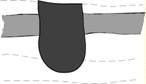
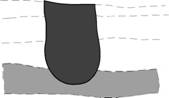
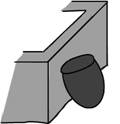
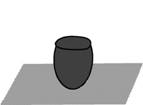
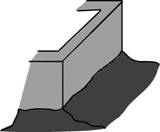
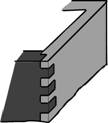
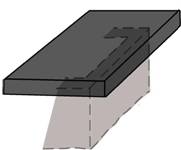
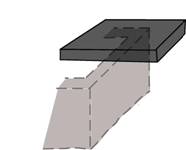

Chart 17-1
Type of contact association
17.9
Back to top
Variants for variable K4=sh: Shape – for ceramic vessels
(M. Kelly-Buccellati)
These codes are applicable for pottery
shapes only, i.e., they are applicable when the variants for roster slot B10=df
“definition” include either cv or any of the following: bo, bt, di, go, ja, po,
pl. Note: the symbol >> means “considerably greater than.”
Overall
shape
ob bowl (rim >
height)
oc cup (small bowl
oj jar (rim < height)
op pot (rim =
height)
opl platter (rim >>
height)
os stand no solid base
ox other shape should
be described as a local note, e.g., ox @vat
Rim
rh hole mouth
ri inturned
ro outturned
rs straight
rx other
Base
bf flat
bfv flat, slightly concave
bfx flat, slightly convex
bhf high footed
blf low footed
bp pointed
bring ring
bround rounded
bsp slightly pointed
bx other
Handle
hitab interior triangular tab
hlug triangular lug
hsc small semi circular
hsh strap handle
htab tab
Other
x1 interior ledge for holding cover
x2 interior groove
x3 other
17.10
Back to top
Variants for variable O11: View range
c close-up
f far shot
m medium shot
t tight shot
w wide shot
For an explanation of the
concepts behind the codes see above, 16.19 (O21)
17.11
Back to top
Variants for variable O12: View orientation
n north
e east
s south
w west
ne northeast
nne north northeast
etc.