Back to top: Depositional data for Unit J2 Disaggregation
Introduction
The main disaggregation in J2 is the expansive brickfall that covered the area in the mid-Mittani period. Other scattered collapses and fills contribute to the incidences of disaggregation as well.
Back to top: Depositional data for Unit J2 Disaggregation
Fills
The fills of the holes in the apron can be attributed to the general process of collapse and filling in J2 during the middle-Mittani period. The holes (f279, f281, f283, and f285) filled in as the staircase and apron were gradually covered by brickfall and other deposits.
Back to top: Depositional data for Unit J2 Disaggregation
Brickfall
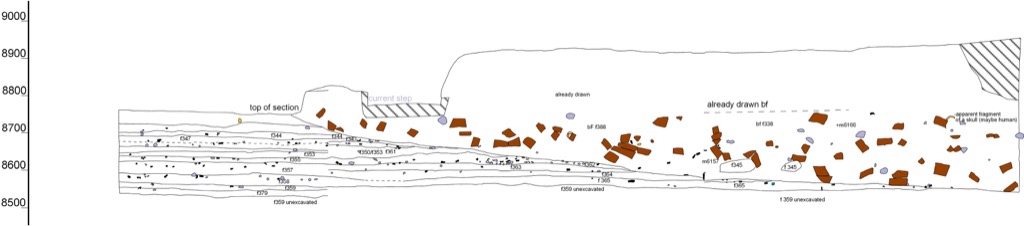
The brickfall slopes across J2, emanating from somewhere to the southeast. It stretches across J6 and J7 as well as J2. It extends the entire distance across J2 for more than 20m from east to west and continues to the west. The brickfall is composed of eroded gray and red bricks with the the upper layers more heavily eroded, indicating they were exposed for some time. The materials inside the brickfall include human bones (identified only in J7) as well as large quantities of pottery. The brickfall follows the preexisting slope in the area indicating that the area was not filled in with brickfall but rather unintentionally covered. The slope resulted from the erosion cut, on top of which the collapse falls.
Back to top: Depositional data for Unit J2 Disaggregation
Erosion
|
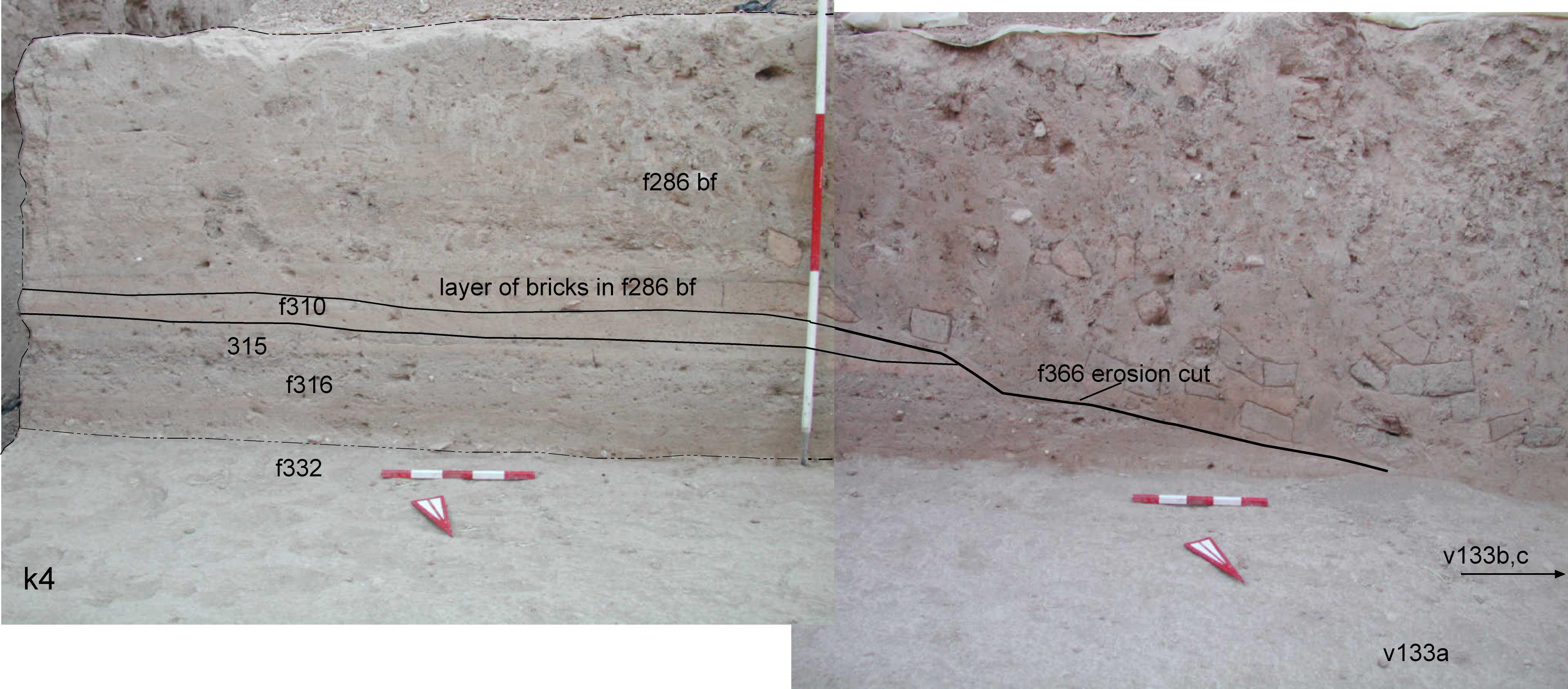
Two erosion caused by water occurred in the area in front of the monumental access. The first in time sequencing is erosion 1, a shallow channel extending from east to west in front of the apron, removing floor 3 and floor 4 during the EDIII period. In the photo to the right is f369, which is the fill of the cut. The second erosion is a much larger and affected the use of the monumental access. The erosion 2 is a cut that slopes sharply from east to west before levelling off to a more gentle slope in the west. It damaged or completely removed many floors from the EDIII period onwards. The cut occurs immediatly before the brickfall. The photo on the right shows the cut f366 The absence of floors or use areas from the end of the EDIII period to the middle of Mittani in front of the monumental access is due to the erosion. |

|
Back to top: Depositional data for Unit J2 Disaggregation