Back to top: Reading the UGR
Reading the UGR
When first approaching the UGR system, one is lead through a logical sequence of steps which take the reader from a presentation of the wider context of the UGR system and from the clarification of the underlying methodology to a set broader thematic issues. This is the sequence described in the system's logo.
This is how we expect readers to confront this particular type of digital publishing: they would acquaint themselves with the UGR context and with the methodology, and then look at the broader thematic categories: the site as a whole, individual structures such as the royal palace, organized sets of data such as ceramics or glyptics.
Typically, readers would refer to excavation units as a repository of data, the data that support the various syntheses presented in the thematic digital books.
| 
|
Back to top: Reading the UGR
Reading a unit book
A unit book is conceived as a full fledged publication
Unit books ought to be read
discursive nature and database
|
Back to top: Reading the UGR
Examples
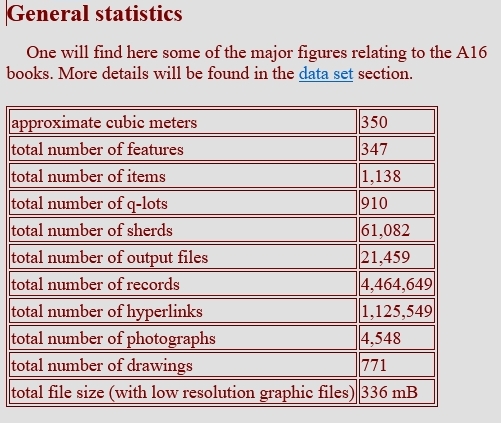
As an example, we may look at unit book A16.
An excavation unit is generally limited in size: A16 is typical having 8 4x4 m squares.
But the amount of data is very large, including for instance 347 features and 61,082 ceramic items (vessels and sherds).
| 
|
|
|
|
| grammar and UGR? give page with links to GRM and UGR
|
|
detail of one page
MZS: list of beads, setting among units
AP: courtyard
TGL: list by field number
Back to top: Reading the UGR