Back to top: The primacy of excavation units
The nature of an excavation unit
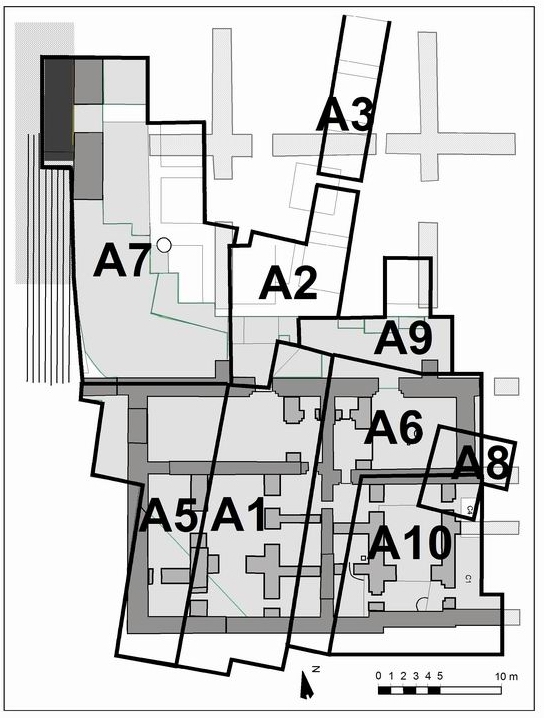
Typically, a unit is defined by "arbitrary" limits placed on the site before it is known what is to be found underneath. The image to the right shows the boundaries of the units that were drawn before the excavationjs revealed the service quarter of the palace below. Accordingly, it would seem inappropriate to claim primacy for such an entity which is, through its very origin, artificial and not correspoding to any ancient reality.
The reasons for thinking otherwise are two.
- It is only in the unit that we encounter emplacement and document it. Since this aspect is fundamental for a properly archaeological record, it stands to reason that it should receive special attention.
- Given the fact that excavations within a unit typically continue for one or more seasons, they develop an identity of their own. They are like windows that frame the particular view that opens up onto the reality beneath the surface, and the window itself acquires a physiognomy all its own.
| 
|
Back to top: The primacy of excavation units
Primacy
When speaking of "primacy" of the unit books we have in mind two factors in particular.
- There is a chronological priority. Every single element that is found, is first observed and documented within the framework of an excavation unit.
- But there is especially a structural primacy, as it concerns emplacement and deposition. The primary observations all take place within the excavation unit, and are thus to be seen within that context.
|
Back to top: The primacy of excavation units
The publication of an excavation unit
A major difference vis-à-vis the current standard in archaeological publishing is that we produce a full final publication of each excavation unit. What is normally reserved for a preliminary report, which is typically very selective in its coverage, is here given in full. It contains the totality of the data as observed during the excavation, in the form of a running argument tightly interwoven with the data, which are also available in a database format.
The excavation unit website is the building block of the entire UGR system, in two ways.
- Each unit website stands on its own, as a self-contained and coherent publication that defines the unit as a meaningful entity, and describes the totality of the finds, stratigrapically and typologically.
- Each unit website is tightly interrelated to each of the thematic websites: these provide the synthetic interpretation at the sitewide level, and integrate the details of the unit websites into this larger picture.
In the section on reading and writing we will look in more detail at the way in which the unit websites relate to the UGR system as a whole, and then how they have to be seen in themselves.
|