Back to top: Properties of constituents
Intrinsic properties as criteria for definition
Back to top: Properties of constituents
Definitions
There is a rich set of properties which define any given constituent. The specifics of these properties are given as paradigms of variables or attributes, which I call rosters, and as lists of variants or attribute states, which I call lexica; they are described in detail below (for the “main roster”).
Property is one of several analytical traits which together define a constituent. It is to be further differentiated into variables (or attributes) and variants (or attribute states ).
A variable or attribute argument is one of a set of possible qualities or identifying marks which may be found to characterize a given constituent (e. g., type of contact or a color). Since these variables are listed as part of a roster, they are also called “roster slots.”
A variant or attribute state is the content of a variable, i.e., the particular quality which happens to fill the particular slot (e. g., white). Since these slots are those listed within a roster, the variants, which fill these slots, are also called “roster entries” (or contents).
A paradigm is an inventory of choices sorted in a structural sequence. There are two basic paradigms: the roster for variables and the lexicon for variants
Variables and variants are organized according to the logical structure of any given whole (e. g., emplacement), resulting in specific paradigms. These are essentially inventories of choices sorted in a structural sequence. There are two types of pertinent paradigms; a roster is a structural sequence of attribute slots (variables), and a lexicon a list of attribute states (variants for variables).
Back to top: Properties of constituents
Corollaries
A special category that is related to the lexicon is that of standards (see chapter 10). These are criteria that define variants according to precise parameters, e. g., the Munsell standard 10R 5/3 “weak red” as a more specific and verifiable definition than a more generic “reddish.”
Any given constituent is defined on the basis of a batch of properties that are drawn from the paradigms indicated, and it is identified through a unique label. A label is an alpha-numeric code that is derived from a sequential log. There are different labels that correspond to different degrees of specificity.
Every constituent must have a generic label, which is based on stratigraphy and on a minimum of typological specificity – essentially features and items.
To the extent that typological analysis proceeds, higher levels of specificity are possible, and they are reflected in a variety of specific labels definition?.
Back to top: Properties of constituents
Overview
This overall classification may be presented synoptically as follows.
| attribute | one of several analytical traits which together define a constituent | variable | or Roster Slot or Attribute Argument: category of element structure (e. g., color) | ||
| variant | or Roster Entry or Attribute State: content of variable (= typological or specific label, e. g., white) | ||||
| paradigm | inventory of choices sorted in structural sequence | roster | structural sequence of attribute arguments (variables) | ||
| lexicon | list of attribute states (variants for variables) | ||||
| standard | description of parameters defining variants | implicit (e. g., “brown” as common sense value) | |||
| explicit (e. g., Munsell color value) | |||||
| label | alpha-numeric code derived from sequential log, which identifies uniquely any given constituent | generic label | minimum stratigraphic/typological definition (e. g., feature, item) – primary or first level of specificity | ||
| specific label | intermediate typological definition (from lexicon of variants, e. g., wall, tablet) | ||||
Back to top: Properties of constituents
Summary
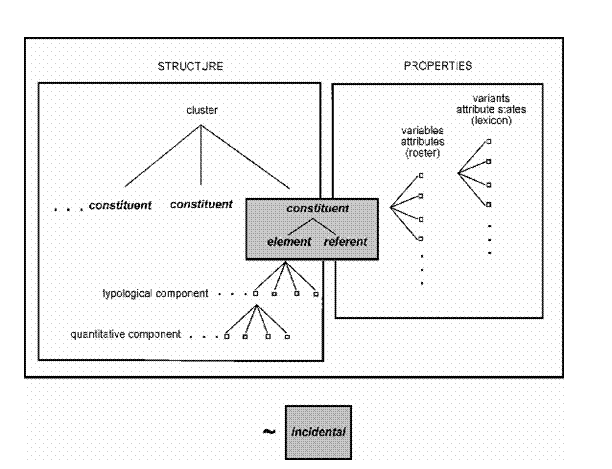
The analysis given above for constituents and incidentals is summarized in the diagram given below. The constituent is represented by the shaded box in the center, next to which one may place the incidental, which is outside the main system, and does not therefore have any of the systemic articulation of the constituent, but fills an analogous location within the archive.
Within the main box, the constituent proper is the central node. The two main classes (elements and referents) are shown as branching out below this central node.
The structure is represented in two ways – the components splitting the element as lower branches (for typology and quantity, in sequence; the quantitative component ia also called a sub-component), and the clusters serving as higher nodes which group one or more individual constituents.
The properties or attributes are represented by the variables or attributes (as listed in the rosters), for each of which there is in turn a variant or attribute state (as listed in the lexicon).
 |
Back to top: Properties of constituents
NOTES
*For a full discussion of the -etc ad -emic notions see the Critique of Archaeological Reason
Back to top: Properties of constituents