Glyptics (Version 1)

Styles

Dotted eye

Marilyn Kelly-Buccellati – July 2000, December 2025

Back to top: Dotted eye

Introduction: Stylistic characteristics

     One of the principal characteristics of the Dotted Eye Style is the manner in which both human and animal bodies are rendered. In this style often human and animal heads are large and the eye is large and prominent and usually dotted in the center. The eye is depicted in front view although the head is almost always shown in profile. The seal carvers must have studied the human profile and noted that in that view only one eye is apparent and choose to prominently display only one eye. The eye is usually carved with a continuous outline which can result in a round or oval shape; a large heavy dot is placed in the center. In many cases the nose and mouth are continued from the line of the eye. Part of the uniqueness of this style is the visual impact of this eye and the artists and their patrons must have thought that this part of the human face was the most important.
     Another characteristic of this style is the way the horns of animals can be emphasized with segmented lines. Also the shape of the legs of the animals and humans are emphasized by portraying them in thin straight parallel lines. As an example we can see in A5.137 the animal carrying the winged gate on its back shows these characteristics; additionally the human figure behind this animal has a large head with a large triangular nose connected by a line with the area of the eye; he has very straight and thin legs characteristic of this style. The crescent with a dot above can be seen also in the Deep Fringe style.
     Figures are typically shown with full bodies and are often separated by relatively wide spaces, creating compositions that emphasize clarity rather than crowding. Overlapping figures are uncommon; although example A6.103 shows overlap in the human figure positioned before the bull, this appears to be an exception rather than an important feature of the style. Example A5.137 illustrates the usual composition, in which figures are not overlapping but are clearly spaced.
     However some compositions in this style do have whole or partial animals scattered indiscriminately over the entire field (A5q704).
     A5.180 shows some other unusual characteristics of this style. The body of the caprid is full but the legs are very linear, the bulbous nose is out of proportion with the face. The horns are not a clear linear pattern but [REMOVE?] have some unclear curved lines associated with them. On the other hand the lion has a face in outline with a large dotted eye in the center. His open mouth is a thicker line than his head. The human figure in the homed cap on the end of the scene carries a long weapon and is shown by a large nose. He may be holding the tail of the lion which has a long curving shape. This seal has the dotted eye for the human and animals but the linear emphasis of the figures is unusual and shows us that variations can be present
      [What does this refer to?] To the left is a seated figure but its relationship to the composition of the rest of the scene is unclear. The stylistic characteristics of this bull can also be seen in A5.180.

A5.137

A6.103

A5q704

A5.180

Back to top: Dotted eye

Human Figures

     Human figures in the Dotted Eye Style are distinguished by large heads, usually circular or oval in form. In some cases the head and especially the eye are rendered with a single circular line containing a raised dot near the center. In others, multiple lines define the eye and extend outward to form the nose and occasionally the mouth. The nose itself may be triangular, while the lips are generally small and the chin often pointed.
     Human figures in the Dotted Eye Style are distinguished by large heads, usually circular or oval in form. In some cases the head and especially the eye are rendered with a single circular line containing a raised dot near the center. In others, multiple lines define the eye and extend outward to form the nose and occasionally the mouth. The nose itself may be triangular, while the lips are generally small and the chin often pointed.
     A5.159 provides a particularly clear example of these characteristics of the human heads. Here one eye is depicted positioned centrally within the head. This eye is large, prominent, and typically marked by a heavy central dot that creates the impression of a wide depression within the face.
A5.159
     The linear quality of the head is echoed throughout the body. Garments are articulated through strong linear patterns but the garments are not distinguished by their decoration. Seal impression A5.58 demonstrates this tendency, where linear differentiation is evident even in the depiction of furniture; the table legs and top vary in thickness, and the thickened line above the head clearly represents a hat. A5.58
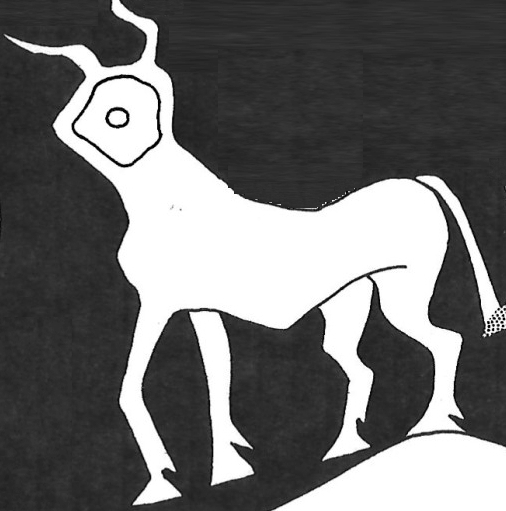
     Seal impression A5.137 further exemplifies these traits. The human figure behind the animal carrying the winged gate displays the characteristically large head, triangular torso, and elongated, thin legs. The triangular nose of this standing servant connects directly to the eye through a continuous line. The heads in this impression are drawn with thicker lines, particularly along the upper part. While most limbs remain rigidly straight, occasional deviations occur, such as the slightly bent knees of the standing bull.
A5.137
detail of
standing human figure
behind the bull

Back to top: Dotted eye

Animal Figures

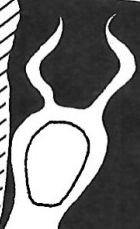
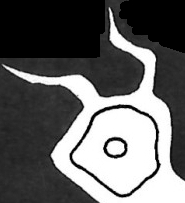
     Representations of animals in this style share many of the same characteristics observed in human figures. In A6.147, for instance, the eye appears as a wide oval containing a large central dot, from which the line extends to connect the nose and mouth. The horns are rendered frontally despite the head being shown in profile; they are full and sweeping. All these characteristics highlight the linear pattern of the design.
A6.147
     In A5.137 the bull’s head is again presented in profile with a dotted eye, however here the circular shape is somewhat irregular. The horns are segmented, and the hooves terminate in sharp points. The other horned animal in the same impression appears to present its head frontally, possibly indicating a bearded bull, although this is not clear from our sealing. The rendering of the standing bull shows a sharp contrast between the full body and the thin lines for the legs, especially the forelegs.
     An additional motif, a crescent topped by a dot, also occurs in the DeepAn additional motif, a crescent topped by a dot, also occurs in the Deep Fringe Style.In A5.137 the bull’s head is again presented in profile with a dotted eye, however here the circular shape is somewhat irregular. The horns are segmented, and the hooves terminate in sharp points. The other horned animal in the same impression appears to present its head frontally, possibly indicating a bearded bull, although this is not clear from our sealing. The rendering of the standing bull shows a sharp contrast between the full body and the thin lines for the legs, especially the forelegs. Fringe Style.

A5.137
details of two animal heads
and of bull
     In Alq975.18 the head of the bearded bull is shown in front view making it necessary to depict the two eyes smaller than is usual in this style. This head is created with a small drill hole for each eye and one at the base of the chin; the exterior shape of the frontally positioned face is in a raised outline with the rest of the face in an undifferentiated flat plane. In Urkesh animal combat scenes usually portray bearded bulls with the face in front view but the face usually has more details.
Alq975.18

Back to top: Dotted eye

Conclusions

     This style is also connected with the royal seals from Urkesh; both those of the king and queen as well as their attendants. In the example of the seal of Zamena (AKc3) we see that the heads and eyes are large with the eyes centrally placed in the heads which are in profile; this is the case for Uqnitum as well as the child and servants depicted in the seal. All the noses are triangular. While the torsos are not triangular the arms of Zamena, the child and the servant are all thin and depicted with straight lines. The chins, especially the one of Zamena, are pointed and the triangular noses are connected to the line around the eye.
AKc3
     While we have few kings seals, AKc1 appears to be carved in this style.
AKc1
     Interestingly the later cook’s seal (AKh5), where we have her name Tuli, is a variation of this style; the noses are not connected with the line around the eye and the arms and legs of the human figures are slightly more realistically depicted.
AKh5