A Grammar of the Archaeological Record (Version 2, Beta release)

II. Epistemics

Introductory

Giorgio Buccellati – January 2025, January 2026

Back to top: Introductory

The epistemic framework

The epistemic aspect of archaeological field work relates to the way in which data are acquired and defined within a coherent categorization system, and then integrated into a larger frame of reference. We may look at this from three parallel points of view and we will organize gthe material accordingly.

“Context” refers to the way in which data occur physically, in the ground and otherwise, and we may distinguish three types.

context method system
matrix aggregative stratigraphy
assemblage structuring typology
integrative
selected whole restructuring conservation
presentation

Here we will review the three major areas of this system (see already above), and show how they appear in the relevant unit digital books.

Back to top: Introductory

1. Aggregative: Stratigraphy

Matrix. – This refers to the original state when data are being disengaged from the soil which acts, precisely, as the amorpohus matrix in which the "things" are found. photo of small picks in the ground

The data emerge from an amorphous matrix where they have come to rest as the result of multiple cultural and natural forces, and over very long periods of time.

In a few cases, the original state is preserved, and we can see the data in their primary functional aggregation. The most obvious case obtains when several walls are seen to constitute a room or a whole building. Another case is that of objects laying on the same floor level, or contained with a pit. These aggregates may be seen as portions of the otherwise disaggregate universe as it is uncovered by the excavation.

For the most part, the data show no structural relationship to each other – i. e., they do not reflect their original functional setting. Their primary definition is thus tied to their findspot and their association with the other elements with which they are in contact. This process is subsumed under the concept and the practice of stratigraphy.

the four aspects

Back to top: Introductory

2. Structuring: Typology and integrative

Assemblage. – Stationary features (such as walls) and movable items (objects and samples) are seen in their identity as individual elements but correlated to other elements of the same kind: they constitute an exhaustive and comprehensive collection for study purposes. photo

Once excavated, data can be assembled into meaningful wholes according to two distinct criteria.

The first criterion looks at data depending on their intrinsic qualities: we construct typologies on the basis of inner-referential attributes, i. e., attributes that refer exclusively to the data as such, e. g., shape or material for ceramics, iconography for glyptics, paleography or linguistic analysis for texts.

The second criterion looks at the data with a view to integrate them into a broader picture, in terms of a variety of extra-referental attributes: these include comparison with data from other excavated sites; analysis of materials with techniques such as Carbon 14 analysis; confrontation with the broader historical framework as defined by textual data.

Back to top: Introductory

3. Re-structuring: Conservation and presentation

Selected whole. – A selection of the stationary elements in the grounds, essentially walls and permanent features such as pavemetns or platforms, is not removed, and is preseved for conservation and presentation. photo

Archaeological data present a special problem when it comes to preservation. This is due to the double fact that

  1. the excavation process entails by necessity the need to sacrifice certain elements in order to expose others (hence, they cannot be preserved), and
  2. what is not sacrificed must be immediately conserved in order to avoid its deterioration.

It is for these reasons that archaeological preservation must be inscribed in the excavation strategy, and is therefore part of the grammar. One must indicate the reasons behind the determination as to the disposition of any given element so as to make explicit the nature of the conservation process.

presentation

Back to top: Introductory

Grammar and semiotics

see UGR

Back to top: Introductory

Theory and its implementation

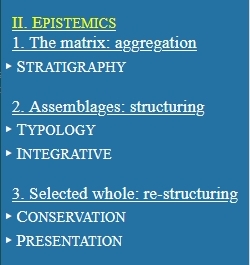
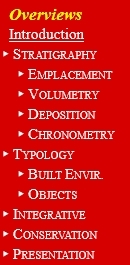
     The theoretical framework I have described is closely reflected in the digital unit books. The two images on the right show how the unit books mirror the theoretical scheme of the Grammar:
  • the Grammar displays the description of the data in terms of the method
  • the unit book displays the data in terms of the system

     In other words, the Grammar sidebar highights the theoretical orientation that governs the system, as explained above.
     The A16 unit book sidebar is in the section on Overviews within the Synthetic section, and it highlights the orientation one would expect when dealing with the materials from the excavation.


Back to top: Introductory