Back to top: Epistemics: introduction
The epistemic framework
The epistemic aspect of archaeological field work relates to the way in which data are acquired and defined within a coherent explanatory system, and are then integrated into a larger frame of reference. We may look at this from three parallel points of view and we will organize the material accordingly.
- Context refers to the way in which data occur physically, in the ground or otherwise.
- Method refers to the type of analysis that is brought to bear on the data.
- Sub-system refers to the specific categories used, within the broader System
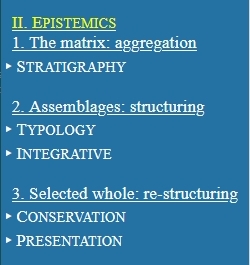
Here is an overview of the entire framework, which will be discussed in some detail below.
context method sub-system 1 matrix aggregation stratigraphy 2 assemblage structuring typology integrative 3 selected whole restructuring conservation presentation
Back to top: Epistemics: introduction
Theory and its implementation
The theoretical framework I have described is closely reflected in the digital unit books. The two images on the right show how the unit books mirror the theoretical scheme of the Grammar:
In other words, the Grammar sidebar highights the theoretical orientation that governs the system, as explained above. The A16 unit book sidebar is in the section on Overviews within the Synthetic section, and it highlights the orientation one would expect when dealing with the materials from the excavation. |
|
 
|
Back to top: Epistemics: introduction
to be considered
- C. Stratigraphic clustering. – The correlation between space and time as the constituents are clustered according to type of contact into strata first, and then into phases and horizons.
- D. Typological clustering. – The specific identity they assume on the basis of a transversal typological clustering.
- E. Analytical organization of the record: data structure. – The organization of the record within an overarching archive structure: directories and files (accessed from the right-hand side).
- F. Synthethical organization of the record: main narrative. – The organization of the record in a synthetic and sequential manner, based on conventional archaeological presentation (accessed from the left-hand side).
Back to top: Epistemics: introduction