Back to top: Ceramics from Unit A12 WORK IN PROGRESS
Methodology and corpus
ADD LINK TO LIST OF ANALYSED Q-LOTS (do we need to make this first?)
ADD note about separation from ?A10 when abi recognised
All ceramic sherds from Tell Mozan are processed according to a standardised procedure in the field, and analysed based on a specific set of typological criteria, supervised by Marilyn Kelly-Buccellati.
For post-excavation analysis, review and digitisation, please see below section A12 ceramic review.
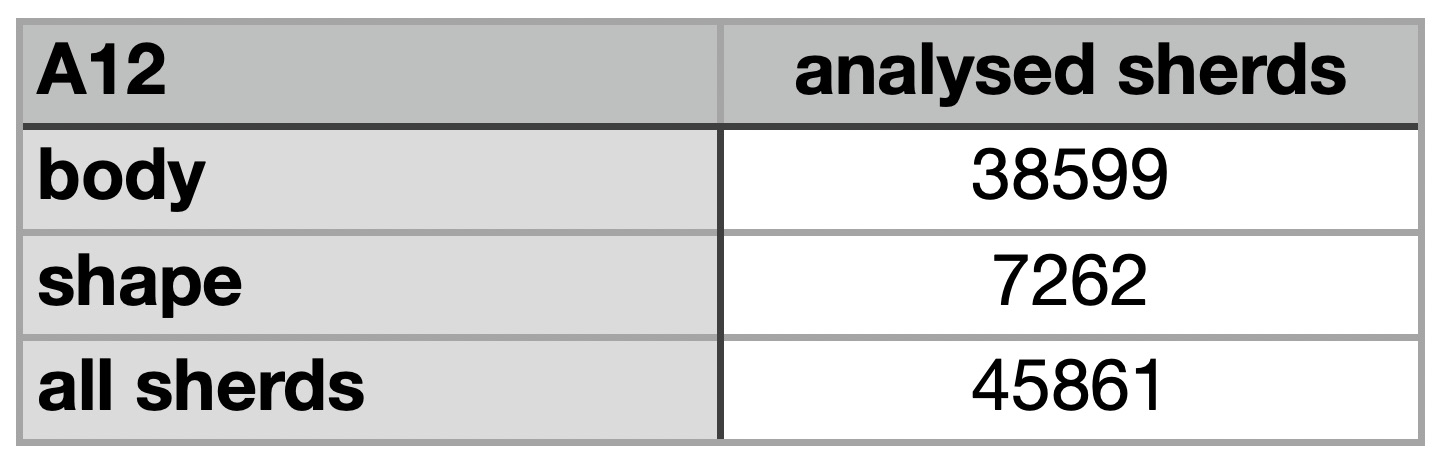
A total of 45,861 sherds have been collected and analysed from this unit, 38,599 of which are body sherds, and 7262 of which are shape sherds (diagnostic sherds). The individual sherds for A12 can be found in the righthand menu under qp pottery.
Back to top: Ceramics from Unit A12 WORK IN PROGRESS
Chronology
The review of the A12 ceramics has been carried out before the final strata assignments of the unit. For this reason, comments on chronology are here kept to a minimum, and must be regarded as preliminary.
Back to top: Ceramics from Unit A12 WORK IN PROGRESS
Wares
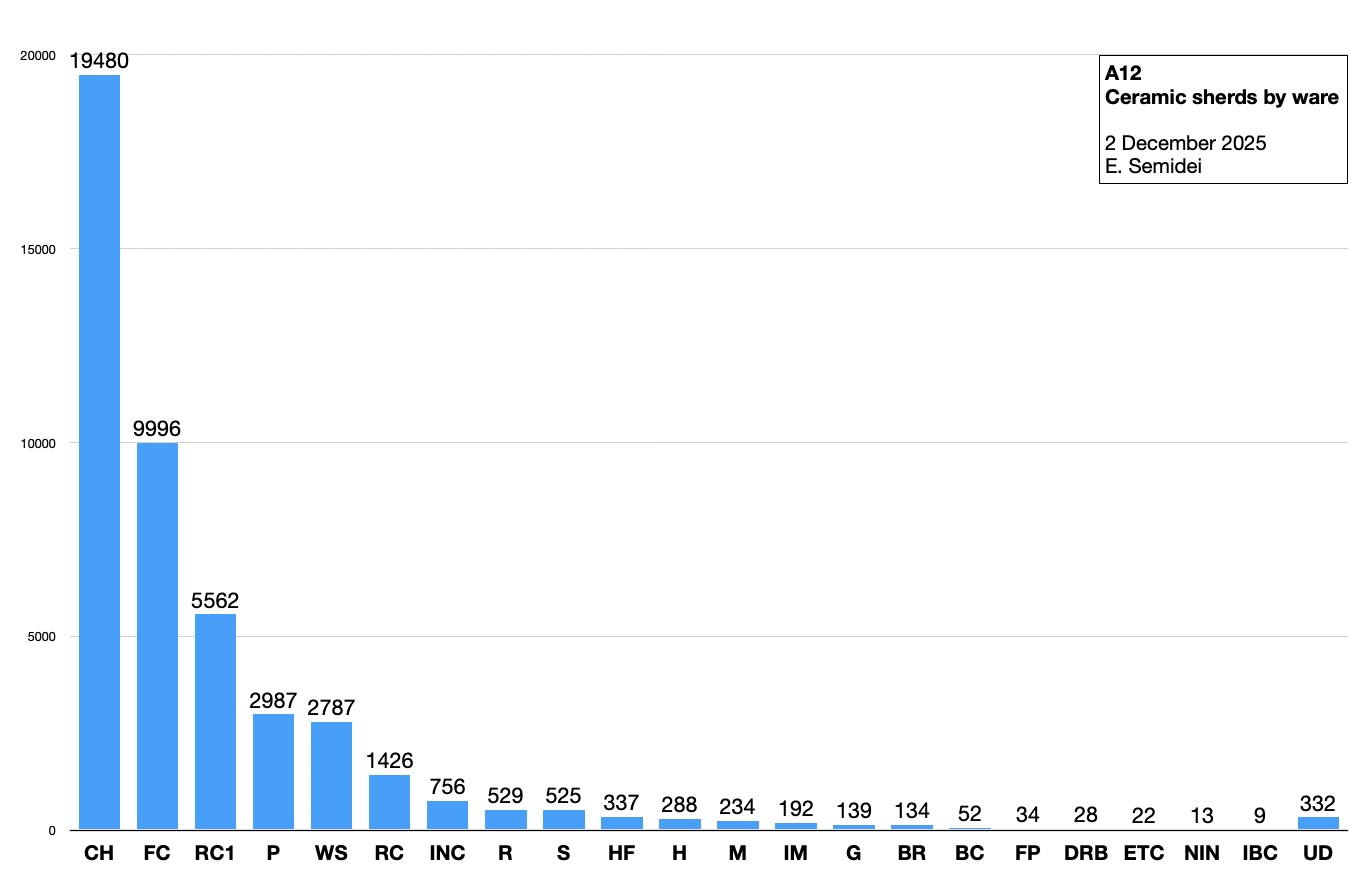
The ware distribution in A12 correspond to what we typically find throughout the site. Most of the ceramic sherds (~65%) belong to Chaff Tempered ware (CH) and Fine Chaff Tempered ware (FC).
The next quarter consists of Fine Red Orange Calcite Temper Ware (RC1), Pebble Temper Ware (P), Wet Smooth Ware (WS) and href=https://urkesh.org/MZ/A/TCR/TEXTS/A2/ware-rc.htm>Red Orange Calcite Temper Ware (RC). The remaining ten percent are divided between Fine Chaff Temper Incised (INC), Rough Ware (R), Simple Ware (S), High Fired ware (HF), Khabur ware (H),
Metallic Ware (M, 234 sherds), Imitation Metallic ware (IM, 192 sherds), Gray Ware (G, 139 sherds), Name of ware (BR, 134 sherds), Bi-Color Ware (BC, 52 sherds), Fine Pebble Temper ware (FP, 34 sherds), Dark Brick Red ware (DRB, 28 sherds), Kura-Araxes (ETC, 22 sherds), Ninevite 5 Ware (NIN, 13 sherds), Imitation Bi-Color ware (IBC, 9 sherds).
Back to top: Ceramics from Unit A12 WORK IN PROGRESS
Decoration
Various types of decoration are represented in the A12 corpus, including:
Painted Mittani decoration:
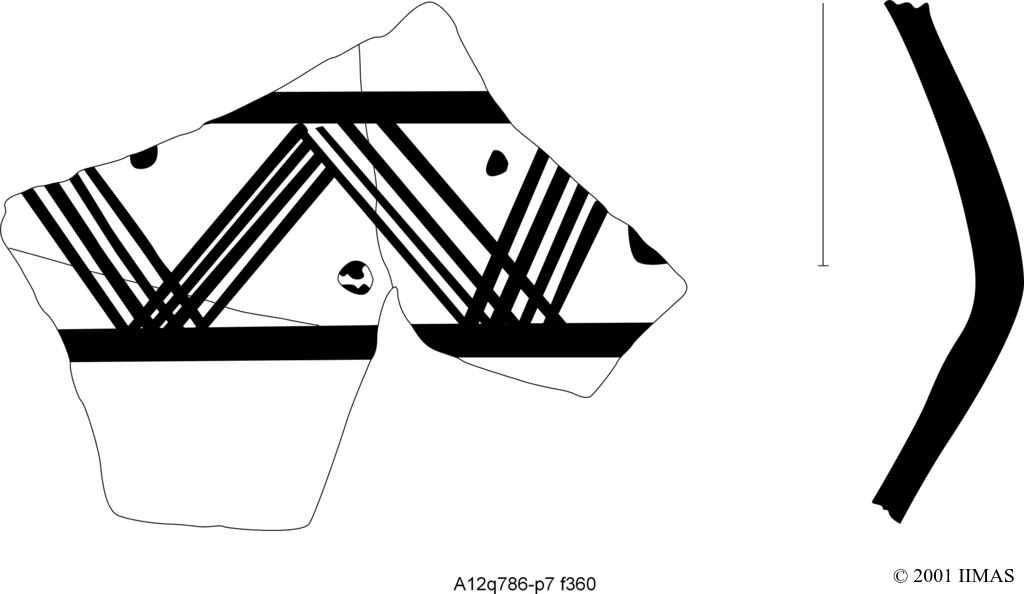
Painted Khabur decoration:
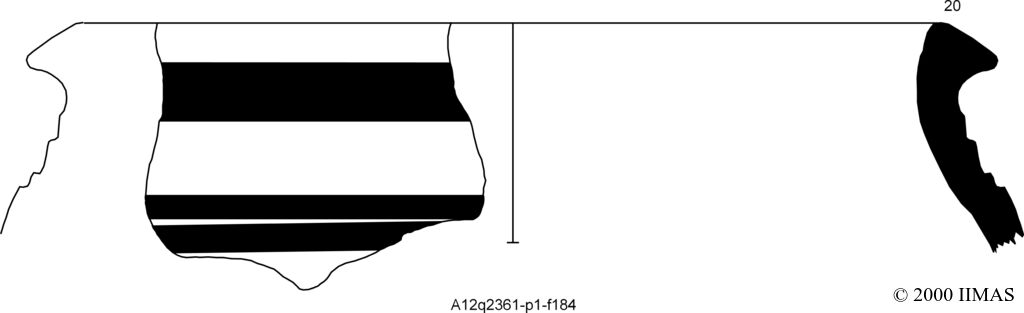
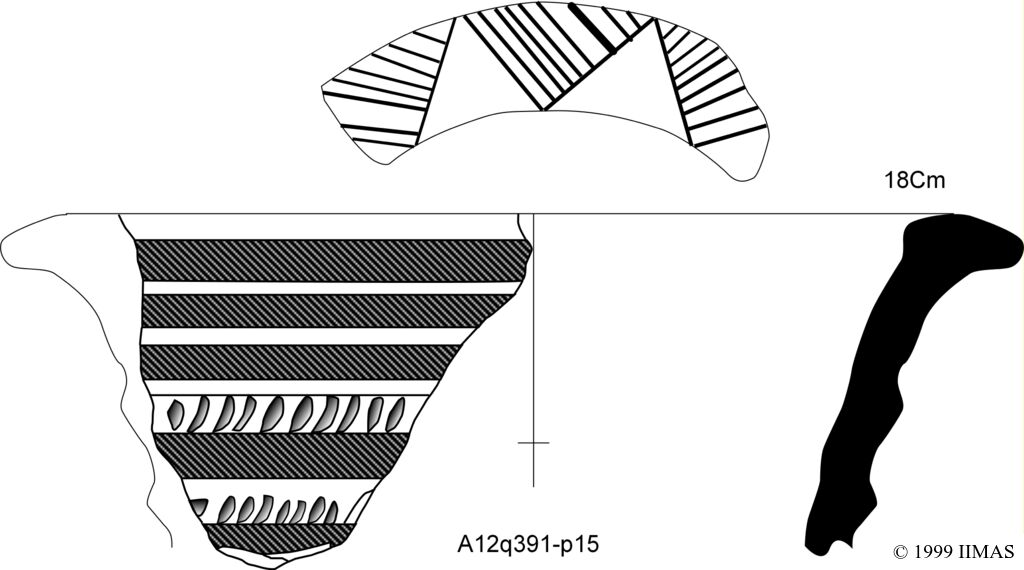

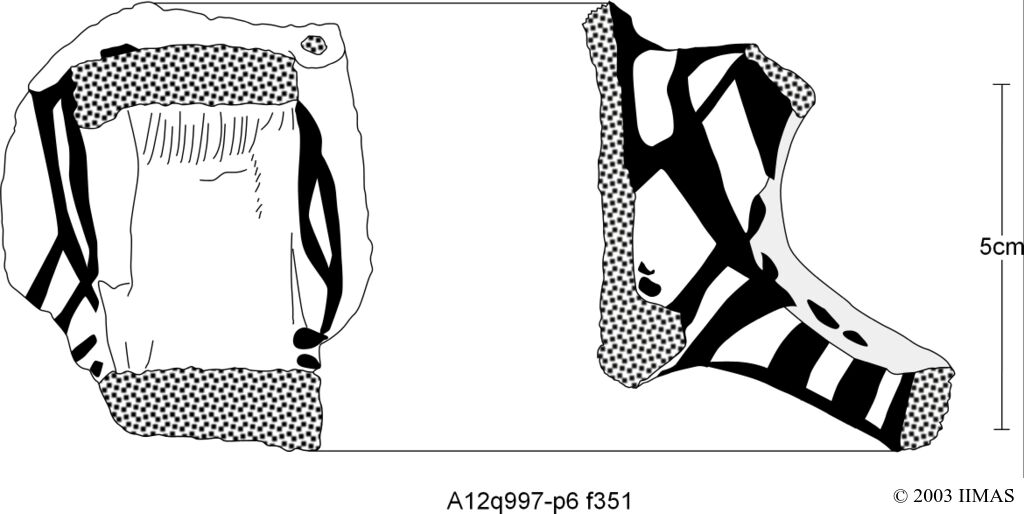
Painted Bitumen decoration:
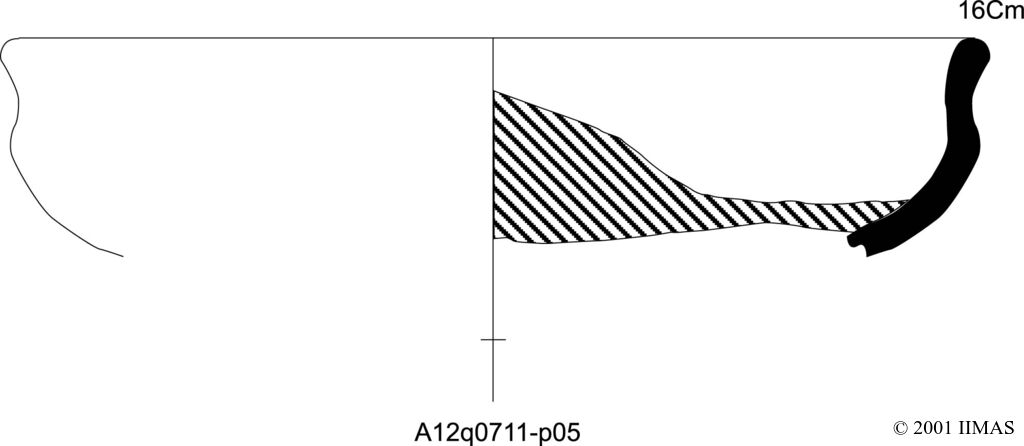
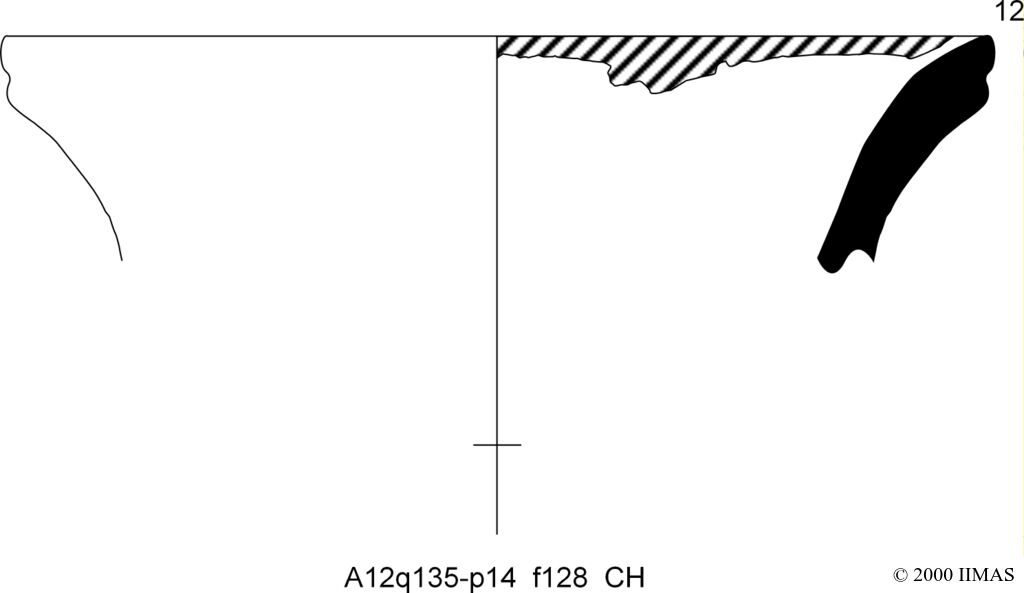
Incised decoration:
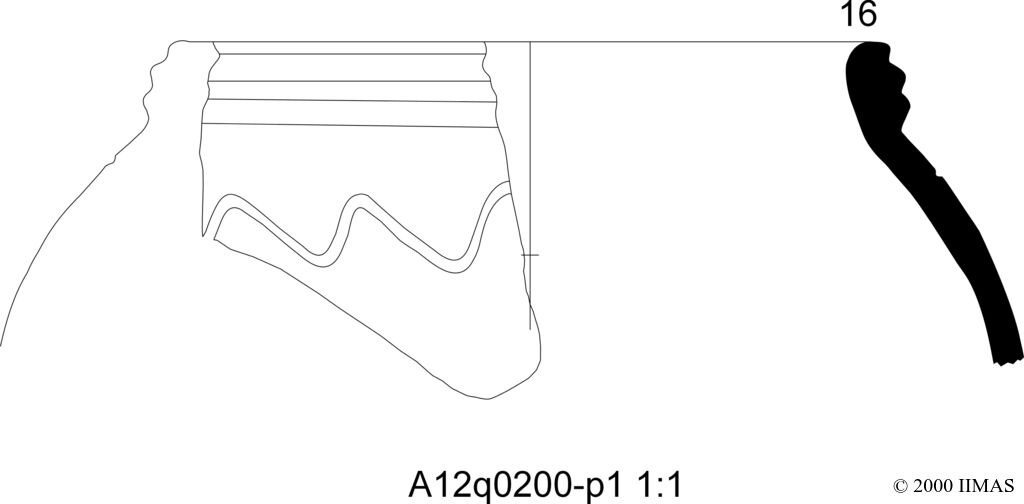
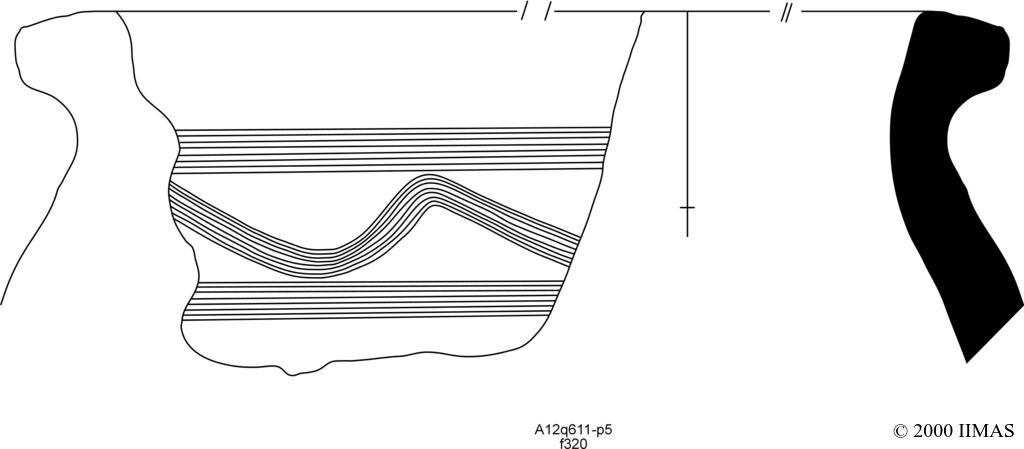
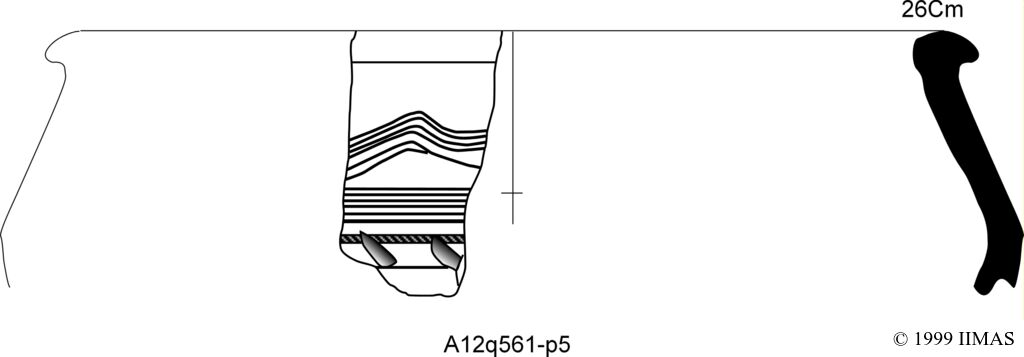
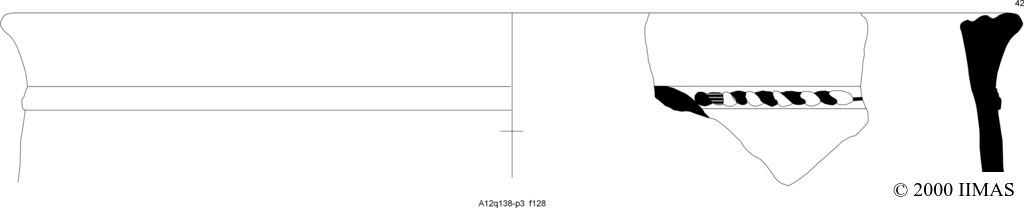
Applied decoration:
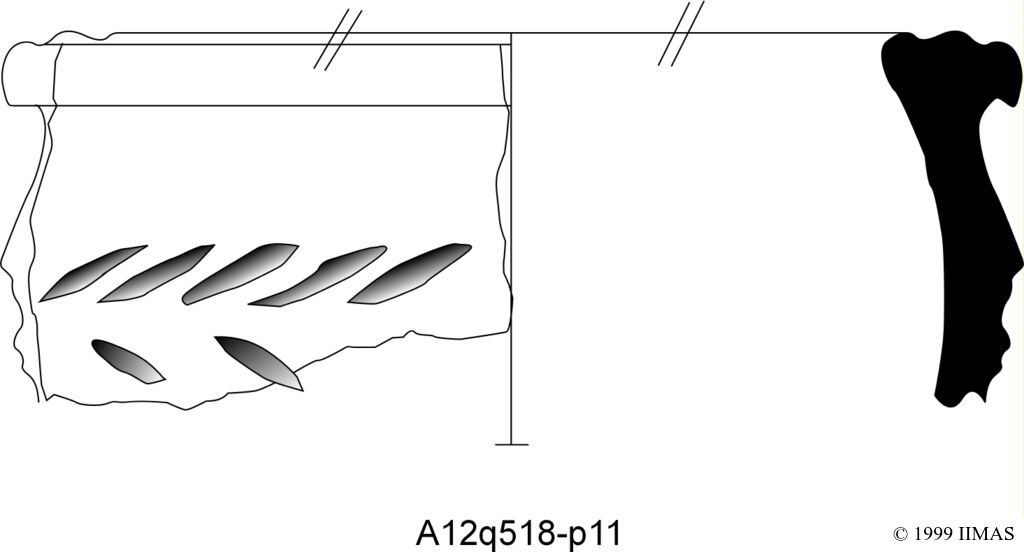
Back to top: Ceramics from Unit A12 WORK IN PROGRESS
A12 ceramic review process and methodology
The review of the A12 ceramics was carried out in 2025-2026 by Emilio Semidei and Laerke Recht, and followed the usual procedure. A12 presented particular challenges worth noting here:
● The unit was excavated when an older ceramic coding system was used for recording in the field. As the old codes do not clearly translate to the new typology with numbered types, and it was not possible in each case to correlate the codes, the original codes have been translated ‘ad verbum’. For example, the original nj-et has been updated to jn.–et (necked jar with externally thickened rim). In cases where a typological number (ZcsaS3 Details) was assigned, this has been maintained (e.g. cc.-5), but please note that these may not entirely correspond to the new typology. In other cases, it was not possible to understand the old codes to subshape or even main shape: for these, notes have been made in the individual records.
● The majority of entries were not in a digital format at the beginning of the ceramic review. The many scanned pages were digitised by Emilio Semidei. In some cases, human error meant that entries or parts of entries were not readable (cryptic handwriting, overexposed or punched pages). The data have been transcribed as comprehensively as possible, but some uncertainties and gaps remain.
● Many sherds were not assigned an individual p# when we began the ceramic review. This makes it difficult to always clearly identify whether entries are duplicate entries or sherds with very similar, if not identical data (often also analysed by the same person, on the same day). This was judged on an individual basis for each sherd (in the case of shape sherds) or ware group of sherds (in the case of body sherds). Subsequently, p numbers were assigned, always starting from 99 and downwards for body sherds, and 69 and downwards for shape sherds, to clearly flag that these assignments were made at a later (review) stage of the analysis.
Possible errors and additional challenges can be found in the errors page.
Further, the following notes on the review of the drawings were made by Emilio Semidei:
Back to top: Ceramics from Unit A12 WORK IN PROGRESS
Review of ceramic drawings (eS)
The prime goal of the ceramics review was to detect if the drawings and the entries in the UGR portray the same sherd. If discrepancies between the drawings and the entries in the UGR occurred it was tried to rectify the problems. Although it must be stressed that not all individual problems were solved. Minor discrepancies were ignored as long as sherds and drawings clearly described the same sherd. If only one information (ware code, diameter, feature, inaccurate rim code, missing deco code) did not match the problems were classified as minor discrepancies that were not always resolved. Wherever multiple discrepancies were identified a thorough search for the right drawing or entry was initiated. Changes made to successfully reunited entries and drawings were documented in the relevant j-files and/or the note sections of the UGR entries. These problems usually consisted of labelling inaccuracies on drawings and the lack of cp# in UGR entries. In cases where problems could not be resolved the entries and/or drawings were either removed from the dataset or the problems described in the note section. Most entries that had to be removed had a feature and/or shape code mismatch, occasionally, entire q-lots had to be excluded.
Further problems where drawings were removed include: multiple drawings of different sherds with the same label; a drawing and an entry not portraying the same sherd; multiple drawings showing the same sherd.
During the revision of the drawings, a main issue was related to the code conversion. Some entries had expired shape codes that were updated based on the drawings. Moreover, relevant drawings were used as templates to improve our understanding of the code development and changes. However, some codes used in the UGR did not accurately describe the corresponding drawings. In cases where no distinct pattern could be identified, the codes were changed based on the drawings and the process documented in the notes section.
A substantial amount of drawings did not have a corresponding entry in the UGR, therefore those sherds were added based on the drawings only. However, this might suggest that multiple sherds from A12 are not included in this dataset.
Occasionally, pencil or vector drawings were not available. Missing vector drawings have been made on the basis of pencil drawings, but no substitute for missing pencil drawings are given in the current version.
Lastly, many individual problems have been solved relating to missing decoration codes, slight shape code discrepancies, feature mismatches and labeling mistakes. All changes were documented in the notes section as well as in the relevant j-files.
Back to top: Ceramics from Unit A12 WORK IN PROGRESS
Errors
Back to top: Ceramics from Unit A12 WORK IN PROGRESS
Individual sherd numbers (p#)
In addition to many sherds not assigned a p number in the original files, many shape sherds had been assigned numbers usually reserved for body sherds (p70-p99). These numbers were retained wherever possible (when not duplicated), but moved to the shape sherd file in order to ensure inclusion in the overall statistics related to shapes.
The lack of p numbers in the original files may have resulted in duplicate entries in the current UGR.
Back to top: Ceramics from Unit A12 WORK IN PROGRESS
Rim diameter
In a number of cases, the rim diameter had been noted as 1 cm. As this is an unlikely measure for all sherds, a recording error must have occurred. The notations have been left as originally entered, with the note here that these do not accurately reflect vessel size.
Back to top: Ceramics from Unit A12 WORK IN PROGRESS
Dates and initials of ceramic analyst
The scanned sheets did not always contain the date of recording or the ceramicist analysing the sherds (or were not readable). In these cases, we used the initials xX and the date ZJ101 (1 January 2025). Generally, the A12 sherds appear to have been analysed in the years J, K and O, especially by hH, vP and mH.
Back to top: Ceramics from Unit A12 WORK IN PROGRESS
Q-lots and features
In a number of cases, the features noted for a q-lot in the cumulative files were not yet available in the UGR. Until further information becomes available, we have kept all entries. These are:
[INSERT THE FULL LIST]
In other cases, the feature in the cumulative ceramics file was not the same as the one listed in the UGR. This can mean: 1) the q-lot number is incorrect; 2) the feature is incorrect; 3) the feature listed in the UGR is incorrect. Where possible, we have tried to solve these, but when this was not possible, we used the following procedure:
● If more than one q-lot sequence of sherds was listed in the cumulative list, and one had the correct corresponding feature number, the sequence with the incorrect feature was removed
● If only one q-lot sequence with a feature not matching that in the UGR, we have, until further information becomes available, retained the sequence. This will need to be reviewed when the features and q-lots have been fully analysed.
[ADD LINK TO LIST OF REMOVED SHERDS]
[ADD LIST OF SHERDS/Q-LOT WHERE FEATURE NOT IN UGR]
Back to top: Ceramics from Unit A12 WORK IN PROGRESS