Back to top: Referentiality
The ancient referents
Any element we find today in the ground referred in the past to a specific dimension in the life of its users: a house was a home for certain individuals; a grave was recognized as a resting place for deceased members of a given family; a certain vessel was used exclusively for divinatory purposes; and so on. Each element carried a specific meaning, known to the living carriers of that cultural tradition.
But, as found by us in the ground, archaeological data bear little or no direct evidence to such reference. A wall or a sherd can be identified as artifacts, i. e., as something made for a given use. But the degree of referentiality is at first limited to just that definition: a mudbrick wall or a ceramic sherd.
Back to top: Referentiality
The referential dimension
| A painting by Magritte has acquired an iconic valence in describing the notion of referentiality (Everaert-Desmedt 1999). Contradicting Magritte's statement inscribed in the painting, we may say that "this is a pipe – referentially." The referential dimension is real because there is only one pipe that can match this representation. The reality is in the referential dimension.
R. Magritte | 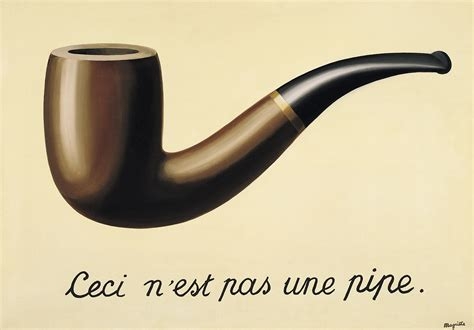 |
Back to top: Referentiality
Degrees of specificity
In any given case, however, the referent may hold different degrees of specificity. The immediate referent for us, in Magritte’s painting, is the object used for smoking. For a contemporary of the painter, it may have been a pipe of a specific brand. For the painter, it may have been the pipe of a friend or a relative. And so on.
The notion of referentiality is central to our discussion about typology.
Back to top: Referentiality
Levels
Our epistemic process aims to recover as full a referential dimension as possible and, to this effect, we may distinguish several levels of referentiality. They define various types of grammatical methods which are described under typology.
Back to top: Referentiality