Back to top: Syntax
Collocational analysis
It is important to distinguish the two moments of collocational and perceptual analysis. Collocation refers to the identification of factual spatial correlations, and perception to the correlative attribution of meaning. To be firmly grounded, the interpretive conclusions must first rest on the identification of recurrent distributional patterns. What collocational analysis adds, is the identification of a single point of view from which the distributional arrangement acquires a unified perspective. Such focalization introduces a very substantial new element in our consideration of the evidence. The “bent axis” interpretation of the access to Mesopotamian temples is a good example (the forced turn in the access path favoring a deflection towards the numinous). Another example into which we may delve here consists of two alternative ways of framing the entrance to monumental buildings.
In southern Mesopotamian palaces, the doorway is de-emphasized: as one looks at the facade of the building (the focal point of a visitor approaching from a distance), the doorway appears as a panel among others in a series of recessed planes framed by buttresses. As one crosses the threshold, one is led through a series of narrow and dark corridors to a courtyard that reproposes the open space of the outdoors, but framed on all sides by the architectural volumes of the building. These are the facts of collocation. An interpretive key is to look at the focal point as perceived by a visitor who comes from the brightness of a flat outdoors, his attention focused on the building as a whole, with a subtle suggestion of where access can be found, until, having arrived in the courtyard, a new framed brightness is rediscovered.
In northern Mesopotamia, by way of contrast, the entrance is emphasized by a portico (from in antis porches to the bit ?ilani scheme) on which the attention of the visitor is focused as a point of arrival almost more than as a threshold to the inside. Interpretively, this collocational reality may be understood in terms of the larger perception of the landscape, so different from the total flatness of the southern horizons, and the climate, which brings frequent rain and shorter winter days. The portico as the focal point, then, is a shelter, a point of arrival in the north as much as the inner courtyard is in the south. It is as though the dark southern corridors and the sheltered northern porticoes served as alternative decompression chambers from the outside to the inside, distinct in their function and the perception they elicited.
Back to top: Syntax
Environmental analysis
Two considerations are important for an appreciation of the perceptual response to architecture. First, volumes should be seen as such, i.e., as volumes, and not just as floor plans. Since what we generally have are, at best, floor plans (often incomplete), our perception of the “ruins” tends to be instinctively thwarted into a two-dimensional mode. A complete footprint serves already a useful perceptual function: by filling in missing walls and identifying doorways, it attunes us to circulation within buildings. But we must go further and recreate the perception of three-dimensional spaces that are enclosed all around, with what that means, inter alia, for the play of light and shadows. Short of a reconstruction (physically in the ground or virtually on a computer screen), we must compensate for, e.g., the loss of roofs and windows, which has of course a great incidence on the availability of light. An interesting example is found with Greek temples, which have a peristyle often well preserved, but no roof on top. As a result, we instinctively see the columns as the focal point, almost as if free-standing monuments; however, given a complete frame as provided by the roof, the space encased by columns and roof emerges as the real focal point, highlighted by the interior darkness and the bright light of the exterior
In our own case, at Mozan, I may point at two distinct examples. (1) The abi (= unit A12) is a deep underground chamber which was open to the sky for certain periods of time, and covered in other periods of its history. The circular side wall was not plastered, and the stones are particularly rough, producing a cave-like effect. Since we have set in place (for conservation purposes) a removable cover, one may develop an appreciation for both effects - a dark closed cave on the one hand and, on the other, a hole open to the light of the sky but from the considerable depth of an enclosed pit. (2) The walls of the service wing of the royal palace of Tupkish (= AP) were not plastered, in contrast with those of the formal wing: with the roof in place, the rooms of the service wing would have been darker than those of the formal wing. Also, each of the four sectors of the service wing includes an iwan, i.e., a roofed rectangular space with one long side completely open to the north: this meant that the inside space would have had a constant northern light ideally suited for careful hand work.
A second important consideration is that one should, as much as possible, look at structures in their relationship to contiguous structures. The state of preservation often militates against a full fruition of how an urban space may have been perceived in antiquity, but even in such cases one can plausibly extrapolate connections that at first sight may not be apparent. In Mozan, the temple staircase, framed by the revetment wall, produced the double effect of a sharp vertical barrier (the wall) and a broad ascensional path (the staircase): both were visible at the end of a wide Plaza, of which we have the southern edge, at a distance of some 50 ms from the staircase. In our excavation strategy, we are making a special effort at clearing a wide portion of the Plaza so as to provide an unobstructed view that would replicate the perception of space enjoyed by the ancients. We also know that in last century of Urkesh history, the Plaza came to be surrounded on all sides by a heavy buildup, which reduced the open space to a large depression: this helps explain why the fruition of the Plaza changed, in such a way that it was allowed to be filled in completely.
architectural logogram
Back to top: Syntax
Taxonomical analysis
Refer to both perception of classes within taxonomy and to the concept of fragmentation and the reconstituting perception linearity.
Kierkegaard, straght jacket…
Function and perception
The distinction between collocation and perception is analogous to that between emplacement and deposition. Collocation and emplacement, on the one hand, refer to the actual configuration of elements as observed in the ground, while perception and deposition are based on inferences drawn from the observed data.
Function takes us one step further in the inferential process: we argue as to the purpose for which something was set in place, and the use to which it was put. Thus, in the case of palace entrance, the porch-like entrance in the north may well have served the very practical function of drying and cleaning up when coming in from the rain and the mud, while the simple southern doorway followed by corridors may have catered to the urgency of leaving behind the bright and sunny outdoors and finding shelter in the welcoming shade of the cool indoors. The practical needs of function might well have been the overriding prime motive for the differentiation, and as such are found in modest private structures as well as in public buildings. Perception might well have developed subsequently, once a pattern was established that developed into an aesthetic preference as well.
An example: the prestige of a drinking cup
As an example, we look back at the the conical cup assemblage. We already saw how the correlation with a depiction on cylinder seals indicates how the cup would be used in ceremonial occasions.
An assemblage: 23 selected conical cups 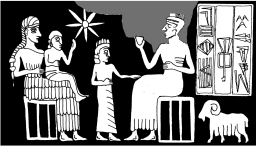
TGL^qu2

TGL^qu4
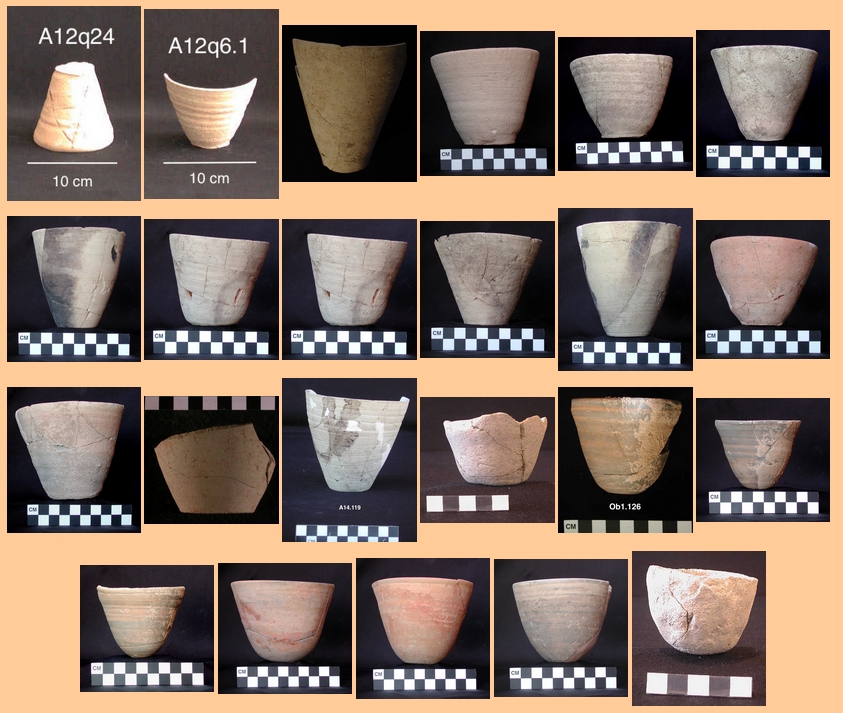


We can now draw a more complex inference from a statistical array of conical cups from eight excavation units, giving the total of vessels and sherds and the totals and percent of conical cups.
There is a total of 2,370 conical cups (wholes or sherds), which is almost one percent (.80%) of a total of almost 300,000 vessels and sherds, with considerable variations among the various units.
|
|
Back to top: Syntax
A grammatical global record
This example gives a good indication of the nature and significance of grammatical analysis in function of drawing valid inferences from the data, inferences that have a direct bearing on hermeneutics.
The inference was only possible possible because the data had been properly grammaticalized. The 2,370 elements in the assemblage can be so grouped because they have been originally identified as conical cups.
Furthermore, the validity of the inference rests on the global nature of the corpus. The nearly 300,000 items in the sample represent the entire body of ceramic vessels and sherds for these units, and that is what gives the statistics their power and validity.
Ws can on this basis recapture the sense of what a conical cup meant for the ancients. We do not just see it as a container for liquid, appropriate for drinking. We can identify with what would have been an instinctive appreciation for the ceremonial aura that the cup would hold, for its use whether in a high level social context within the royal family or as part of a religious ritual that connected humans with the spirits of the deceased.
This is in line with the other examples we have already seen in the section on semantics, where several examples have been cited that lead our perception to a level of higher closeness with the perception of the ancients.
Back to top: Syntax