Back to top: Categorization
The epistemic dimension
articulation of knowledge
Categorization refers to the way in which we define the real world, as we break it down into a variety of discrete elements. Even in the pre-linguistic phase of human development we may assume a degree of categorization: the stone tools that served different purposes were identifiable for proper use even if no word yet was available to codify the types in the inventory (Wynn 1989).
With the introduction of logical thought and language, of writing, and now of digitality, the categorization process has developed into a number ofever more complex systems, each applicable to a distinct and coherent set of elements – such as, in the case the UGR, the different conditions that define emplacement, the types of ware that define ceramic objects, the iconographic traits that define the image resulting from the rolling of a cylinder seal.
Back to top: Categorization
Attribute systems
Digital categorization rests on a system of attributes that are linked to any given element. We may distinguish two basic subsystems which articulate these attributes.
- A set of variables: they define an aspect of the element in question for which a variety of different realizations are possible, e. g. “color.”
- A set of variants: they define the potential realizations for the apsect defined by the variable, and they may be reduced to a list of codes (e. g., “bl” for blu and “bk” for black), or they may consist of a full lexical entry (e. g., “pale blu”)
In the UGR system, we use the terms roster and lexicon to refer to the systems, respectively, of variables and variants. They are treated at length in the Grammar.
Back to top: Categorization
An example
The total number of ceramic vessels and sherd in excavaktion unit A16 amounts to 59,818 items. This classification is already the result of a categorizaion step, because the “ceramic” items are only a portion of all that is found in A16, and have been so defined on the basis of well established criteria.
Each of these items is in turn classified into finer categories. A first step is to divide the total into distinct groups identified by the roster variant “ware.” An index combines all items into 23 distinct variables (i. e., ware types), which vary greatly in terms of the amounts for each category – from minimum of 3 for “Dark brick red ware” to a maximum of 34,179 items in the category of “Chaff tempered ware.”
The “ware” variable or category is only one of a number of variables that are applicable to the category of ceramic vessles and sherds. The full A16 database, given in plain ASCII format suitable for treatment with available programs, lists twenty-nine variables (of which ware is one), and for each items indoicates for which of these items there is an applicable variant.
Back to top: Categorization
A coherent universe
Categorization is built on a fundamental theoretical presupposition, namely that the universe of data to which it applies is a coherent reality. The import of this presupposition cannot be overemphasized. We assume that there is an order that exists independently of the categories, an order which is, however, properly reflected in the categories we have created. In other words, the categories have value because they have a basis in reality.
This relates to the basic point about semiotics and hermeneutics, which has been briefly discussed above in the pages about broken traditions and about referentiality.
Back to top: Categorization
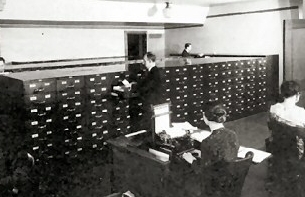
Pre-digital categorization operated at a very minimal level. The organization of the material was relegated to card filing systems, which offered essentially a two level categorization system.
- The cards were contained in drawers, which were labeled to reflect the content of the drawer;
- Within each cabinet, there were dividers which provided further subdivisions of the content. (The term "folder," in current use for computer operating systems, is analogous since it is borrowed from the term "manila folder" which served, and still serves, to contain loose pages).
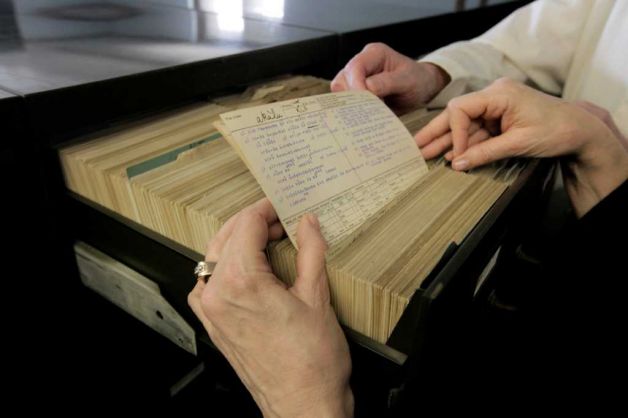
The images to the right illustrate the system in use for the production of the Chicago Assyrian Dictionary (see here and here). The first image shows the metal cabinets with drawers containing 5x8" cards, while the second shows an open drawer with the details of one card.
Texts were entered on one card, and then as many copies were made of the card as there were words; each card was then filed alphabetically according to the first letter of each word.
We may say that the categorization system was limited to just one level, that of the alphabetical sequence of the words. In other words, there was only one attribute, namely the alphabetical order based on the first letter(s) of each word.
Reiner 2002 p. 15, 66-67
| 
|
Back to top: Categorization
Pre-digital systems: output
The publication of the Chicago Assyrian Dictionary was a major achievement in the whole field of the Humanities. Twenty-one volumes, each dedicated to a letter of the (English) alphabet, where the data are collected and organized in a critical sequence.
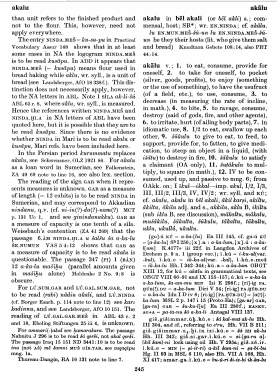
Thus the card shown in the image above, which reproduces a text where a form of the verb akālu occurs, is now embedded in the matching voice in the CAD (volume 1, part 1, pp. 245-259).
This voice, of which we see here the first page, and which takes up to fourteen pages of the volume, is subdivided into twelve major sections, corresponding to as many different lexical acceptations of the word. In a sense, these may be seen as categories, which define in greater detail hte semantic nature of the word.
An intermediate stage towards a digital version of the Dictionary is its availability in electronic format.
|
| 
|
Back to top: Categorization
Logical antecedents
The most significant foreshadowing of the digital system is the one proposed by P. Delougaz for the pottery excavated oin the 30’es in the Diyala region. The system is described in detail in the introduction to the publication of the corpus (Delougaz 1952 pp. 1-26), in two regards.
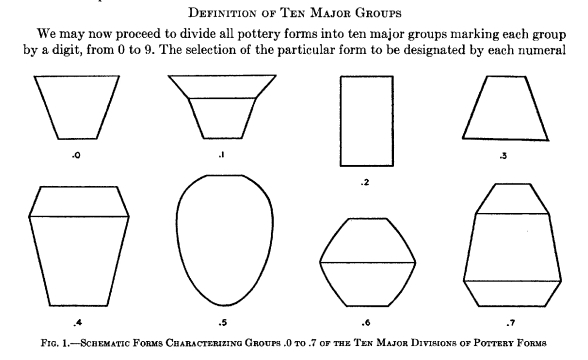
1. Conceptualization. Both the variables and the variants are described with extreme precision, especially with regard to the shape of the vessels. The image to the right (on p. 5) is one of several that indicate very explicitly the extent and boundaries of the system.
What is especialy significant is the fact that the system is intended to be exclusive, meaning that no other shape (in the case in question) can be expdected.
|
|
|
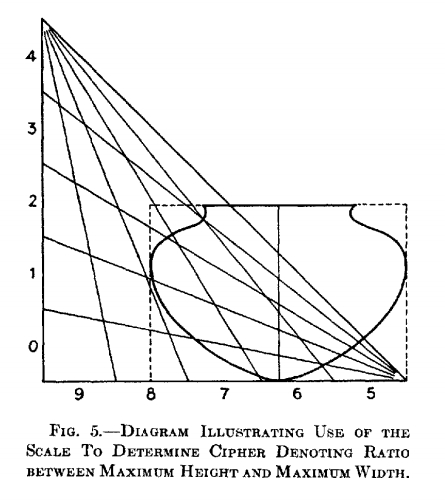
2. Formalization. Great attention is given to the exactness of definitions, for instance using diagrams like the one shown in the first image to the right (p. 15).
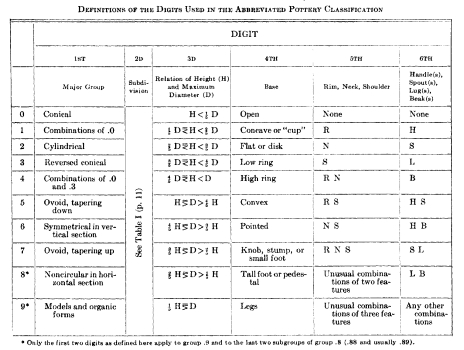
In addition, the system uses a "digital" approach. While not conceived for use with a computer, it is based on a formula (summarized in the second image to the right, p. 18) that very effectively translates the data into numeric sequences.
|
|
Back to top: Categorization