Back to top: Naturalism
Introduction
Naturalism, or realism, is an important aspect of the major styles of seal iconography from Urkesh. Both the individual figures and the way they interact with each other are shown with attention to details of real life. This emerges in Urkesh with Tupkish, and is in contrast with the heraldic style of the earlier ED period.
Back to top: Naturalism
Many of the seal impressions excavated in ancient Urkesh display detailed and realistic figures, some of which have a distinct character. The figures can be ones found in nature or the local environment or they can be results from the seal cutter’s imagination or from historical precedents, or a combination of these elements.
The naturalistic rendering takes into account the body structure of humans, animals and deities. Deities are imaged by combining body structure elements with natural elements such as sun rays (A12.82).The artist considers also the proportions, body positions of the figures they are rendering and movements of these figures.
Some of the seals can have a mixture of naturalistic and non-naturalistic images. For instance the Kumarbi seal impression (Akc21) depicts his body and the animal standing behind him in a realistic manner but the mountain is shown very small.
Movement, too, is analyzed and rendered in the naturalistic aspects of the figures. This is especially important in the animal combat scenes (A16q834.1).
Back to top: Naturalism
The impact of composition
Also important is the way in which composition displays the relationship of individual figures with each other.
For instance in a seal carved in the Deep Fringe style (A9.76) we see a procession that emphasizes all the figures in two ways. (1) By positioning each figure in a wide space, the seal cutter highlights their garments and the decorative nature of these garments. And (2) the procession itself is realistic since the figures are separated not only by a relatively wide space but also the first standing figure is characterized by the weapons that have been placed in front and in back of him thereby emphasizing the importance of this figure. Both the first and second figures are highlighted as they both have their arms pointed to the seated figure whereas the third figure only has one arm raised while the second is at waist level.
While most images portray sitting or standing figures connected in some way to the figures or objects surrounding them, some have compositions of scattered figures such as seal impression A5q704.01: the figures themselves are realistic but their relationship to one another is not clear.
A few of the seal impressions excavated in Urkesh have a double register in the composition ( A7.420, A16c1, A16c3). This is of course different from more than one rolling of the same seal (A1.469). Some seals can have a seated figure but with a figure or object rendered in what appears as two registers (A1.364).
Also, some seal impressions have figures of different sizes (A6.102, A7.321).
We will look at three of the most distinctive aspects of this style: scenes of daily life, ritual scenes, movement.
Back to top: Naturalism
Daily life
Scenes of daily life are usually depicted in a naturalistic manner and this is the case even for scenes connected with the Urkesh royal family.
The scene of Zamena the royal nurse (Akc3) presnets us with a charming real vignette: touching the child seated on the lap of queen Uqnitum takes place in an environment in which Uqnitum is having her hair braided!
The cook of Uqnitum, Tuli, has two scenes showing servants at work (Akc2 and Zsi.h11 THIS IS THE OLD NUMBER). The butcher displays his knife very prominently and holds the animal to be slaughtered. A woman servant stirs something in two necked jars which are placed in a basket. This woman and the butcher flank the inscription with the queen’s name and the animal stands below Tuli’s name in both her seals.
In another royal seal (Akq1) both servants are bending over their work and the inscription with the name and title of the queen is placed over their backs. They are holding up her seal inscription, as if to symbolize their status as subjects of the queen.
Although not a complete double register, a potter’s workshop is depicted as a secondary scene behind a seated figure (A1.364). In the lower part we see the potter working on a large necked jar while above her is a shelf with two completed necked jars. A16.167 also appears to show two potters at work with a small shelf with two complete vessels above them.
In seal impression A5q141 daily life is also combined with a seated figure. The two other figures placed behind this seated figure are both working, one is also seated but on a small stool stirring something in a large jar and the other in a container that may be made of leather, more than likely connected with two possible loaves of bread placed above.
In A6.88 we see another seated worker as well as two standing figures stirring something in a tall vessel.
perhaps add: banquet scenes and concert
Back to top: Naturalism
Ritual scenes
Even a ritual scene can be quite naturalistic. In A15.270 the headless slaughtered bull is hanging upside down while the head is placed at the base of a column holding a large necked jar. See film of a bull slaughter. The stark realism of the butchering scene is brought out by three videos we did of a modern day butchering (
1. animal being hung after butchering, cutting head off,
2. cutting off legs,
3. skinning and removing interior parts
), which shows unexpected similarities with that represented on our seal. Here, the priests have just completed this part of the ritual as one holds the legs of the headless bull so it will have this reversed position and the other priest holds the knife and the tail about to continue butchering the bull. The seated woman is stirring something in a deep pot.
[OK this paragraph here?] A variation of the worship theme is found in A1.241 = AKc102 not a worship scene which is carved in this style; here too the most important gestures are emphasized by being elongated. Therefore the arm of the deity is extended out and up holding the cup. The arm of the figure on the other side of the altar is extended so that the hand touches the altar; this last gesture is emphasized by the fact that above this arm is a crescent with a dot inside.
Back to top: Naturalism
Banquet scenes
The scenes variously show one or two persons while the table can have food on it or nothing on top.In AKc103 two persons are depicted holding a raised cup. They are separated by a table which does not have food but below the table is a large jar which appears to be connected with what they are drinking in a gesture which appears to be one of saluting each other. The standing figure has a deeply fringed skirt while the seated figure wares a long garment and has a long narrow beard. The long pleated garment of the seated figure shows clearly the pleats in the thickness of the relief as it goes under the figure seated on the stool. One foot of the standing figure is preserved and shows the same triangular pattern typical for the Deep Fringe style.
A more elaborate table with food placed on top is shown in Akc102; the table is emphasized by being placed in a halo type of arrangement of dots. Here too the most important gestures are emphasized by being elongated. Therefore the arm of the deity is extended out and up holding the cup. The arm of the figure on the other side of the altar is extended so that the hand touches the altar; this last gesture is emphasized by the fact that above this arm is a crescent with a dot inside. All the figures in this scene ware garments that are heavily pleated and leave one shoulder bare.
Back to top: Naturalism
Movement
Movement also is another important aspect of naturalism in the Urkesh seals. Movement is common in the animal combat scenes, not only those scenes of animals fighting each other (A7.305) but also in scenes of humans fighting animals (A5.135)
In AKc2 we have interpreted as Kumarbi he is shown as walking in the mountains as the text describes him.
Movement is also central to seals of a winged gate placed on the back of a bull, for instance A5.120. In this seal impression the bull is positioned as if prancing as the body is higher in front. The two human figures flanking the bull have their legs and arms bent as if supporting the gate on the bull’s back.
In A5.137 the bull does not move but the human figure is moving to hold the gate on the bull’s back.
| Iin A5.115 we see a hill with trees. In A1.115 there is emphasis on movement in the animal's position, shown as if climbing the hill.
|
| 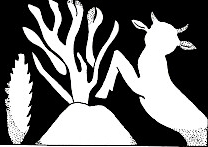
A5.115
|
Back to top: Naturalism