Back to top: Pointed edges
Introduction
In this style the seal carvers emphasized forms that are triangular with sharp edges and pointed ends. Often these triangles are long and narrow and composed in groups (for example, A13.15).
The figures exhibiting this stylistic trait are placed close to each other but not overlapping so that the image is clearly readable even if there are a number of figures in the context.
The sharp rendering contributes to a quick identification of the image, so that the seal owner and those sealing the objects or those breaking the sealing to access the contents could immediately recognize the iconography and attribute it to the proper owner. This contributes to the efficiency of the administrative process whereby the sealed containers (boxes, baskets, etc) could be opened quickly and identified properly.
The use of the style also distinguishes the same subject on the seal from other seals showing the same subject, for instance deities with a horned crown or bearded human males.
In what follows, we will look at distinctive subjects to which this particular stylistic trait applies.
|
|
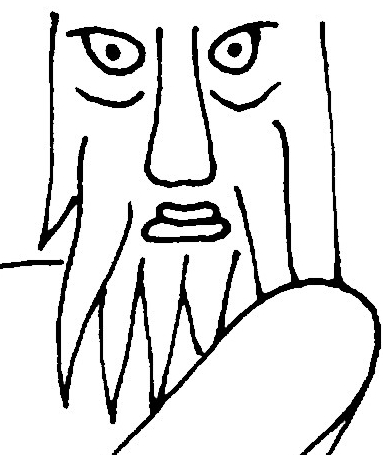
A13.15
|
Back to top: Pointed edges
Landscape
|
Elements of the landscape are also occasionally carved in this style as shown in the small tree and the animal's head in A5.115
|
| 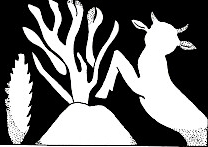
A5.115
|
Back to top: Pointed edges
Comparison with other styles
Back to top: Pointed edges
Comparing the Pointed Edges style with the Deep Fringe Style
In the Pointed Style human figures rarely have decoration on the garments but see (A7.69, A7.194) where one of the figures holding the tail of the bull has a pleated skirt. This is also the case for two figures in A7.327 connecting them also with the Deep Fringe style.
Of particular interest is the skirt worn by Shamash in A12.82 because of its visual connection with the inscription placed directly behind the seated Shamash. The upper part of the garment is decorated with two rows of rectangles and the skirt portion with two rows of long very thin triangles. These patterns reflect the images of the cuneiform signs in the inscription However the seal of Tupkish shows a figure wearing a long garment with a line of pointed triangles down the middle as in the Deep Fringe Style.
|
Celestial symbols are not common but do occur (A15.270, A7.359 and A7.380).
Sometimes bodily articulation is emphasized, such as long thin arms and legs in (A16c2 and AKc106)
Back to top: Pointed edges
Comparing the Pointed Edges style with the Dotted Eye Style
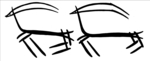
| We see that the eyes in the figures in the Pointed Style are usually small to medium ovals without a dot in the center even though this does occur sometimes (A7.380). In both these styles the head is almost always shown in profile but the eye is depicted frontally. While the eye of the figures is emphasized in the Dotted Eye they are small and not emphasized in the Pointed Style. In both these styles deities have horns in front view.
|
|
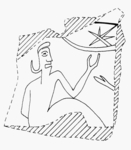
A7.380
|
|
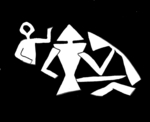
The triangles in the Pointed edge style are completely different from the triangular head in AKc107. This seal has a small human figure with a triangular shaped head and a central eye but the triangle is not pointed except for the nose on the face. However the main figure is a large human-like shape with a triangular head and upper body. The arms are overlapping the shoulder area of the body. The figure is fighting with an animal with what appears to be a triangular head or possibly a leg. These triangles of this seal are completely different from the Pointed triangles which are long, thin and have a sharply pointed end. In A9.24 we see the triangles forming long very thin horns as well as parts of the bodies, especially the legs.
|
|
A7.380
A9.24
Back to top: Pointed edges
|