Back to top: Realism
Introduction
Realism, or naturalism, is an important aspect of the major styles of seal iconography from Urkesh. Both the individual figures and the way they interact with each other are shown with attention to details of real life. This emerges in Urkesh with Tupkish, and is in contrast with the heraldic style of the earlier ED period.
We will look here at three aspects in the treatment of the figures:
- the treatment of the single figure
- the compositional organization of the figures
- the representation of movemnet
In the following pages we will look at three special topics:
- scenes of daily life,
- ritual scenes,
- banquet scenes
and at the formal treatment of two particular details:
Back to top: Realism
The yawning lion
Back to top: Realism
The impact of composition
Also important is the way in which composition displays the relationship of individual figures with each other.
For instance in a seal carved in the Deep Fringe style (A9.76) we see a procession that emphasizes all the figures in two ways. (1) By positioning each figure in a wide space, the seal cutter highlights their garments and the decorative nature of these garments. And (2) the procession itself is realistic since the figures are separated not only by a relatively wide space but also the first standing figure is characterized by the weapons that have been placed in front and in back of him thereby emphasizing the importance of this figure. Both the first and second figures are highlighted as they both have their arms pointed to the seated figure whereas the third figure only has one arm raised while the second is at waist level.
|
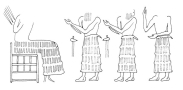
A9.76
|
While most images portray sitting or standing figures connected in some way to the figures or objects surrounding them, some have compositions of scattered figures such as seal impression A5q704.1: the figures themselves are realistic but their relationship to one another is not clear.
|
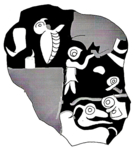
A5q704.1
|
A few of the seal impressions excavated in Urkesh have a double register in the composition ( A7.420, A16c1, A16c3). This is of course different from more than one rolling of the same seal (A1.469). Some seals can have a seated figure but with a figure or object rendered in what appears as two registers (A1.364).
|
| Also, some seal impressions have figures of different sizes (A6.102, A7.321).
|
|
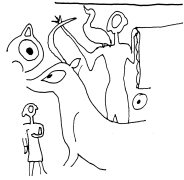
A6.102
|
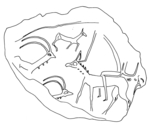
A7.321
|
Back to top: Realism