Back to top: The nature of the record – 1
Deposition: inferring process
The archaeological record is situated, we may say, between two distinct processes: deposition and excavation.
Deposition is the process through which things have come to be where they are in the matrix of the soil. It is the moment in antiquity when, we may, say the living tradition came to an end. We have here the frozen record of that moment – where “moment” does not refer to an instant in time, but rather to a process that may have unfolded over a protracted period.
Excavation is the process that disentangles this frozen record, taking apart discrete elements embedded in the matrix of the soil.
We have, properly speaking, no record of deposition as such. There is, in other words, no record of the process, but only of its termination. The depositional process can therefore be only inferred from the trace it has left.
Back to top: The nature of the record – 1
Emplacement: documenting the locational context
The terminal state of the depositional process, its trace, appears to us as the locational context, within the soil, of discrete physical elements which can be identified as stationary (a wall, a pavement) or as movable (a ceramic sherd, animal or human bones). These elements are located in space, and the first task is to record this locational context, i. e., the place in which they are in relationship to each other.
The term used for this static record is emplacement. It is the only objective record available, and the primary, and exclusive, task of archeology is to account for this record. Which must be considered in tis entirety, hence the emphasis on “globality.”
Back to top: The nature of the record – 1
Stratigraphy
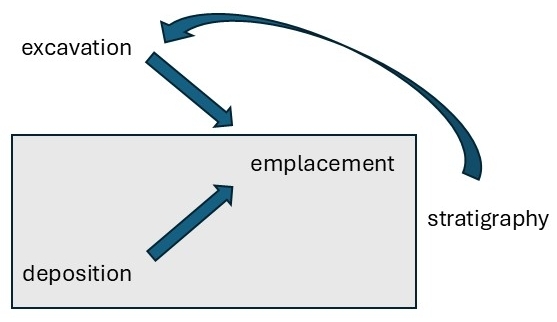
Emplacement is at the intersection of excavation and deposition. It is the static dimension of the record that serves as an interface between two dynamic dimensions, and the only one that can be properly documented. The excavation process lays it bare, and the depositional process is in turn inferred from it.
Stratigraphy is the procedure that subsumes both emplacement as documented and deposition as inferred.
|
| 
|
|
Stratigraphy builds on, and is concurrent with, the process of excavation. It has, therefore, a decisive impact on strategy – as symbolized by the curved arrow in the image. That is how the two processes, excavation and deposition, relate to each other: the progressive understanding of deposition, made possible by the process of excavating the emplacement, is articulated by stratigraphic analysis, which in turn conditions decisions on what and how to excavate next.
|
Back to top: The nature of the record – 1
Globality
It appears from the foregoing why we need for a global record. The process of deposition can be safely inferred only if nothing is omitted from the emplacement record. This applies to emplacement as it is uncovered at the moment of excavation.
But is just as important at the moment of “publication.” The emplacement record is the only objective data we have from an excavation. The single elements, once extracted, are obviously susceptible of an objective analysis – but once extracted from their locational context, they are no longer to be considered part of the archeological record. They belong to architectural, art historical, or whatever other type of analysis may be brought to bear on them, and in that sense they also are “objective” data. But, once extracted from their locational context, they live a life of their own, no longer properly an “archaeological” life.
We will discuss further in the next page.
Back to top: The nature of the record – 1
The nature of observation
What is recorded are the excavator’s observations. They include written statements, measurements, photographs, videos, drawings. They all depend on the excavator’s attention and decisions, and to that extent the objectivity of the record is certainly affected. The record we have is not of the emplacement, but of the way in which has been observed.
We cannot, accordingly, repeat the experiment with the original data. But we come as close as possible to that ideal: we can retrace the observational process.
It should be noted that there are, in a sense, no “wrong” observations: the observation, as such, is the objective data, and as such it remains in the record (see under authoring). If it turns out that the facts are different from how had been observed, a correction will be entered in the record, but the original one remains. This, too, is part of the “globality” concept. “Wrong” observations have an impact on strategy, and as such they must be preserved.
Back to top: The nature of the record – 1
Closure
Once the locational context has been broken apart and the elements have been disaggregated, the process comes to an end for that particular portion of the emplacement. No more observations are possible – and the global aspect of the record may be considered closed.
Back to top: The nature of the record – 1