Back to top: Writing the UGR
Writing the UGR
When writing the UGR, the sequence between thematic and unit books is actually inverted. The first to be written are the digital books relating to excavation units, each of which has its own website.
Each unit book follows closely the progress of the excavation and is "written" on a daily basis by a number of contributors whose observations are entered in the record, without exception.
This alternative sequence does not, however, apply just to the moment of the production of data: it is also a structural sequence. The unit books are by no means to be seen as just containers of data, as databases. They provide a well-structured presentation of the unit seen as an entity with its own physiognomy.
While serving as autonomous entities, the unit books are at the same time closely tied to the thematic books, which draw on them as they are being written and afterwards, just as the unit books refer to them in their analysis of the data.
|

|
⇆
|

|
Back to top: Writing the UGR
Browser edition
Central to our effort is the ability to use the browser edition as an integral element of the data entry phase during the excavations. The reason why this is important is that the browser edition is not a distant finishing line, where the product is the result of thorough-going harmonization and synthesis. Rather, the browser edition proceeds pari passu with the excavation. It is, in effect, an instant translation of the notes taken individually by all members of the staff, from the excavator and the registrar to the photographer, the surveyor, the draftsman. The browser edition is produced on a daily basis through an in-house program that operates on all the inputs from each different source, i.e., from each staff member. These are simple inputs in plain ASCII format, and from them the browser edition is constantly kept up-to-date. In this manner, the browser edition provides an excellent environment for achieving the kind of integration that is a major desideratum for an archaeological excavation. It is within such an environment that all members of the staff relate on a daily basis to their own data.
(As of the 2003 season of excavation, there were still some delays and gaps in the actual functioning of the system as described. But in its essential elements the system is in fact operative.)
Back to top: Writing the UGR
Examples
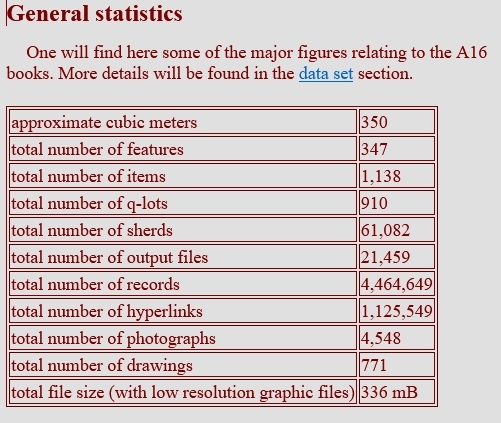
As an example, we may look at unit book A16.
An excavation unit is generally limited in size: A16 is typical having 8 4x4 m squares.
But the amount of data is very large, including for instance 347 features and 61,082 ceramic items (vessels and sherds).
| 
|
|
|
|
| grammar and UGR? give page with links to GRM and UGR
|
|
detail of one page
MZS: list of beads, setting among units
AP: courtyard
TGL: list by field number
Back to top: Writing the UGR