Back to top: Early Walls in the Plaza
Introduction
A series of stone structures were found in all JP below EDIII structures. These date to the EDII or earlier. In the plan to the right the structures are marked in brown. Below are described the walls. For the early staircase see staircase.
|
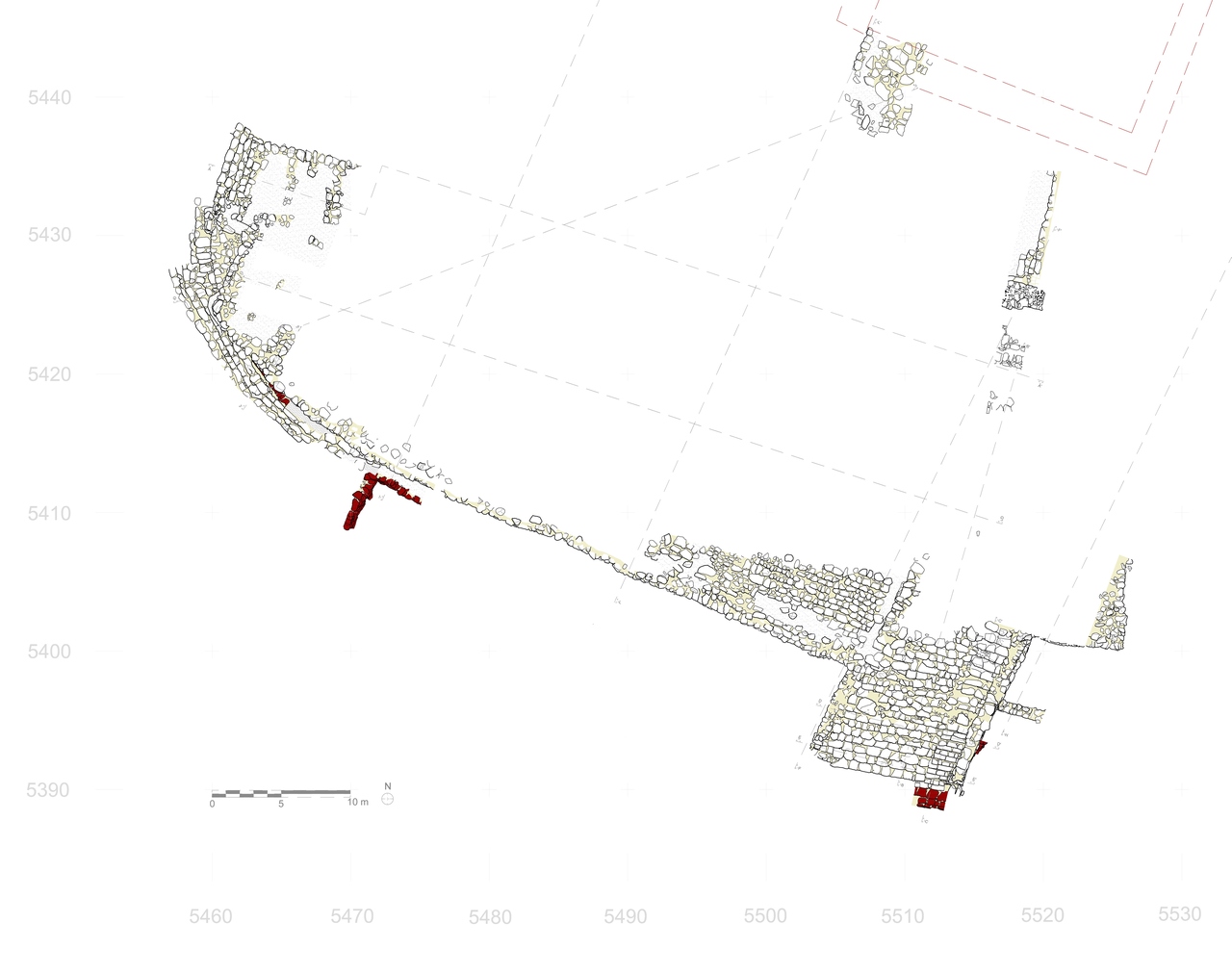
JP and BT ground plan |
Back to top: Early Walls in the Plaza
JP^wall7
The deepest stone architecture excavated in Area JP was uncovered in Unit J1, apporximately 7 m below the topsoil (at an elevation of 8500 m), under EDII levels. See also chronology and constructional historyfor interpretation and chronology. These walls may represent an early version of the revetment wall.
wall7 is located within the Plaza in Unit J1, immediately south of wall6, the EDIII Revetment Wall. Its uppermost couse lies 10 cm below the first course of JP^wall6, while maintaining the same alignment and orientation.
wall7 consists of two bonded stone walls set perpendicular to one another. The western wall runs southwest-northeast, while the northern wall extends northwest-southeast. The walls are not straight, instead both lean against the soil. The visible faces are the southern of the northern and the eastern of the western wall. On these exposed faces, the stones are carefully laid, with their flatter surfaces facing outward to create a relatively regular wall face, instead the back is more irregular and lean against the soil. This indicates that the walls were constructed after the adjacent deposits had accumulated, rather than as freestanding structures. Their construction therefore suggests a retaining function, intended to support and stabilize the surrounding deposits.
Both walls are only partially preserved. The western wall has collapsed along its northern section, while the eastern end of the northern wall has also suffered collapse. Numerous large stones were recovered immediately in front of the walls, suggesting that both walls originally stood considerably higher than their present preserved height.
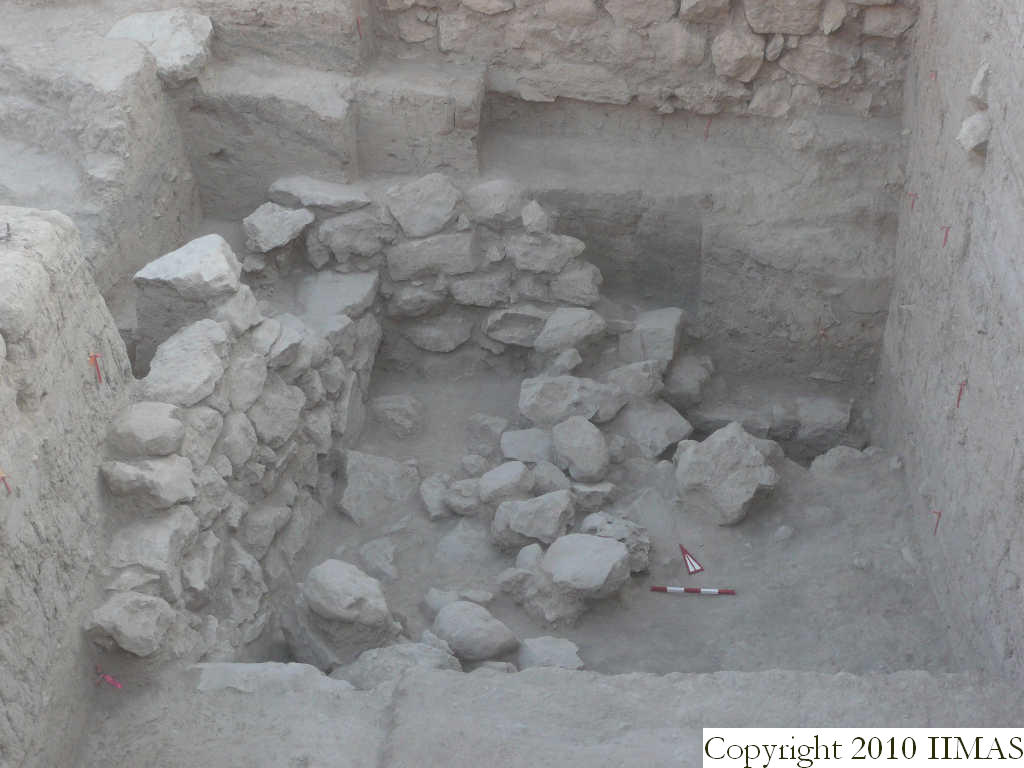
JP^wall7 from the south |
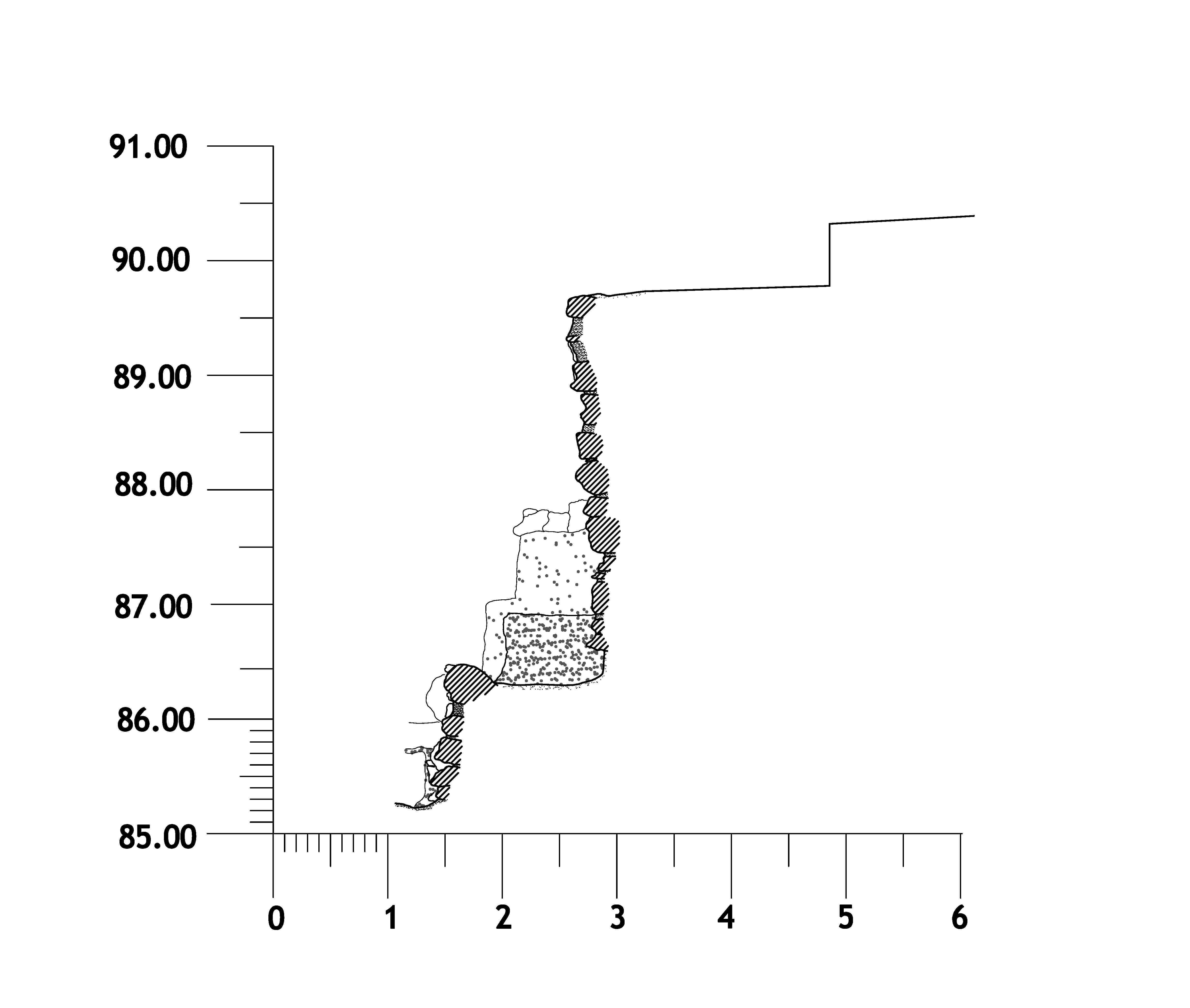
Section drawing I-I scale 1:100 |
Back to top: Early Walls in the Plaza
JP^wall8
wall8 is a wall segment located directly under wall6 in unit J5. It is oriented northwest-southeast and is preserved to a height of 2 courses.Its full width can not be dedermined. The wall follow a slightly different alignment from JP^wall6. The stones of JP^wall8 are angular and roughly parallelepiped in shape, with their flat faces set on the exposed side, producingn a regular wall face comparable to that of Wall JPw13. Escarpment1 abuts the first visible western stone. wall8 may represent the eastern continuation of wall13, which collapsed at some stage and subsequently been rebuilt. Alternatively, like to JP^wall7, belongs to an earlier construction phase of the Temple Terrace.
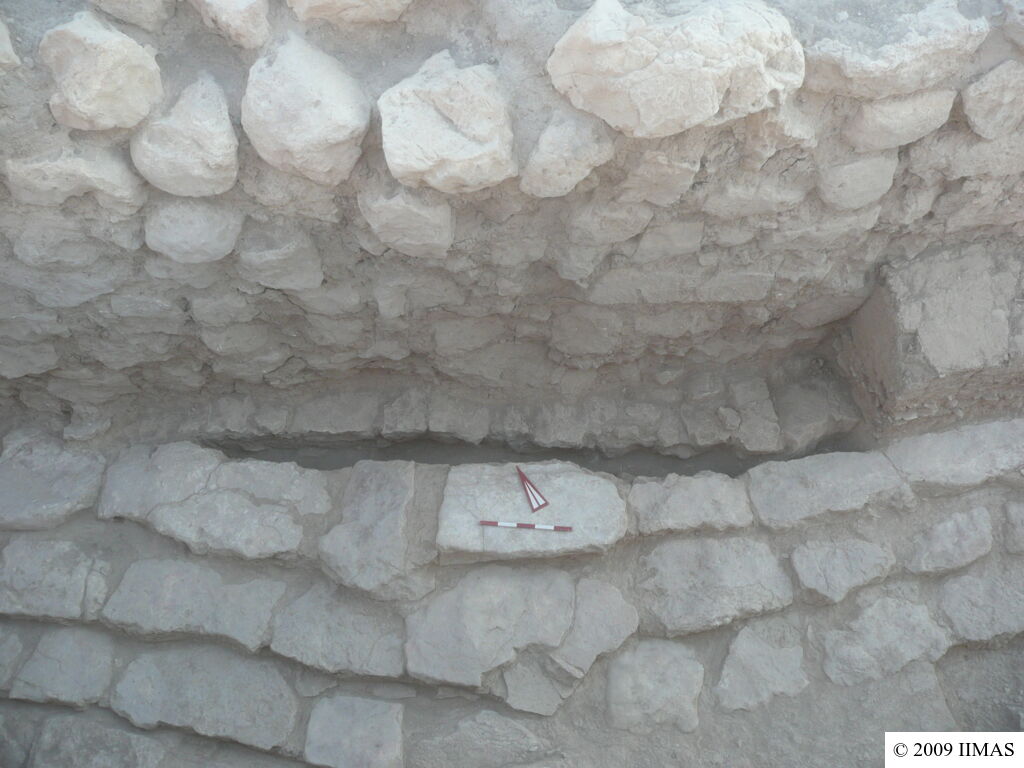
JP^wall8 from the south |
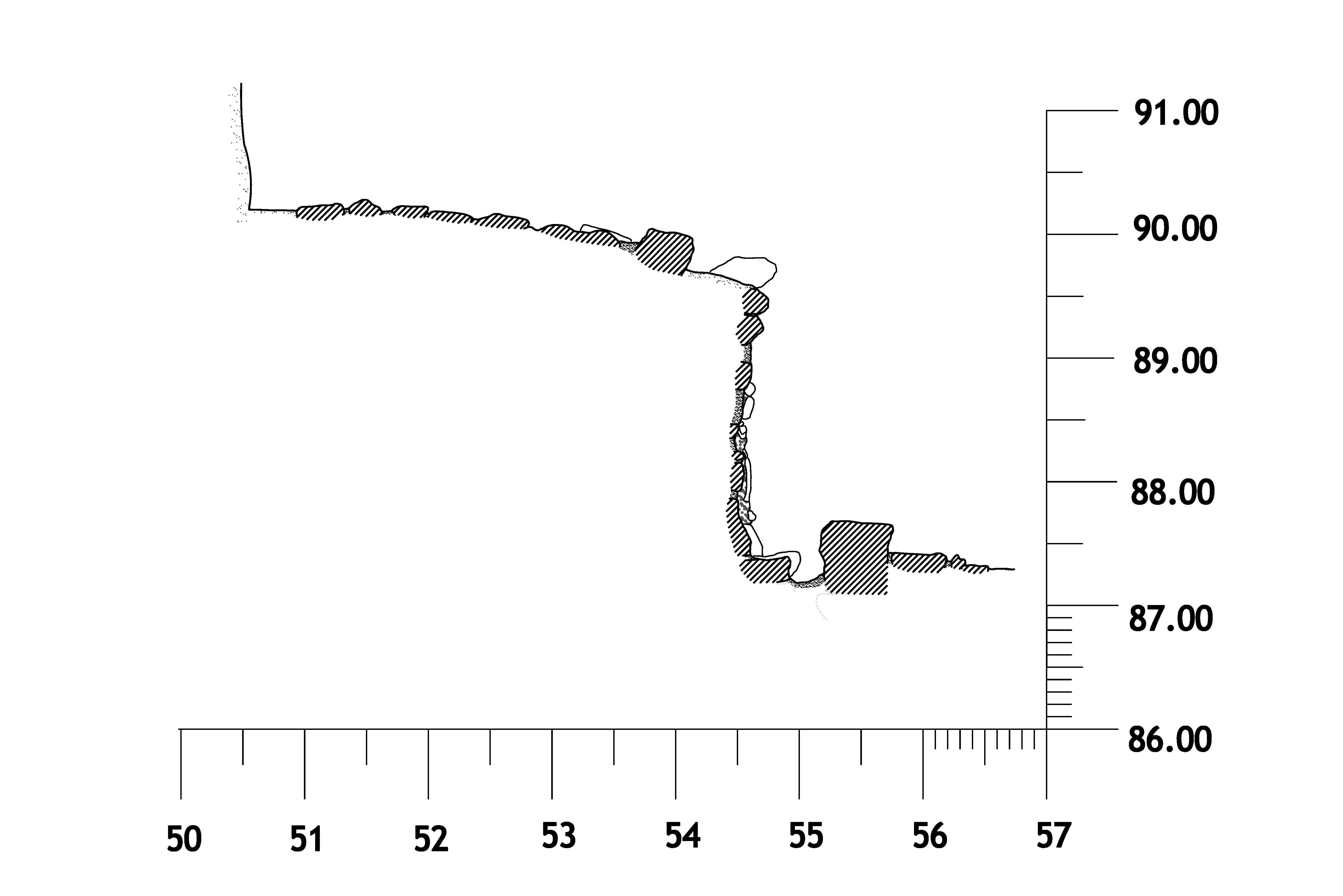
Section drawing J-J scale 1:100 |
Back to top: Early Walls in the Plaza