In the general website one will find an in-depth presentation of the digital dimension which informs the basic conception of the Urkesh Global Record (UGR).
An explanation of the broader concept of a digital publication in the UGR section of the Urkesh website, and a discussion of the even wider implications of digital thought in the corresponding digital monograph of the Methodology section of the Urkesh website.
To be able to “read” a UGR digital book requires a certain familiarity with its structure, although the intent has been to make access to the browser edition as transparent as possible. This section explains in detail the formats used within the UGR page layout for the CERAMICS book, as follows:
General Overview
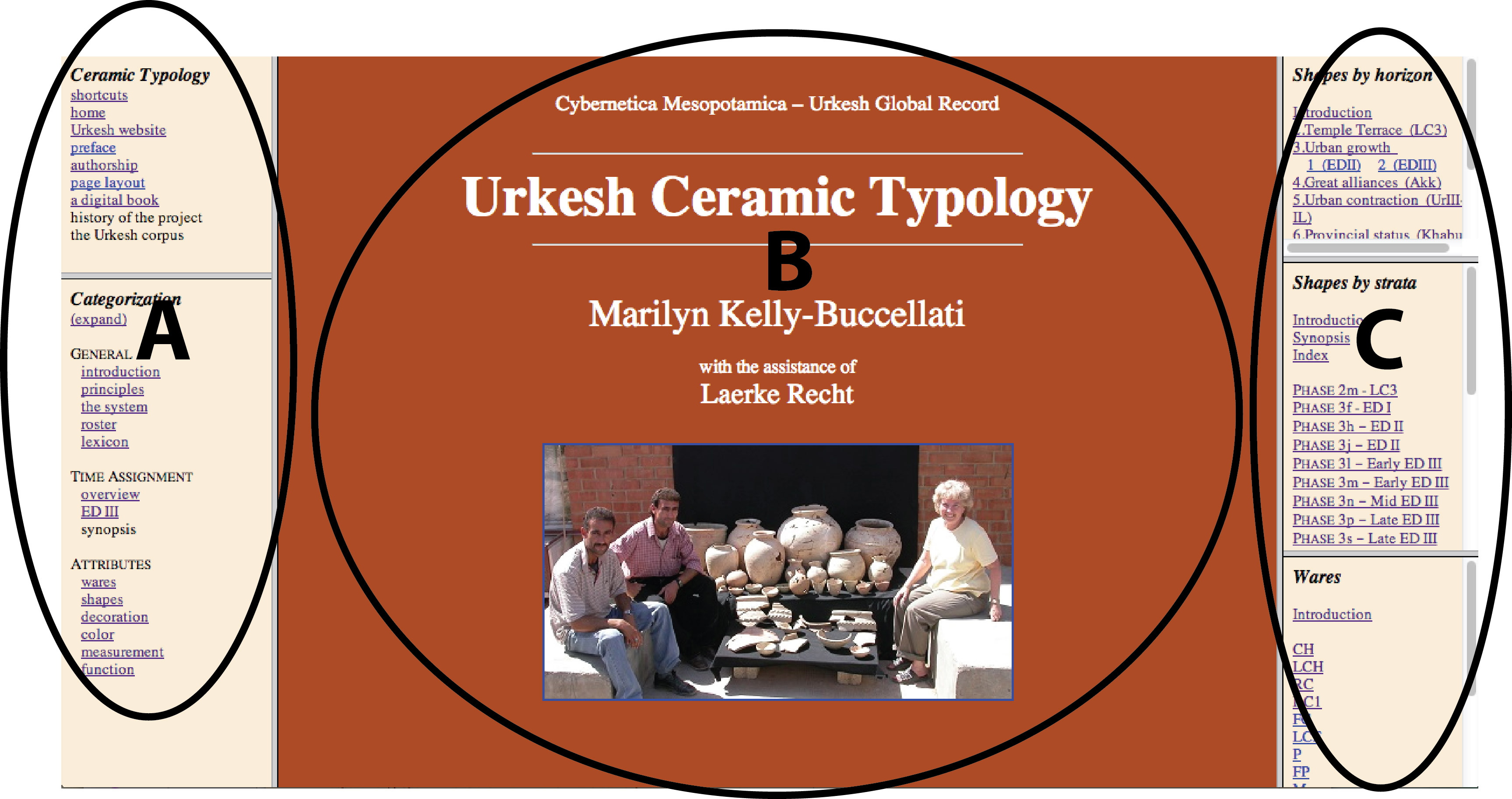
A. The left sidebar relates to a synthetic presentation of the data, in a traditional vein.
B. Both the left and the right hand side vertical bars open links to the main frame in the center, where the data are displayed.
C. The right sidebar relates to the analytical presentation in the format of the UGR grammar. |
 |
|
Left sidebar
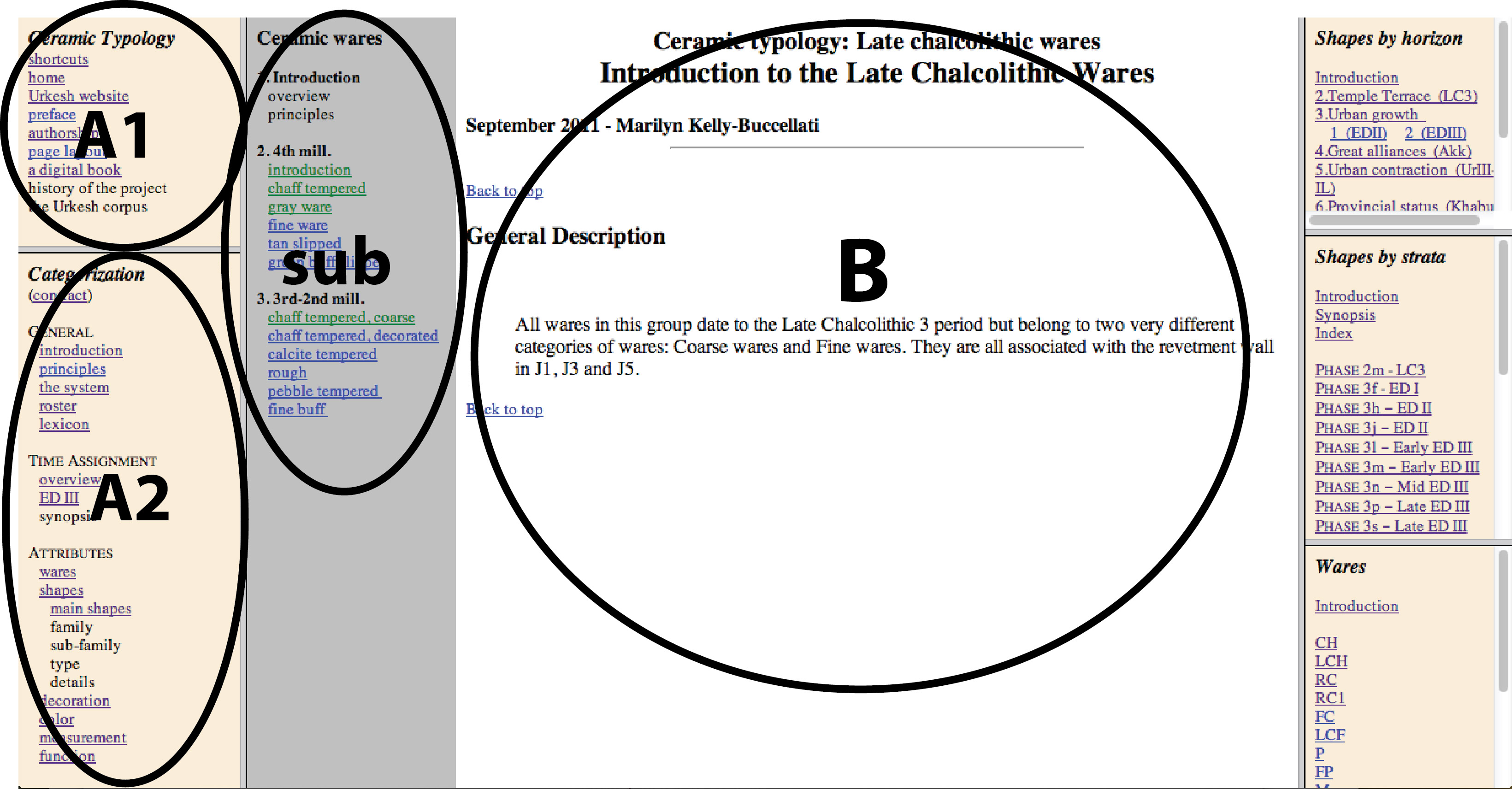
The left sidebar opens links in the main frame, B.
A1. General introduction and shorcuts to the main areas of the website.
A2. Discursive section on the ceramics, using for the most part concepts and language current in the discipline.
A-sub. Occasionally, a sub-menu is used to supplement the left sidebar. |
 |
|
Right sidebar
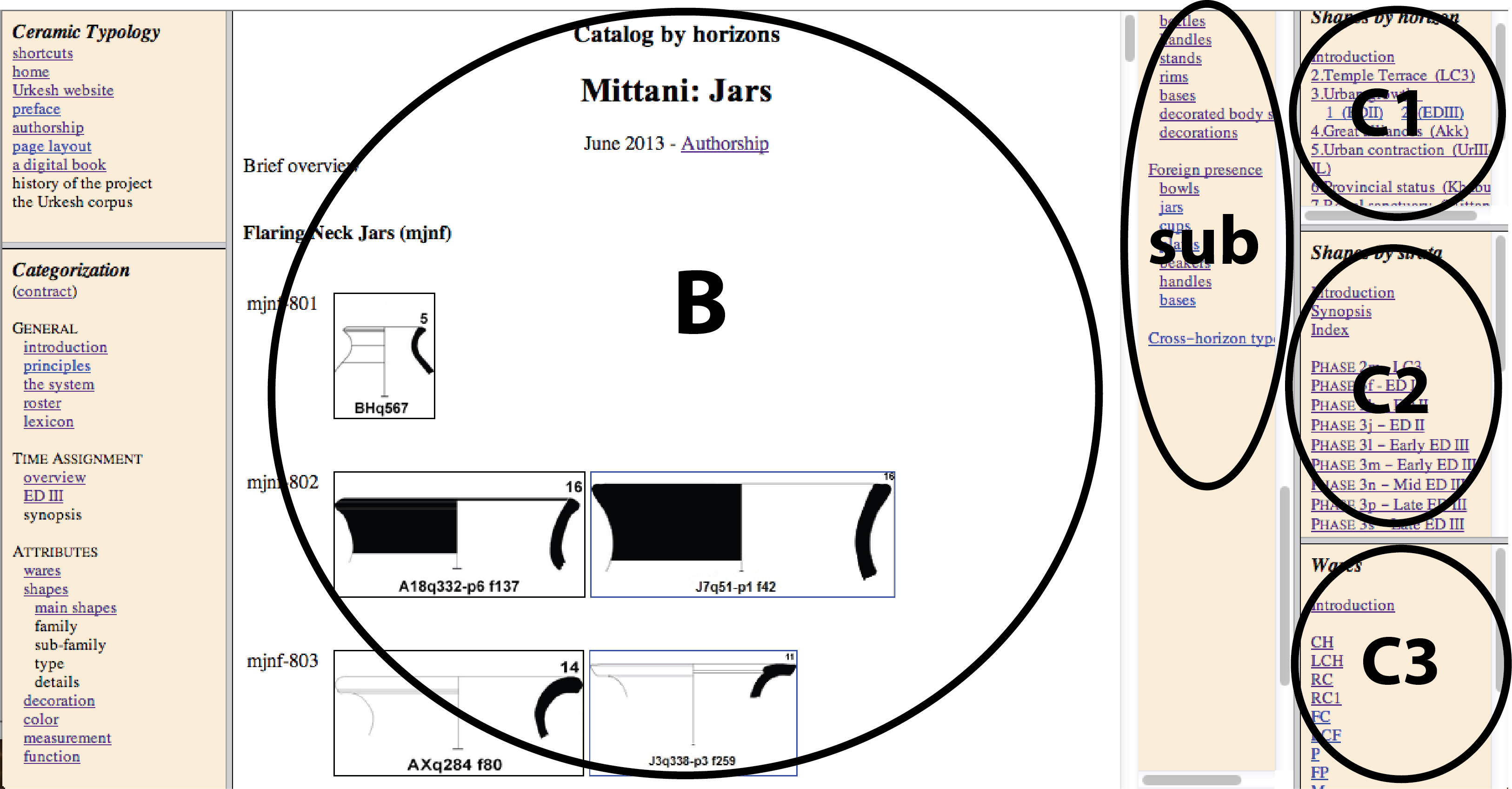
The right sidebar opens links in the main frame, B.
C1. Ceramic shapes by horizon.
C2. Ceramic shapes by phases and strata.
C3. Ceramic wares organised according to phases and strata.
C-sub. Occasionally, a sub-menu is used to supplement the right sidebar. |
 |
|
Back to top: Page layout
xxx this and the nex one from old preface
As with the other digital books in the Urkesh Global Record (UGR) the format for the Ceramics book is divided into three sections see page layout. The central section (B) displays the link called up while the two sidebars contain the structured links. The left sidebar gives in detail the “how” of the analysis while the right hand sidebar shows the “what” that was analyzed in both chronologically based and typologically based formats. The upper left hand side (A1) contains a section on the book as a unit and gives the background to the work including the various collaborators who helped construct the digital book. Particularly helpful on the Left Hand side is the section on field methodology which explains the steps the ceramic vessels and sherds went through from the initial excavation to the final disposition. The second section of the left sidebar (A2) contains the categorization system which explains in detail the principles of analysis and the methodology used to apply this system in Mozan. In two major sections this side gives a description of all the terms employed in the analysis: roster and lexicon. The attributes, such as wares, shapes, decoration are described while the section on Time Assignment gives an overview of how the chronology of all the ceramics is presented.
The right hand sidebar (C1) presents the ceramic shapes sorted by chronology. While the detailed shape descriptions are found on the left hand side, here the ceramics are categorized by their individual chronological horizons and in sub-categories divided by shapes including overall shape, family, sub-family and type number. Particularly useful is the Cross-horizon typology section. The right hand sidebar has an extensive portion with indices (C2). These indices represent only those ceramics found in the chronological section and are sorted by chronology and typology. The tabulations for the individual field books are found on the Left Hand side of those books. See for example [tabulations] (/mz/a/A16/ugr/-frame.htm). In the unit books in the UGR the individual items in their original stratigraphic context are shown with the complete description of that context and an inventory and description of the elements found in the context. This allows the user to go from the highest node (the context in this case) to the lowest node (a single sherd in this case) easily, a characteristic of the entire Urkesh Global Record.
Back to top: Page layout
An example
To best illustrate this linkage between context and typology the trajectory of a single sherd will be here followed. The sherd chosen comes from a Mittani period deep bowl with a line of painted birds as the decoration. It is from the J1 unit book and was excavated in feature 38. Within this feature it was found in q-lot 139 and labeled as p1, the link gives a description of the context, with further links indicated, and a photo and drawing. The shape type drawing for the Mittani period is found in the Mittani horizon catalog. The decoration type is categorized as M6. By clicking on these links the detailed analysis of both the context and the typology can be studied.
Back to top: Page layout