Back to top: Principles of stratigraphic analysis
Introduction
Back to top: Principles of stratigraphic analysis
The first encounter
When first approaching a site we are faced with a mass of data that can claim epistemic status only to a very limited extent. The mass is dense and filled with elements that have no clear identity and no clear connection with each other.
The inference is that this mass was formed over time as the result of cultural and natural events. Excavation disrupts the cohesiveness of the mass, and stratigraphy is the method which records the effects of this disruptive process.
Stratigraphy
Back to top: Principles of stratigraphic analysis
Presuppositions
diff. geological strat
function, accidental, singulsrity
depos & fuction presupposed & inferred
presupposes function use accidents
resulting in deposition
evidenced in emplacement
Back to top: Principles of stratigraphic analysis
Build-up
notoin of deposition
notion of pristine fragment
Back to top: Principles of stratigraphic analysis
Disaggregation
excavation
explain “disaggregate” in relatiship to “aggregate” as element – a mass
dynamics, point of repose
disarray
Back to top: Principles of stratigraphic analysis
The epistemic dimension
properly archaeological, along with conservation
Back to top: Principles of stratigraphic analysis
Excavation/The process: disentangling
Back to top: Principles of stratigraphic analysis
Excavation
The process results in the exposure of elements, and we may distiguish two aspects of this process: horizontal and vertical exposure.
Back to top: Principles of stratigraphic analysis
Horizontal exposure
To a large extent, the data as excavated show no structural relationship to each other – i. e., they do not reflect their original functional setting. Their primary definition is thus tied to their findspot and their association with the other elements with which they are in contact.
As a reslt, the “finds” emerge as a mass of disconnected fragments. To “disentangle” means to extricate them as individual pieces from this mass, all the while accounting for the process itself and arguing for the nature of the relationship the fragments have in the mass.
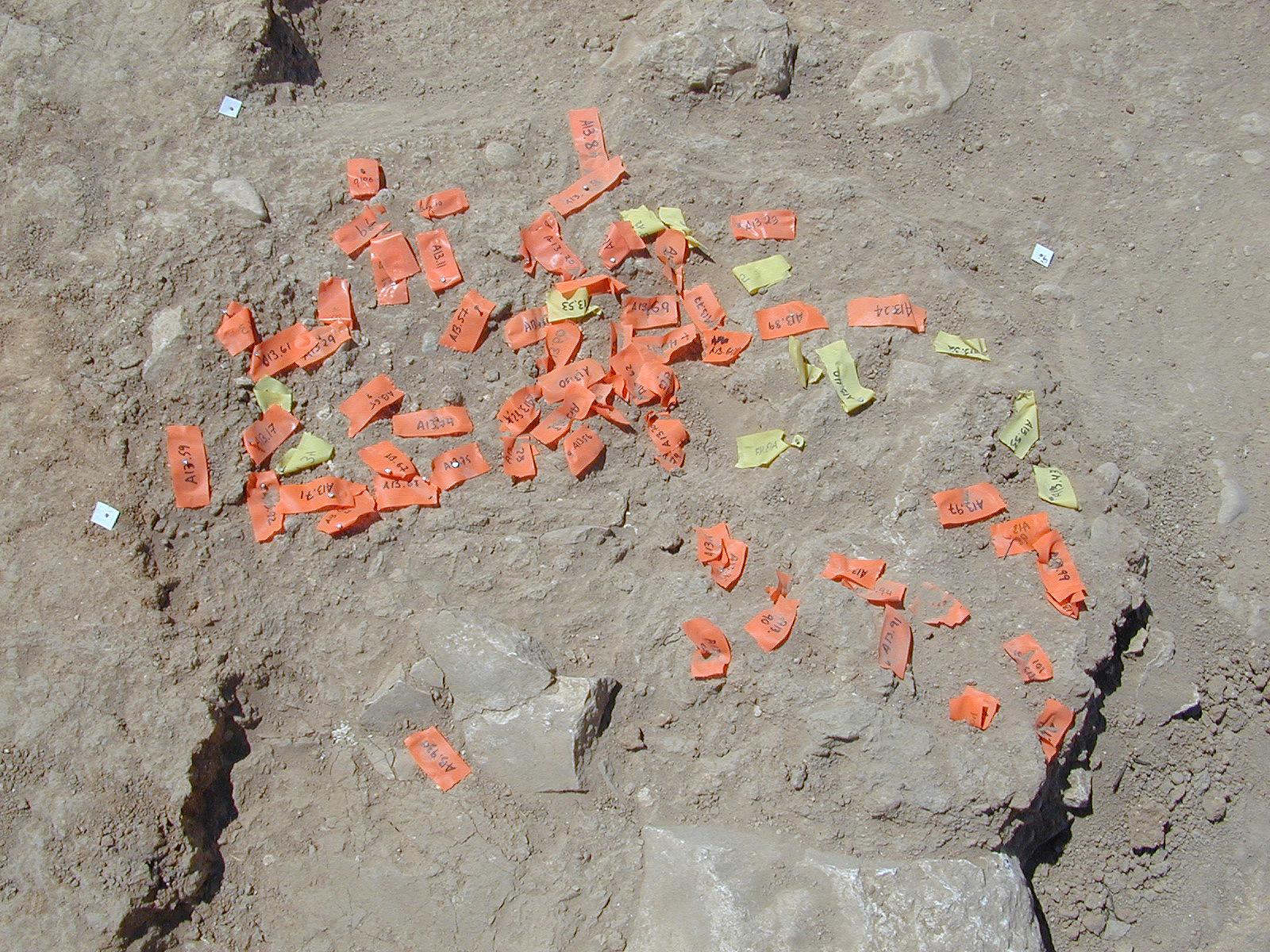
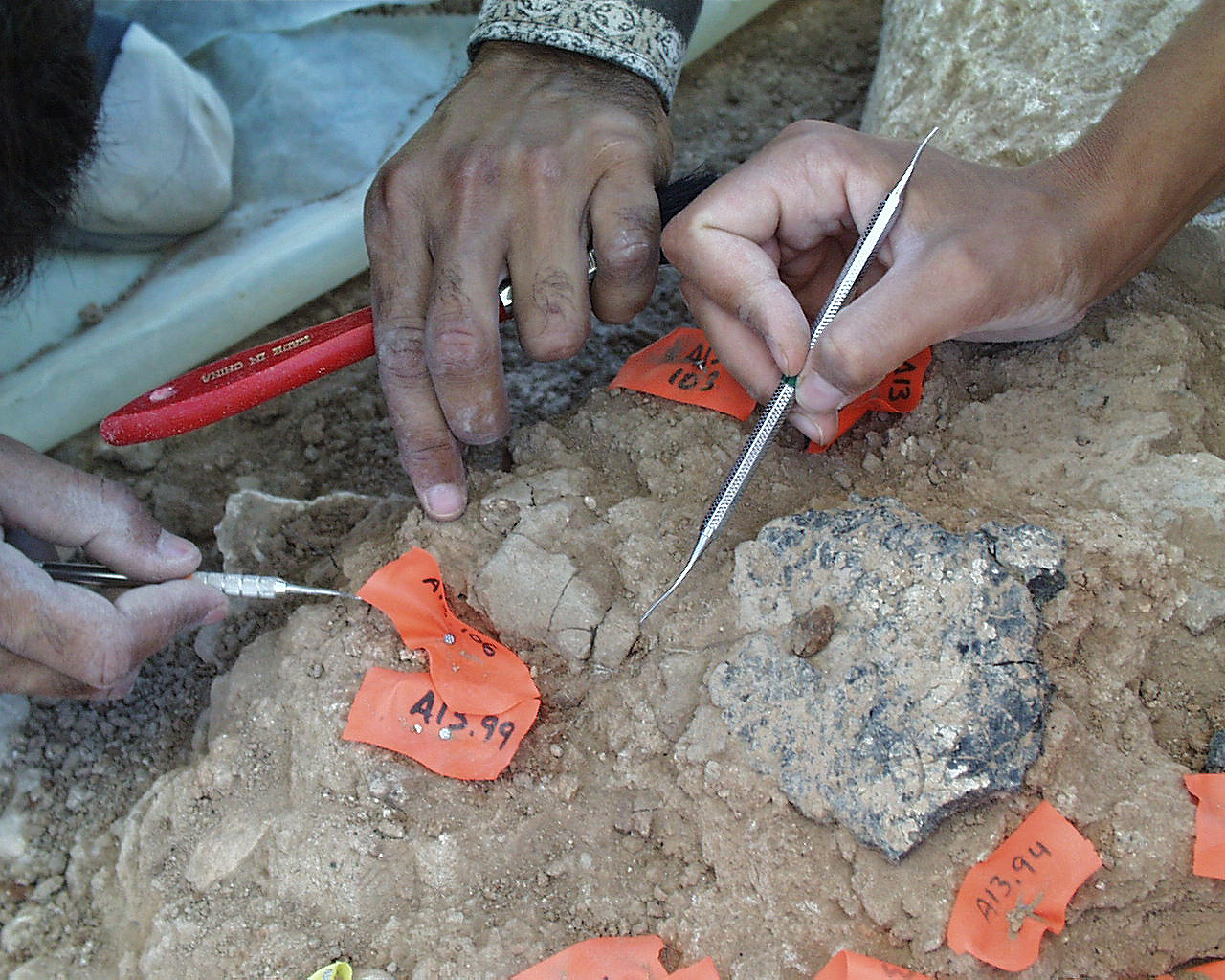
By way of example, the two images below illustrate a given situation. Each orange or yellow ribbon identifies a small nodule of clay which may turn out to be a sealing. They are embedded in the soil in a way that requires a careful extraction procedure. As soon as they are exposed, they are assigned a number and located geo-referentially before being removed individually from the casing in which they are emplaced.
 A13v13a
|  A13
A13
|
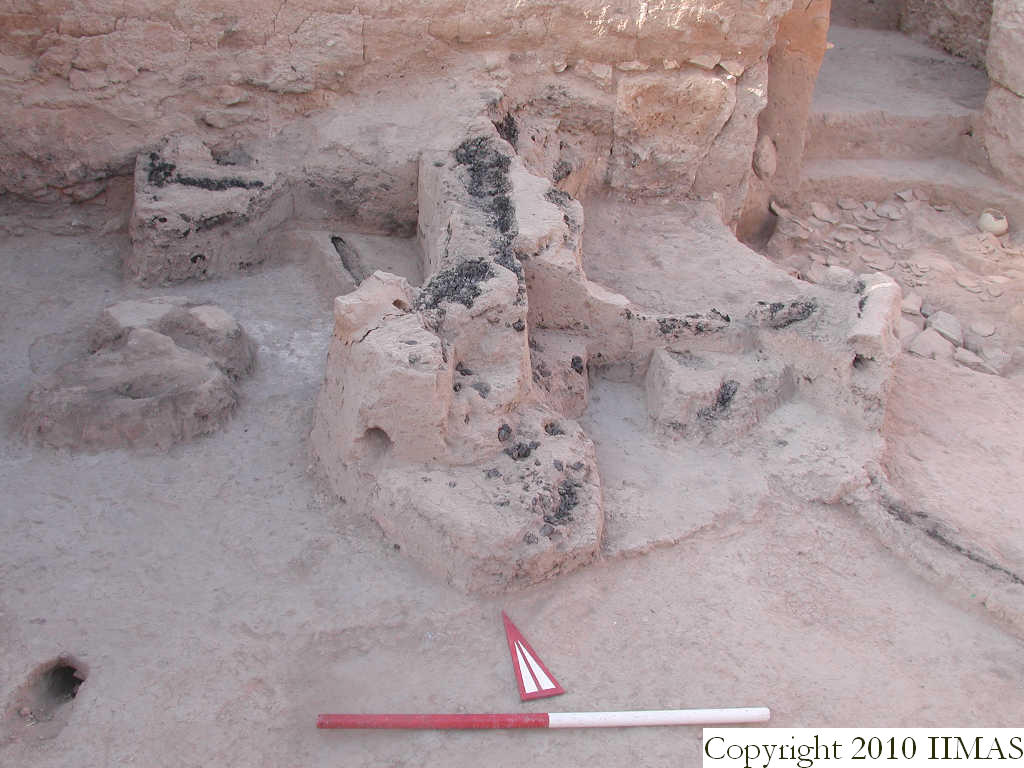
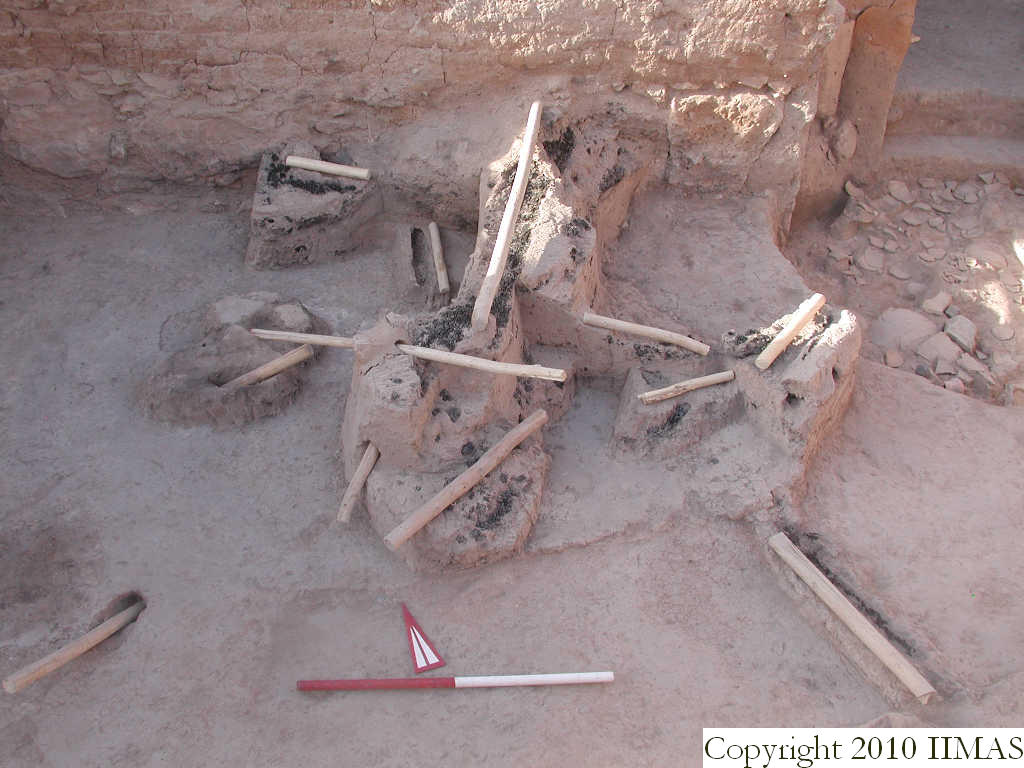
The next two images indicate how one can best visualize a situation not immediately apparent from the remains in the ground. On the left we see a set of charred wooden sticks as originally found during excavation, and on the right as evidenced by new wooden sticks placed where the original ones would have been.
|  |
Back to top: Principles of stratigraphic analysis
Vertical exposure
A vertical cut through the matrix provides a view into the matrix as it has been exposed, which serves as a visual record of the process. Such a “section” is a standard tool in archaeology.
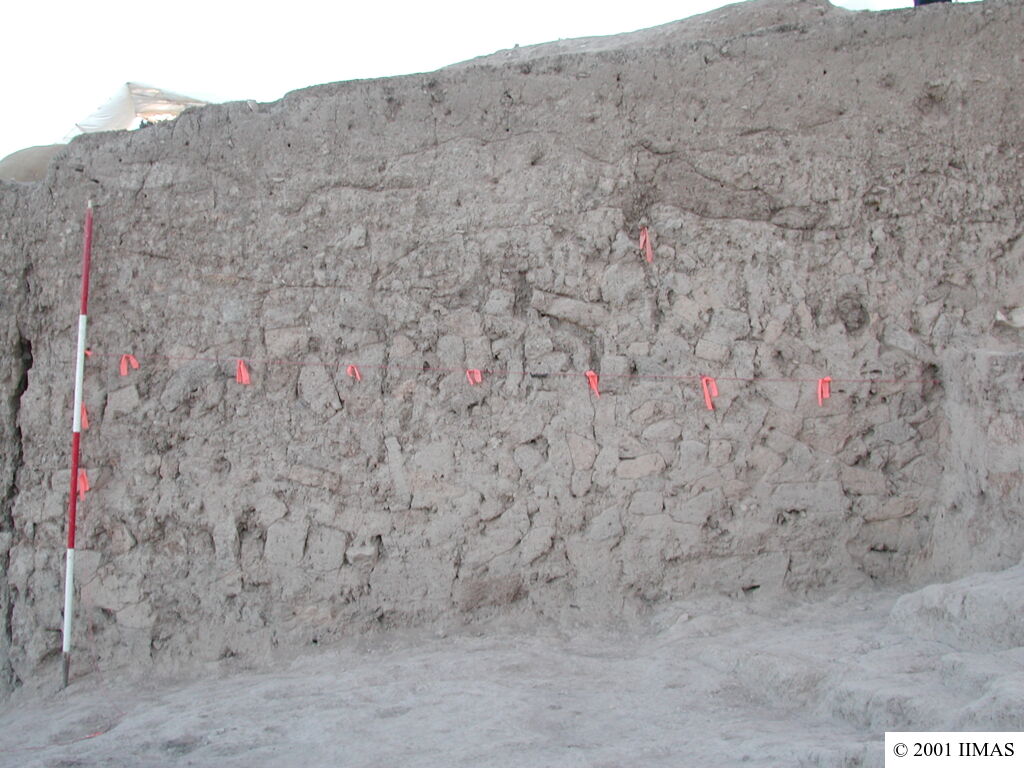
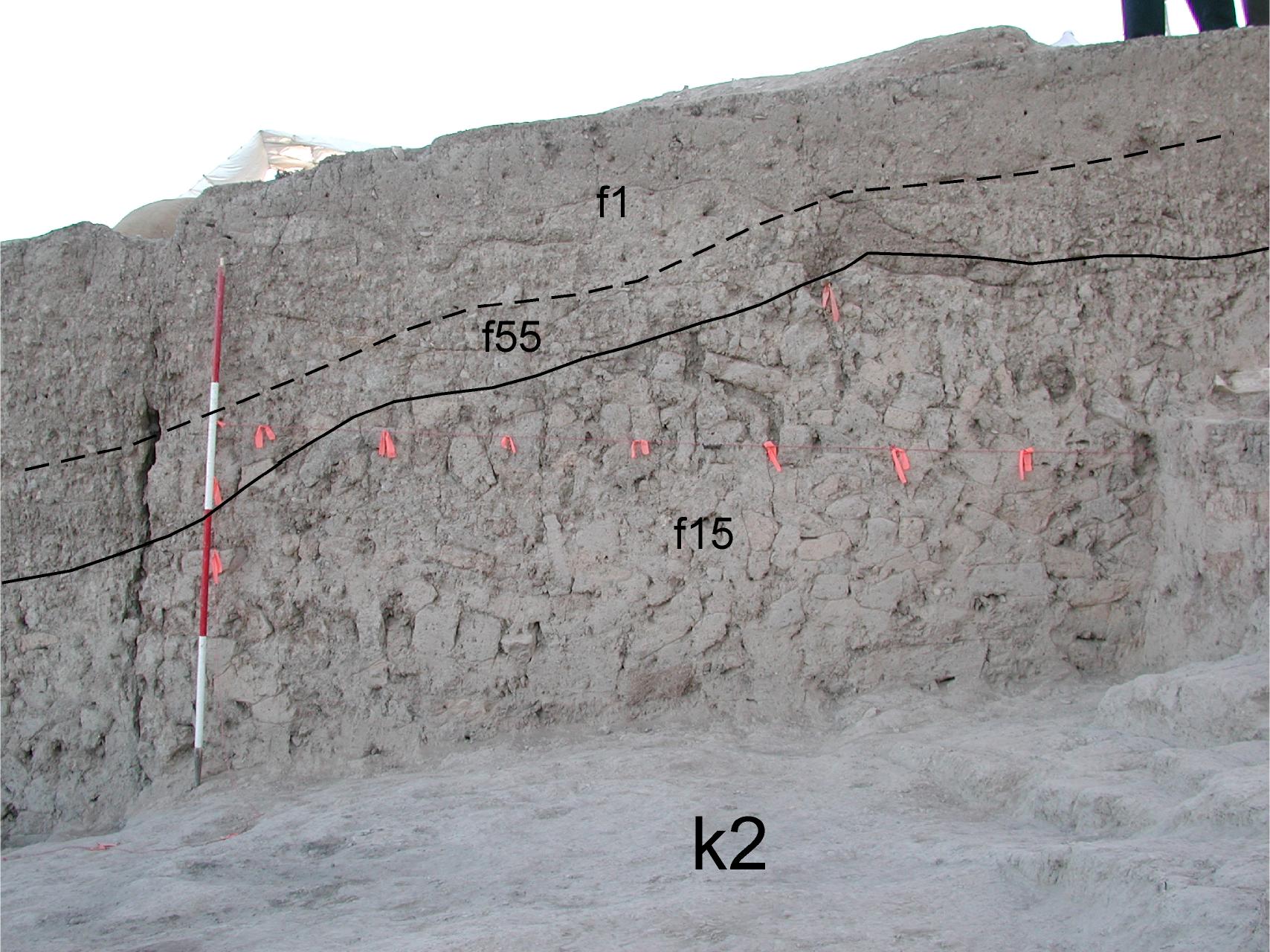
The two images below show a section consisting of three layers:
- f1 is a topsoil, that has accumulated over a period of some three millennia, since the abandonment of the site around 1200 B.C. till present day;
- f55 is the decay of the brickfall found in the lower layer f15 – it does not have a sharp boundary with f1, because it was exposed exposed for a long period of time and it merged with the additional material accumulated in successive centuries;
- f15 is a massive brickfall from a pre-existing building.
| 
|
Back to top: Principles of stratigraphic analysis
A three pronged approach
unique to archaeology in that it creates its own record
disentangling and the disentangled
How to handle the process
- Excavation. – Handling of the physical evidence – not under method, but only under process? discuss more there
- Recording. –
- Inference. –
strategy and tactics
chronology and function to semiotics
Back to top: Principles of stratigraphic analysis
Elements and contacts/The data: the mass and the fragments
Back to top: Principles of stratigraphic analysis
The matrix
The matrix is an amorphous mass, which contains a number of particles that are either floating or anchored to another elemenbt, generally a flat surface.
distinctive structural components which must be identified and processed in the course of the excavation.
Back to top: Principles of stratigraphic analysis
Elements: stationary and movable
Elements are the things that are found in the matrix. We will see in typology how these elements can be defined and described. Within the realm of stratigraphic analysis we distinguish two main categories:
- stationary elements – their typological identity is tied to a location, and
- movable elements – their typological identity is independent of place<.
This distinction is simple enough that it can be applied without hesitation in practically every instance. It is especially useful during the first moment of excavation, when other distinguishing characteristics may not be as apparent, or when specialists may not be present for identification. See under referentiality.
Back to top: Principles of stratigraphic analysis
Aggregates
In some cases, the original state is preserved, and then we can see the data in their primary functional aggregation. The most obvious case obtains when several walls are seen to constitute a room or a whole building. Another case is that of objects laying on the same floor level, or contained within a pit. These aggregates may be seen as portions of the otherwise disaggregate universe uncovered by the excavation.
Aggregates are “wholes” even if they are incomplete. In this sense, they emerge as structured from the excavations, and they are subjected to further nesting into greater wholes.
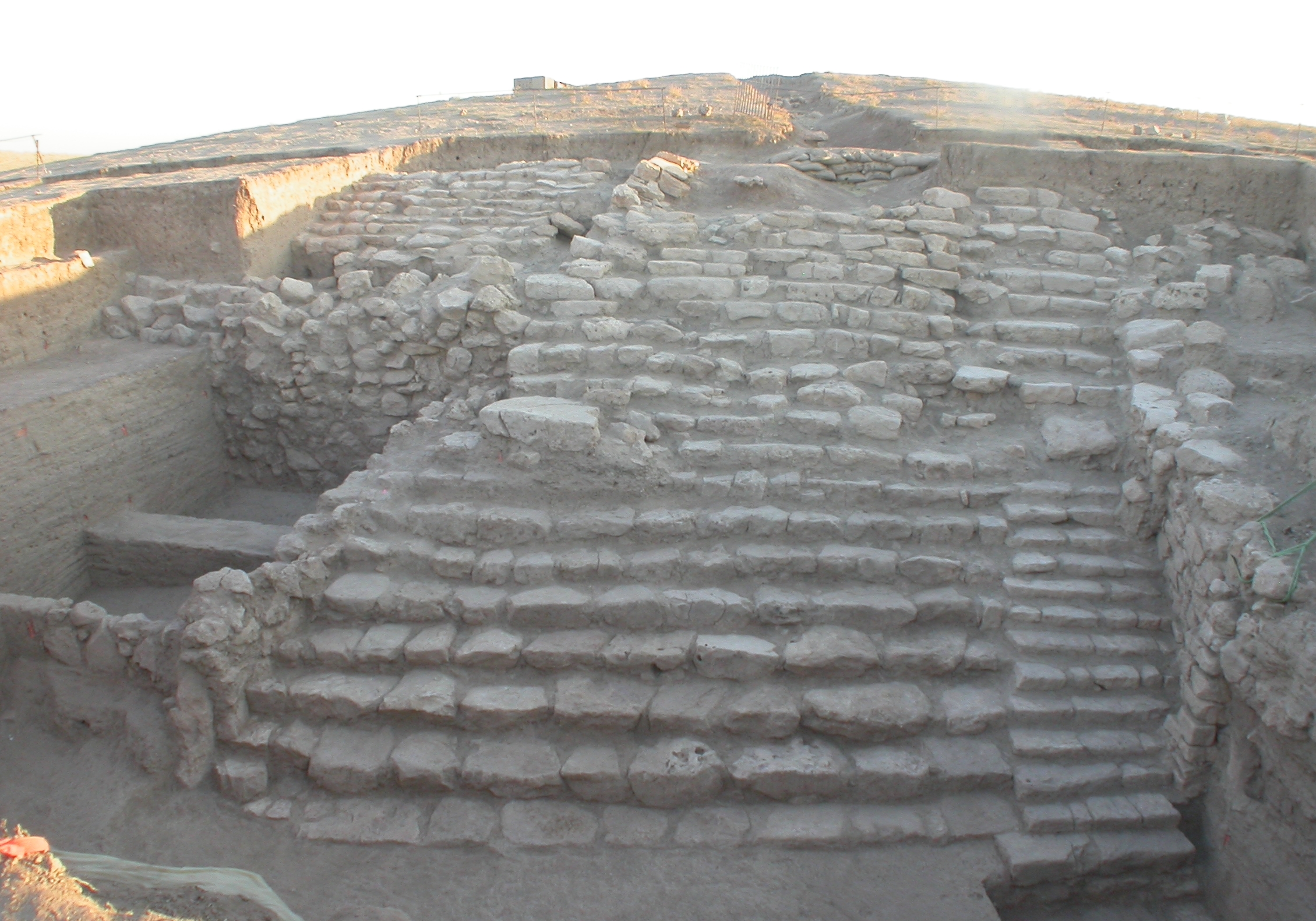
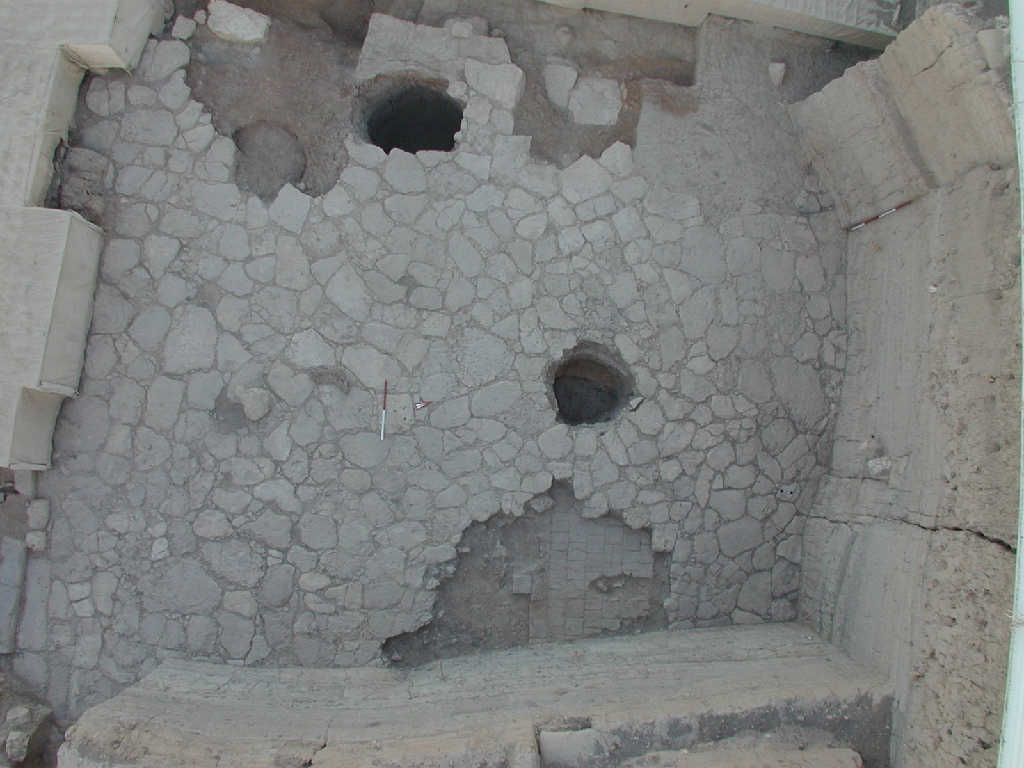
Below are the images of two large aggregates from Urkesh, the staircase leading to the great Temple BA and the courtyard of the Royal Palace of Tupkish.
|  |
Back to top: Principles of stratigraphic analysis
Movable
snake jar
andiron
sherd
tablet
sling ball
soil phytoliths for samples
Back to top: Principles of stratigraphic analysis
Combinatorial properties
Back to top: Principles of stratigraphic analysis
Contacts
The notion of contact presupposes the identification of discrete entities, the elements. The contact is not mere juxtaposition. From various factors, such as texture, alignment of components, organization of planes and volumes, etc., we may plausibly argue for different types of contact. In other words, the clustering is hierarchical, and supports the basic inferences about the depositional process that is to be assumed.
Back to top: Principles of stratigraphic analysis
Clustering
Stratigraphic clustering refers to the way in which elements in contact, in the physical space, can be linked so as to denote temporal sequences.
The physical contact is what can in fact be observed and documented. As such it is the starting point of all archaeological analysis. The individual instances of contact are defined as part of emplacement, and are measured as part of volumetry. What lies beyond is the clustering of these points of contacts into groupings that subsume all the pertinent primary observations. From this we derive, in a properly arguable fashion, the depositional process and the overall sequencing.
Back to top: Principles of stratigraphic analysis
Strata
The notion of clustering finds its prime realization in the concept of stratum. This is a cluster of elements arranged according to the type of contact, and sorted according to nesting criteria that result in discrete wholes. These wholes are defined by the congruence of the elements in contact (e.g., a series of pits cut into a single accumulation), and by broad elements that extend to an entire volumetric unit (e.g., a floor that covers the entire surface of a locus).
There are three types of contact:
- direct – physical contact between elements
- indirect – contact mediated by a a third element (e. g., two floors on either side of a wall)
- inferential – contact implied by the consonance of various factors, including typological analysis, across larger excavation areas (e. g. elements across several squares within the same unit).
For a detailed example see for now this file.
In the standard approach to archaeological publishing, the stratigraphic record remains by and large ungrammaticalized. The data are understood as a language might be for which no grammar is provided: we have a sense of what the data say, but their integration into a unified conceptual structure is incomplete and inarticulate as far as the .
Back to top: Principles of stratigraphic analysis
Casing
The elements are embedded in a loose accretion which is the result of long lasting cultural and natural processes. It may be called a casing in the sense that it envelops the elements. It is generally in the shape of loose soil which may be the result of various events – the collapse of structural elements, such as mud bricks; intentional discard of organic and inorganic material; blowing in of external elements such as sand.
Back to top: Principles of stratigraphic analysis
Space/time/Method: analysis
Back to top: Principles of stratigraphic analysis
Space/time continuum
That space can be translated into time is the basic postulate that underlies the whole process. For instance, having distinguished (through emplacement) two vertical planes as a cut vs. a face (on the basis of texture, alignment, hardness, etc.), we may argue that the face is contemporary with the element behind it, whereas the cut is subsequent to it.
Four methods are available to deal with the issues just raised:
- two deal with the physical or locational aspect: (1) the identification and documentation of the pristine fragments as found in the matrix (emplacement) and (2) the description of the nature of the contacts among these fragments, from which one can deduct the nature of the deposition;
- and two deal with the dimensional aspect which encases these data in space (volumetry) and in time (chronometry).
Back to top: Principles of stratigraphic analysis
Space: emplacement and volumetry
In point of fact, the situation is generally more complex, and, even more importantly, one must more sharply differentiate between the two constitutive aspects of stratigraphy, emplacement and deposition.
These two aspects interact with each other as, respectively, the static and the dynamic moments of one and the same situation. They describe the elements as found in terms of how they relate to each other, in two regards:
- emplacement is static because it refers to the collocation of things in the ground.
- volumetry dimensions things as they are placed in measurable volumes – in space.
Back to top: Principles of stratigraphic analysis
Time: deposition and chronometry
Another fundamental aspect pertains to the way in which we can dimension both emplacement and deposition. This refers to the nature of measurements we can overlay on the data: volumetry and chronometry.
- deposition is dynamic because it refers to the process whereby such collocation is inferred to have come into existence.
As such, it deals with time. - chronometry dimensions things as they are are seen to impact each other – in time.
Back to top: Principles of stratigraphic analysis
Summary
The following chart summarizes the relative aspects of emplacement and deposition on the one hand, and of volumetry and sequencing on the other (the numbers refer to the order in which they are treated below):
| static / space | dynamic / time | |
| descriptive | 1. emplacement: internal characteristics and reciprocal contacts of things as they are in the ground. | 3. deposition: inferences about how things have come to be placed where they are. |
| dimensioning | 2. volumetry: metric measurements of things in space. | 4. chronometry: relative intervals in time. |
A full discussion of the concept of stratigraphy as used in the Urkesh Global Record is found in Chapter 5 of the Grammar (cf. also the companion website CAR). Here, only a few key points are summarized to help understand the presentation of the data.
Back to top: Principles of stratigraphic analysis
Stratigraphic analysis
We must go through a series of steps, as follows.
- The logical procedure. – On the one hand we must record data as found, and on the other we must infer how they have gotten to be where they are in the ground.
- The exposure – The excavation may be either horizontal or vertical. In the first case we approach the data from the top, and either extract or leave in place individual elements, on the basis of ad hoc judgments that must be recorded as part of the strategy and tactics followed; in the second case we cut through the matrix “arbitrarily,” i. e., independently of the material found therein, highlighting the the way in which the elements interact with each other.
- The aspect. – The data are seen either statically as they are found in the ground, or dynamically as they can be arranged in time relatively to each other.
- The space-time continuum. – See presently.
- Four methods – See presently.
This is summarized in the following chart (the color green identifies the categories that are given in the sidebar to the left):
excavation/process/presuppositions
logical/cognition
process method logicalexcavationexposureaspectdimensioncontinuum locational dimensional stratigraphy recordexposure/recovery ~ elementshorizontalstatic space emplacement volumetry inference/assignment ~ referent verticaldynamic time deposition chronometry
Back to top: Principles of stratigraphic analysis