Back to top: Principles of typological analysis
WHOLES
Back to top: Principles of typological analysis
The concept
In the initial remarks about “wholeness” I have emphasized the basic principle that typology entails the structuring of the fragments into “wholes.” Typology looks at these wholes from the point of view of their formal and substantive characteristics (respectively through morphology and semiotics).
Back to top: Principles of typological analysis
Simple wholes
Back to top: Principles of typological analysis
Joints
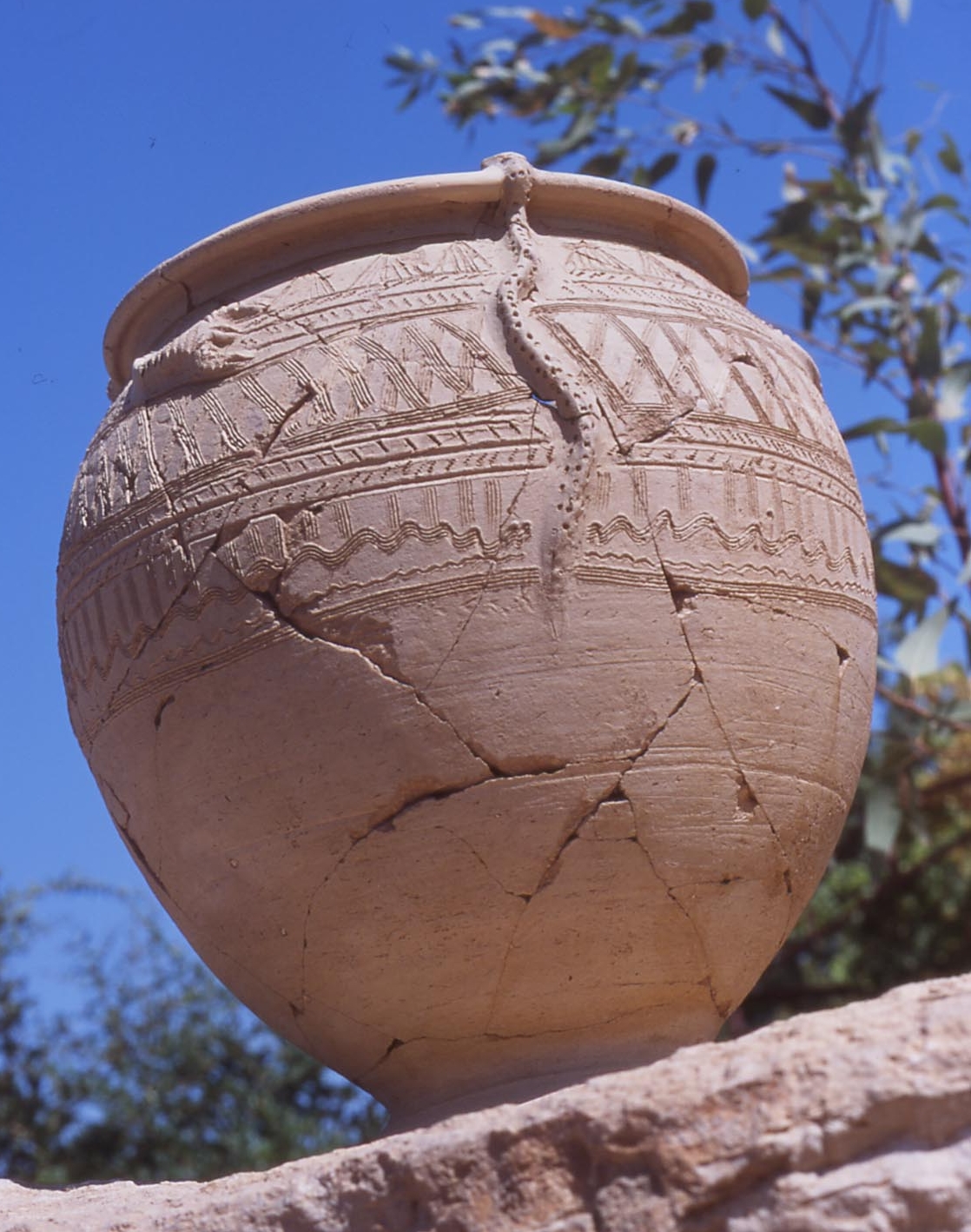
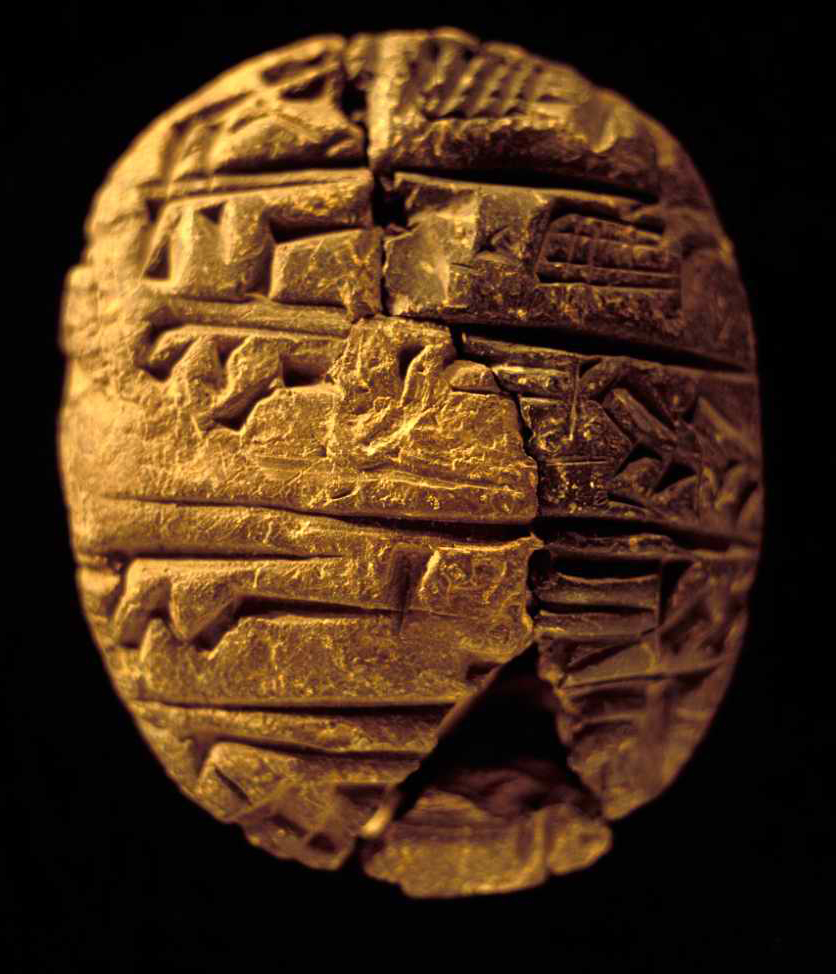
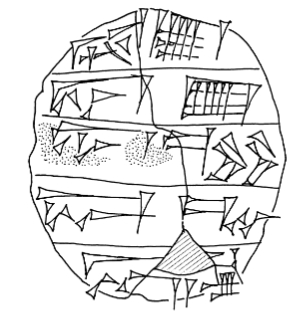
recontructing broken elements, “joints”
A13.3 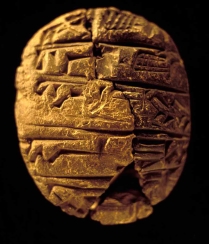
A1j1
Back to top: Principles of typological analysis
Complex wholes
The images below provide some examples.
A brick and an aggregate: burial A8a8
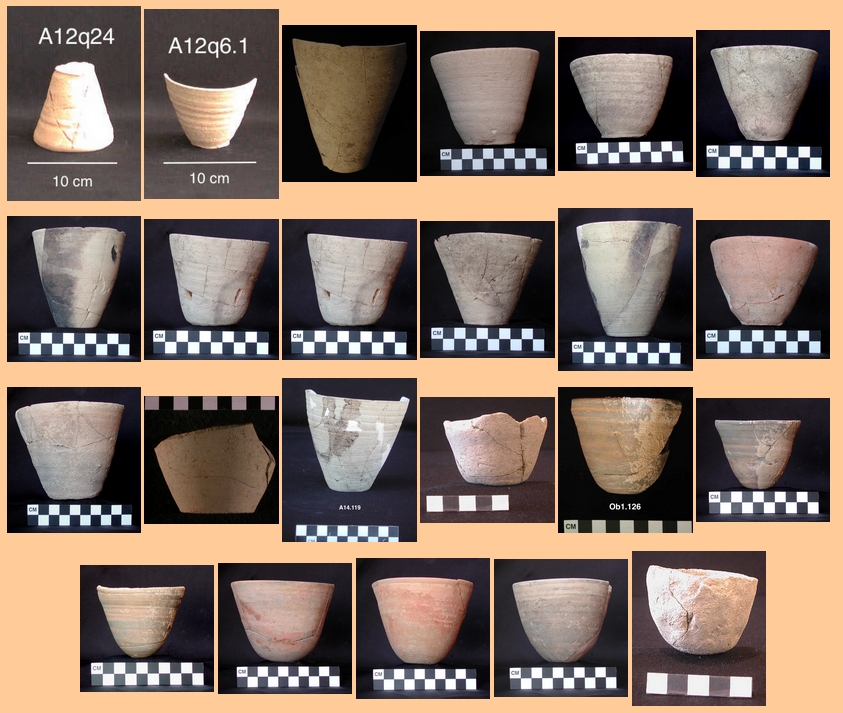
A cup and an assemblage of 23 selected cups
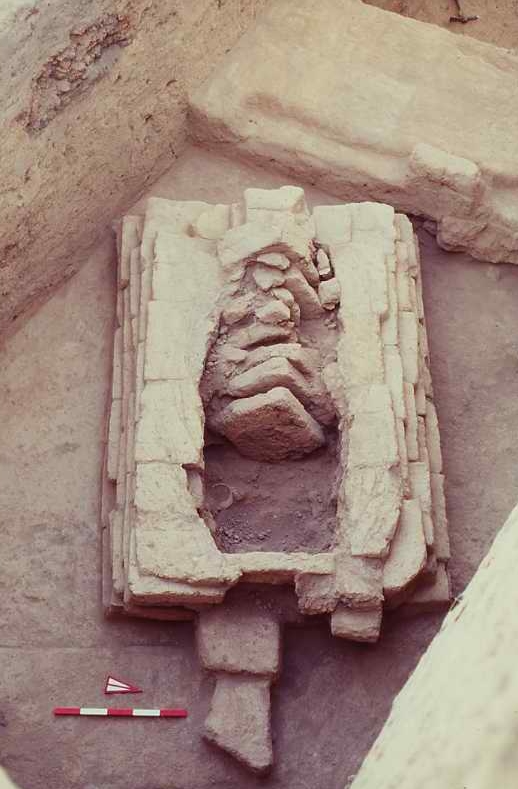
The yellow circle highlights a single element seen as a whole: a brick on the left and a conical cup on the right.
The tomb on the left is a structural whole as found in the ground: a coherent structure, partly damaged (the vertical bricks that formed the top have fallen in), but with its original content still in place: the brick structure, a skeleton, individual offerings, accumulations that derive from the collapse of the roof.
The image on the right represent a whole as restructured by us, a collection of items that share the same attributes, which we call conical cups. These particular twenty-three cups were never seen together in antiquity: they have been put together by us from a variety of different places and strata, but we can be confident that they would be recognized as a coherent “collection” by an ancient in the same way we do – because of the objective nature of the formal traits they share.
A structural whole is exemplified in the two types mentioned above, the tomb and the conical cups. The main difference between the two rests on how each relates to place, and in this regard we distinguish between the two by defining one as an aggregate and the other as an assemblage (see already in the section on constituents).
- Aggregate. – The tomb is a stationary element, meaning that its identity is tied to the place where it is found. Qua aggregate, the tomb is present to us in the same way it was to the ancients: it comes to us already “structured,” since we recognize the aggregate semiotically as a tomb. It is an original whole.
- Assemblage. – The conical cups are movable items, meaning that their identity is not tied to place. While this particular collection never existed in antiquity, it is plausible to assume that it would be recognized as a whole by an ancient the same way we do. It is a whole which we have structured, and which can be said to have a legitimate semiotic valence. In other words, an assemblage is a derived whole.
It follows that there can be an assemblage of aggregates: thus several tombs that share the same traits as the one in our example would constitute such an assemblage.
Back to top: Principles of typological analysis
TYPES
Back to top: Principles of typological analysis
The notion of “type”
- the term “whole” refers to the conceptual dimension, and
- the term “type” to the descriptive dimension.
A type may be defined as a cluster of traits or attributes which are shared by a number of elements.
Types are abstract entities if one looks at the way in which they are formalized. It is the goal of the grammar to define this formalization in terms both of the categories present and the process used in applying them.
But types refer to eminently concrete entities because they apply, in the archaeological context, to “things” that were perceived as real “wholes” by the ancients, a perception our methods aim to re-create.
The validity of a type definition depends on the precision and distinctiveness of the traits that are used to define the type.
In principle, the validity is independent from the total number of elements that can be identified as belonging to a given type. A type that includes only one exemplar is valid simply because of its morphological distinctiveness. The higher number of elements attested for any given type affects the power of the statistical analysis of the data.
Back to top: Principles of typological analysis
Nesting
There is an additional level of complexity: types may be nested in progressive ranges of inclusiveness. We will look at this using the two examples of an aggregate (the tomb A8.8) and an assemblage (the conical cups), discussed above.
The tomb A8.8 is a “whole” which may be included in two broader wholes or parallel sets of elements.
- On the one hand, it is to be seen within the wider context of the area where is was found – a sort of city of the dead, with a number of other burials in the midst of a living quarter of the city.
- On the other, it should be considered as part of an assemblage of similar burial structures, from Urkesh and elsewhere, on the basis of a wider typology that relates to the shape of the tomb, the nature of the offerings, etc.
The conical cups assemblage, in turn, may be seen as part of a wider typological assemblage, in two regards.
- Conical cups may be subdivided into finer sub-categories, depending on details of the shape.
- They must in turn be seen within the full inventory of ceramic shapes from Urkesh, which at this point amounts to 936 types.
Back to top: Principles of typological analysis
Referentiality
Central to the notion of type is the notion of referentiality: the type as an abstract category (e. g., the type “conical cup”) has a concrete referent (a physical conical cup).
The distance between the type and its referent is bridged intuitively by anyone familiar with the context. A carrier of a living tradition “lives” within the context, and thus has no difficulty in seeing the referent behind the type. In the case of a broken tradition the context is lost, and it is the aim of archaeology to re-create it. It is the task of typology.
Back to top: Principles of typological analysis
The limits of referentiality
There are significant limits to any effort at re-creating the context. Looking at the A8.8 aggregate, we can immediately recognize it as being a burial, as the ancients would have; through typological analysis we can place it in a given social and chronological context; but we would never know the personality of the individual buried inside as his contemporaries would.
We address this issue from the perspective of awareness when dealing with hermeneutics.
Back to top: Principles of typological analysis
-etic and -emic
The distinction with regard to referentiality reflects the distinction between -etic and -emic approaches. The terms, originating in linguistics, have become common place in anthropology and the social sciences.
-etic is taken from “phonetic”1: it describes vocal sounds on the basis of articulatory or acoustic criteria. An such, an -etic system applies to any language, say Hurrian as much as Greek, without reference to either Hurrian or Greek culture.
-emic is taken from “phonemic” and it is culture specific: a Hurrian phoneme is operative only in Hurrian, just as a Greek phoneme is operative only in Greek.
The concepts of absolute and relative chronology are analogous. Absolute chronology in based on factors that are extraneous to the culture of the ancients (such as radiocarbon dating or dendrochronology) while relative chronology is based on connections among the data as understood to have functioned in their original context.
Back to top: Principles of typological analysis
TYPOLOGY – METHODS
Back to top: Principles of typological analysis
Overview
Two methods may be applied in typological analysis, depending on whether referentiality applies or not..
Morphology does not have a referential context: the attributes that define a type do not refer to any aspect of the living setting within which the elements in questions were used.
Semiotics, on the other hand, is based on a referential system that applies to the social and ideational context that is assumed to be that of the ancient culture.
I will give here a brief overview of the methods, to highlight their respective approaches, and will then deal with them in detail in the following sections.
Back to top: Principles of typological analysis
Stratigraphy and typology
The stated aim of the Urkesh Global Record is to fix in published form, first and foremost, the stratigraphic context of all the data. Such immediacy is the only way, I feel, to bring us closer to the ideal of objectivity – the goal being for the original observations about emplacement and deposition to be public in their original state, without being filtered through the subsequent crystallization process when data are analyzed typologically and functionally.
It goes without saying, however, that such a typological and functional analysis is the final goal of our endeavor, and as such it must be an integral part of the record at every step of the way. Hence much effort goes into a full, if perhaps never complete, typological categorization of the data.
Back to top: Principles of typological analysis
Morphology
|
Typological morphology operates with criteria that are assumed to reflect categories not operative as such for the ancients. For example, the color of a ceramic sherd, its ware, its dimensions are defined in our grammar by categories that are extraneous to the ancient mindset – the metric scale (as in the drawing to the right), the Munsell color system, a chemical definition, etc. Our categorization system (the metric system) would not have been recognized by the ancients. Thus the drawing of the sherd to the right, which follows our documentary standards, would in effect be incomprehensible to them, and so would our analytical description. | 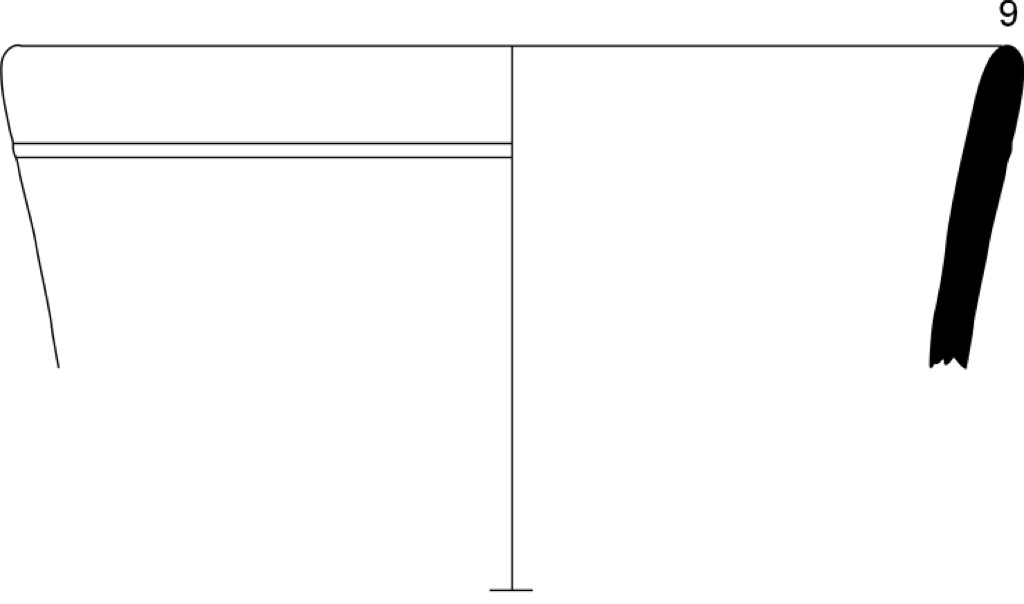 A16q704-p6 |
This does not obviously mean that the ancients had no awareness of dimensions, color, ware; only that our “grammar” is structurally different from what would have been “their” grammar. It operates on the basis of a metrical precision (for dimensions), a codification system (for colors), chemical principles (for wares), that are all extraneous to the mindset of the ancients, and do not take that mindset into account.
Back to top: Principles of typological analysis
Semiotics: relative referentiality
Semiotics sees the elements of language as signs of equivalent elements in reality. For example, a word refers to a specific object (say, a drinking cup), a sentence refers to a specific process (a request for pouring a drink in the cup).
In linguistics, there are three major branches of semiotics: semantics, syntax and pragmatics. They may be seen to apply, in a derivative sort of way, to archaeological epistemics, and we may do this by pointing to three distinct ways in which the referent may be situated.
Back to top: Principles of typological analysis
1. Semantics: observer’s referentiality
| We, as observers, can hold in one hand a ceramic object like the one shown on the right, we can pour liquid in it and drink from it. These inferences may be regarded as obvious, and are formulated as soon as the cup appears – including our term "cup" which is already referential, and thus "semiotic" in nature. The object is referentially present to us as it was to the ancients, and in this case the language equivalence applies properly (e. g., Akkadian kāsu ~ English "cup"). | 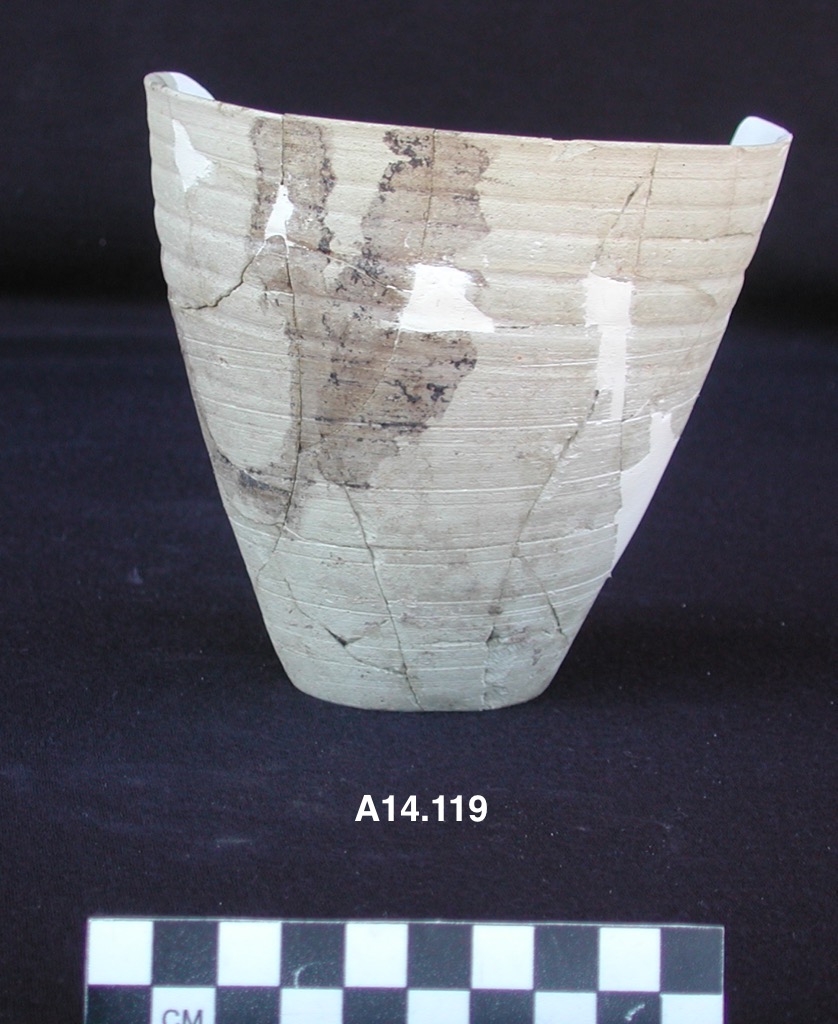 A14.119 |
Back to top: Principles of typological analysis
2. Syntax: context referentiality
| In linguistics, the term "syntax" refers to how discrete elements (typically, words) interact with each other according to well defined rules. For example, in English a subject occurs before a verb in a positive sentence ("I may do this") and after a verb in interrogative sentence ("May I do this?"). I use the term in a derivative sense to indicate how different data are integrated with others to obtain a fuller sense by looking at the assemblage as a whole. Thus the clustering of conical cups points to a connection among these different items that is assumed to have been intentional and thus to have referential value. |
 |
Back to top: Principles of typological analysis
3. Pragmatics: user’s referentiality
| What emotional response would the object evoke in the subject holding it? Two seal impressions give us a clue: a cup is held in one hand by the king in one case and by the queen in the other, in a scene that indicates conviviality but points also to a special celebratory atmosphere. This takes us closer to the perception that the ancients had of this item – being used for ceremonial occasions, when the cup acquired a special meaning, to the point of being rendered several times on the seals of queen Uqnitum. See also below under Hermeneutics. |
TGL^qu2 TGL^qu4 | 

|
Back to top: Principles of typological analysis
References
gB mKB Backdirt 2026
Back to top: Principles of typological analysis
Notes
1^ Properly, the term should be (e)-tic, since the suffix is applied to the noun phone, just as it is to galac-tic or hermeneu-tic.
Back to top: Principles of typological analysis