Back to top: Historical development of the Grammar Excerpts
Introductory
I will here bring out, with some excerpts, how the “grammatical” concern developed over the years, in ways that helped to crystallize the system as it is presented in this website. The amount of detail will document the trajectory of the research, in support of the developmental considerations given above in the section on Stages.
Bibliographical details is given below in the sections on References, under Publications and Lectures.
Back to top: Historical development of the Grammar Excerpts
1978 “Encoding”
It is in the nature of things that encoding should have taken precedence. But the concern for structural coherence, and hence for a theoretical cohesiveness, guided our efforts since a very early date – witness this statement from the preface to the 1978 Encoding Manual (ARTANES 2):
More importantly, the forms should be viewed as a structural system of interlocking parts and understood as forming an organism. To be sure, it is an organism which is alive, therefore subject to change, at the very moment that it is being applied; but change will have to respect the internal physiognomy of the system and the structural interrelationship of the parts at the very moment they are seen to evolve. (p. 5)
...it is in the nature of forms to provide a channeled avenue for observation and recording: it is as if there were a monitoring device built into the moment of primary analysis, which warns of the potential elements present in the data. This heightens, on the one hand, the power of perception; it trains, on the other hand, our sensitivity for the structured universe into which the data fit. Concretely, this means that we are less likely to forget details or short circuit operations, and that we are more apt to gain a meaningful understanding of the whole even while worrying about the parts. Obviously, forms should not become a mental straitjacket, hence the format allows for free-form observations, while in addition narrative descriptions are encouraged throughout as a supplement to the forms. (p. 5-6)
Back to top: Historical development of the Grammar Excerpts
1981 “Sections”
The chapter on sections in a manual on archaeological illustrating does not refer explicitly to grammar, but it addresses some of the basic principles which are now present in it.
Thus "stratification" refers to the concrete build-up affected by the two concurrent processes of accumulation and emplacement, and "stratigraphy" refers to the conceptualization of stratification. The recording of this conceptualization takes either an analytical or an analogical form: the former includes verbalization, digitation and diagramming, while the latter includes photography. Stratigraphic sections are a part of the analytical record. (p.53)
[...]a site should be compared to a machine as shown in its assembly chart (Figure 4-1): the parts all fit together, and to remove them one must follow ah order inverse to the assembly sequence. Of course, the assembly of a machine responds to a single purpose and is essentially a one-time event, whereas cultural deposition has an unbounded time depth and responde to many purposes when it is not wholly accidental. But, by referring to an assembly chart, the point may be more easily grasped that the most suitable graphic recording is the one which best represents the spatio-temporal relationships of volumes. Note the qualification "spatio-temporal": what matters is not only the reciprocal location (in space) of the parts, but also the combinatory process (in time) whereby they came to be where they are. (p.53) 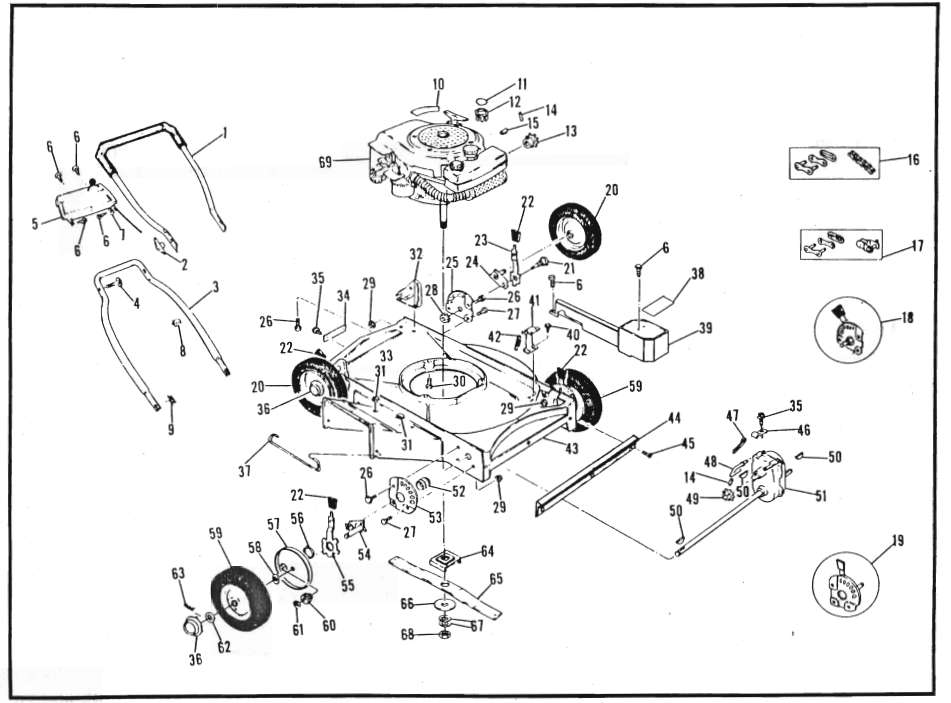
[The section] should be conceived of as serving at the same time both a documentary and an indexing function. It is documentary in that it gives a true depiction of stratigraphic relationships as seen at selected junctures; but it is also an index in that it refers to volumes which are beyond the juncture plane and thus are not registered in it. The section is a window into the larger spaces through which it is cut, not a full account of the third dimension. (p.55)
The following three-way classification may be used to define the nature of the information conveyed in a section:(p.58)
culture-free volumetric elements arbitrary physical elements natural culture-bound cultural elements
Back to top: Historical development of the Grammar Excerpts
1983 “Digital Plotting”
This is a technical paper presenting an early approach to graphic representation of data (see notice in Cyb-Mes.net). It does not deal specifically with the notion of grammar, but it addresses the presuppositions that undergird the whole grammatical approach:
The emphasis on proper stratigraphic controls is in line with a general understanding, characteristic of the Terqa project, of "archaeology as archaeology," i. e. as a discipline with a set of normative procedures and methodologies all its own. Stratigraphic analysis is the hallmark of this intellectual autonomy of archaeology: it is the only task for which the archaeologist borrows from no other disciplines, at least not in a direct way. There seems to be a general consensus that stratigraphic methods and techniques currently in use are adequate: this is reflected in the almost total lack of current literature on the subject, from either a theoretical or a practical perspective. In point of fact, however, the degree of objectivity in stratigraphic analysis is very limited: ironically, the vast intellectual structures which are being built along interpretive lines take for granted a set of data which is itself much less tested and "scientific" than the interpretations it gives rise to. The standard for acceptable stratigraphic material is derived ultimately from the logic of the argument presented and from the reputation of the excavators rather than from independently testable and well documented classes of evidence. The effort of the Terqa project in this direction is intended to serve the needs of an improved approach to stratigraphic analysis, and the elements of digital plotting presented in this article are an important contribution in this direction. (p.7)
Back to top: Historical development of the Grammar Excerpts
1986 “Computer projects”
A brief notice of the Cotsen Institute of Archaeology introduces the notion of a “global record”:
the formal grammar of stratigraphic and typological traits which we have developed provide a powerful conceptual tool for the establishment of a coherent and fully documented record. We plan to make this record available as a new genre of archaeological publication, the "global record" of the excavation.
Back to top: Historical development of the Grammar Excerpts
1988 “Introduction: Mozan 1”
Theoretically,the systematization of the recording process, especially in its stratigraphic aspect, should help develop patterns of regularity after the model of a grammar: such regularity should enhance the possibility of both a structural understanding of the stratigraphic record in itself and a fuller realization of its distributional complexities, within and across site boundaries. Organizationally, the use of electronic data-processing makes it possible, on the one hand, to compact vast amounts of data in a format that is easily distributed and updated at almost zero cost; but what is more significant, this medium allows us to optimize the relationship between a capillary documentation of the data on the one hand, and the most highly generalized synthetic overview on the other. (p.39)
The obvious conceptual kinship with problems posed within the framework of the discipline of architecture led me to seek both intellectual and technical advice from colleagues in this field at UCLA. My specific point of departure was the observation that as archaeologists we face identical sets of problems as those faced by architects, though in a converse sort of relationship. While architects arrive at an organization of space from a known, intended functional use (the client’s requirements), we arrive conversely at a reconstruction of functional use from a known spatial organization (the excavated site). With this in mind, I was fortunate to find William J. Mitchell, Professor of Architecture and Urban Planning at the UCLA Graduate School of Architecture (now at the Harvard School of Design), the most congenial and productive collaborator with a keen sensitivity for archaeological problems. He had been developing an innovative approach to both the technical side of computer graphics and the conceptual dimension of a “grammar of space” (Stiny and Gips 1972; Stiny and Mitchell 1978; 1980). The creation of specific three-dimensional modules which could be conjoined graphically according to a complex set of syntactical rules gave him an insight into the inner dynamics of a building (whether in existence or in the planning stage) that was hardly possible with traditional means(p.100f)
there is a tendency to view space in terms of the flat surfaces to which we have (heretofore) reduced it as a result of the limitations inherent in our technical capabilities. Space must be viewed instead volumetrically, and the organization of space (as well as the depositional entities in a stratified site) must be understood as solids- not as planes. Therefore such planes as we are used to (floor plans and sections) must be viewed purely as correlated indices of volumes (a concept which I have developed in Buccellati 1981). (p.101)
Back to top: Historical development of the Grammar Excerpts
1992 Axioms
Back to top: Historical development of the Grammar Excerpts
2000 Como
The first public lecture (in Italian) about the notion of a Grammar was at the City Museum in Como, entitled: Prolegomena to a structural grammar of archaeological data. The concept of “laws” was prominent in what was then termed the “New Archaeology,” and to balance that I was suggesting that:
The true archaeological universals are the laws of deposition. A grammar of stratigraphy articulates these laws, and sets standards for emplacement: the notion of “Grammar” is based on systemic inclusiveness and power of explanation, and precise definitions are based on structural opposition between elements.
Back to top: Historical development of the Grammar Excerpts
2005 “Spatial”
In an article dealing with “The Tell Mozan/Urkesh Archaeological Project: an Integrated Approach of Spatial Technologies,” Federico Buccellati dealt with the integration of data into a broader (grammatical) system:
Our system relies on notes written in a structured format which is then run through a program that merges all the files and sorts them by referent, giving a global file for each stratigraphic unit or object as output. In this way, notes taken by different members of the field team, the photographer, curator and conservator are all merged into a single file that contains all the documentation relating to a certain item or stratigraphic unit.
Back to top: Historical development of the Grammar Excerpts
2006 “Browser edition”
This article presents for the first time in some detail the UGR publishing concept, and as a backdrop it refers to the notion of grammar as the fundamental organizational system for the whole process:
It is proper to speak of such a process whereby the technique impacts on method, as a "grammar." The main virtue of the term, and especially of the concept that it evokes, is that it excludes ad hoc solutions. A grammar has to be fully comprehensive of the entire universe of data; it has to establish distributional classes that are truly mutually exclusive; it has to articulate a hierarchy of conceptual nodes into which the categories properly fit; it has to identify explicitly the attributes that define each category. And in all this, a grammar must combine, through a constant give and take, the power of deduction derived from generalized systems of principles with the skill of induction based on the observation of the actual data. (p. 49-50)
The criterion by which one can judge of the quality of a grammar is the power it affords us to reach the most capillary extensions through the most rapid access. An unstructured data mass stored digitally would not yield any insight – no more than the sum total of all possible sentences in a language could properly be considered a grammar (though it would yield an accurate, if unwieldy, "description" of the language in question). Rather, a grammar provides us with the most efficient road map to wade through the data. It is a structured coded system in which the basic constituents are tied to each other by univocal relationships; it is a closed system, wherein each element elicits of its own accord a fixed set of correlations to other elements, and to no others. This is familiar to us from the concept of a linguistic paradigm. If in Latin we hear the words amor, amoris, we know what the distinctive sequence is going to be, and the functional valence of each element, even if we ignore the meaning of the word. But a paradigm occurs in a variety of situations, and in each the valence of individual elements is predicated on their correlation to the other elements: thus the red of a stop light in juxtaposition to green and yellow/orange means "stop", but red in a flag held high may mean "go." The power of grammar lies precisely in the fact that it allows systemic predictions, and thereby makes instant access possible to the full hierarchy of nodes. (p. 52-53)
Back to top: Historical development of the Grammar Excerpts
2006 Tokyo
The next well developed presentation was given at the Ancient Orient Museum in Tokyo. Taking as a starting point the then current interest in theory, the point was made that what is normally envisaged are
theories of inference: they deal with what can be extracted from the data. But there has been practically no theory at all about the procurement of the data. In other words, no theory of excavation. This is what I have been developing, and I call it a Grammar of the Archaeological Record. This Grammar rests on a fully articulated set of principles, in particular a sharp differentiation between emplacement and deposition and a rigorous definition of categories and of processes. (Abstract)
In the same year, I introduced the notion of a “Browser edition,” which is made possible by the application of a properly grammatical approach:
The main virtue of the term [Grammar], and especially of the concept that it evokes, is that it excludes ad hoc solutions. A grammar
- has to be fully comprehensive of the entire universe of data;
- it has to establish distributional classes that are truly mutually exclusive;
- it has to articulate a hierarchy of conceptual nodes into which the categories properly fit;
- it has to identify explicitly the attributes that define each category.
- And in all this, a grammar must combine, through a constant give and take, the power of deduction derived from generalized systems of principles with the skill of induction based on the observation of the actual data. (p. 315 f.)
Back to top: Historical development of the Grammar Excerpts
2007 “Non-linear”
A short communication focusing on the concept of “non-linear” re-defined as “polyhedral”:
non-linear” thought, in order to be properly “thought” and not just hit or miss surfing or browsing, must be associated with an underlying knowledge of the structural whole within which the non-linear “jump” occurs. (p.37)
[A number of pre-digital example] presuppose the coherence of a whole within which the argument flows from one point to the next, or jumps across them in virtue precisely of the structural cohesion of the whole. (p.38)
...through a well-developed “grammar” of attributes (typological and stratigraphic), very large quantities of sherds can be brought rapidly within a coherent conceptual construct that matches the material data excavated, and each quantity can be traced back to every single component that goes into making up the total. (p.38)
If a comprehensive “grammar” is in place, one that spells out the properties of the stratigraphic and typological whole (the polyhedron), then automatic tagging can be implemented that will generate unsuspected quantities of hyperlinks (p. 28)
Back to top: Historical development of the Grammar Excerpts
2007 Austin
A 2007 full-fledged symposium in Austin covered the many facets of the Urkesh project. My paper on the theoretical principles dealt especially with the grammatical aspect:
They constitute a closed “grammatical” system whereby each element is endowed, implicitly, with multiple tags. The application of programs makes explicit the full web of paradigmatic connections that these tags imply, and it automatically creates a fully hyperlinked browser edition. Each time a program is run, it updates the very same presentation that constitutes the core of the final publication. (Abstract)
Back to top: Historical development of the Grammar Excerpts
2008 “Browser”
In a joint article with M. Kelly-Buccellati, we expanded on the notion of a Browser Edition and brought out the way in which disparate elements are combined through the use of a paradigmatic approach:
a closed "grammatical" system whereby each element is endowed, implicitly, with multiple tags. The application of programs makes explicit the full web of paradigmatic connections that these tags imply, and it automatically creates the final presentation, which is fully hyperlinked. [...] In so doing, we seek to achieve the two complementary goals of a rigorous preservation of every single atomistic observation on the one hand, and, on the other, to construct a meaningful and intuitive framework within which all the observations cohere. (p. 1)
Back to top: Historical development of the Grammar Excerpts
2009-10 “Website”
A preliminary version of the website gave the basic outline as it is still used in the current Version 2. The notion of grammar was explicitly articulated in an introductory page, which is largely retained in the current version. I will report here a few salient points:
The issues raised in the Introduction of the Grammar call for a new approach to archaeological publishing – not an approach that is based on different editorial techniques, but rather one that starts from a different understanding of archaeological categories. [...] A primary goal of the system, and of the browser edition that derives from it, remains the primacy of the stratigraphic record as such, which is deemed to be completed at the end of the excavation. Thus, in the measure in which our own ability to work within the system as here described increases, we intend to publish the full stratigraphic record of any given operation at end of each excavation season, allowing for typological updates to the extent in which our own typological analysis proceeds.
... a grammar aims to be powerful more than it aims to be correct: the sum total of the sentences that can be spoken in a language is a grammar of sorts, and a correct one at that, but quite obviously far from powerful. In my view, the stratigraphic record remains, in the standard approach, by and large ungrammaticalized. The data are understood as a language might be for which no grammar is provided; but their integration into a unified conceptual structure is incomplete and inarticulate.
My main goal is to suggest ways to produce such a grammar, [...] I would like to claim some power for this approach, but I will not claim that it is the correct grammar. I hope that it might generate sufficient interest in the subject matter, and that the supporting exemplification will prove to be sufficiently valid, so as to elicit a new awareness for the underlying problems, a realistic sense of reliance on the electronic medium used for its genuine powers, and a discussion of the substantive issues involved in this effort to “grammaticalize” the stratigraphic recordd.
Back to top: Historical development of the Grammar Excerpts
2012 Moscow
A lecture given in Moscow and then reprised as an article deals with the notion of grammaticality in a strict sense, as it is used in the linguistic realm:
The method I propose is a grammatical one, in the sense of a closed syntactical and syntagmatic categorization system that allows statements of predictability and of non-occurrence. (P. 37)
It is in this sense that I conceive of an “archaeological central theory,” in terms of itself (rather than of “anthropology” or whatever else), defining its constitutive elements and showing how they are structurally integrated into a closed “grammatical” system. I take “grammaticality” to refer to the paradigmatic predictability of correlations. It is not used in a vague analogical sense. It refers instead to the definition of rigorous paradigmatic and syntagmatic coherence of the defining categories, that are nested within each other according to well articulated hierarchical modes. (p.41)
Back to top: Historical development of the Grammar Excerpts
2014-15 UCSC
An important moment in the development of the Grammar was a seminar held at the Università Cattolica del Sacro Cuore in Milan in 2014-15, for which see the project report in the Critique of the Archaeological Record website. Given under the auspices of the Department of Philosophy, it concentrated on the hermeneutic aspects, and in so doing it highlighted the potential cognitive impact of the system.
Back to top: Historical development of the Grammar Excerpts
2015 “Crossovers”
The comparison with linguistic grammatical theory was taken up in an article dealing with compositional patterns in the figurative arts. It does not speak about grammar as such, but it deals with an aspect of linguistics, i. e., discourse analysis, that is related to a grammatical mode of thought:
Composition is what holds the tensional elements together. On the one hand, the compositional process fuses the elements we have seen so far into a single structural whole. On the other, compositional analysis identifies the criteria that are originally introduced to obtain such a fusion. The term used in the case of word based texts (whether spoken or written) is discourse analysis or rhesiology. (P. 295)
What is common to both the visual and the textual record is the presupposition of, and search for, an underlying coherence of the whole. Its main overall trait is structural inclusivity: each of the components depends on the other (hence the dimension of tensionality) and it excludes elements that do not share in this reciprocal dependence. (P. 296)
Back to top: Historical development of the Grammar Excerpts
2017
The year 2017 was a major turning point in the theoretical definition of what a grammar should be, in three ways: a book, a website,and two articles. The material is too extensive to be given here full coverage: I will point out the aspects that are particularly meaningful in terms of the conceptual development of the grammatical method.
Back to top: Historical development of the Grammar Excerpts
(1) The Critique book
See separate page.
Back to top: Historical development of the Grammar Excerpts
(2) The Critique website
The Critique website does not have any special treatment of Grammar, but there are some intersting mentions in the bibliography, for example:
Carlo Sini, Il sapere dei segni, 2012
A philosophical essay that takes seriously the evidence from prehistoric representational figures, accepting their interpretation by Anati and Gimbutas as full-fledged writing systems (with which interpretation I disagree). But what is of interest for our argument is Sini’s understanding of grammar as a “science of elementary classes and foundation of all the (western) ‘atomizing’ science; a unity of analysis and synthesis going from the elements to the whole” (p. 38, my translation).
H. Wöllflin, Kunstgeschichtliche Grundbegriffe, 1915
From the specific point of view of the Critique, it may be said W. addresses directly the question of grammar, with the intent to distinguish clearly this level of analysis from that of hermeneutics ... We may add that the next stage is that of iconology, as taken up subsequently by Panofsky.
There is also a special theme devoted to food:
S. Ermidoro, The grammar of food, 2014
The Grammar of food
The analysis of eating may be considered similar to a grammatical analysis. A meal is, thus, as complex as a sentence or paragraph: its smaller individual elements, its “words”, are the essential ingredients which have on their own a peculiar provenance and that carry one or more tastes. Just like words, these basic elements can be taken singularly, and yet they are enhanced and give much more sense, when they are mixed in a potentially unlimited number of ways, acquiring a whole new meaning every time.
Back to top: Historical development of the Grammar Excerpts
(3) “Iconology”
An article on iconology sees grammar as the first of four frames of reference, a grammatical level that is devoted to
an inner- or non-referential formal analysis. It is a form of grammar where the elements are devoid of explicit associations to the larger world we share. (P. 49)
Back to top: Historical development of the Grammar Excerpts
(4) “Perceptual”
§Perceptual”} An article on the Perceptual, Grammatical and Hermeneutical Dimensions of Digitality develops a sustained argument about grammar as constitutive and descriptive:
There are, we may say, two parallel notions of grammar. The first is constitutive: it is the actual coherence of the data. The second is reflective or descriptive: it identifies and conceptually defines such structural coherence. A conical cup tends of its own accord, at the time of its making, to be clustered with other conical cups: this is the constitutive grammar. Conversely, we conceptualize the attributes that are inherent in the data and, thus, establish the corresponding descriptive grammar. (P. 163 f.)
It is in the nature of all structures to have components that are so tensionally linked with each other – hence, the constitutive dimension of grammar –, whereas the descriptive dimension reflects the conceptualization we give of it. A digital grammar raises the ability to identify the most minute filaments in this tensional network of relationships, and to fully control their dynamics.
unlimited extent to which such capillary nesting can be implemented. This is a central dimension of grammar. Capillarity means that the tensional bracing can be seen in the form of an inverted tree, where progressively lower nodes subsume clusters of attributes that come closest to the original organization of the data. Nesting refers to the way in which some nodes are subsumed under higher ones. The power of the digital approach is that through such a capillary system one can instantly reach the lowermost nodes and the single elements that are included therein, regardless of how complex the system is.
Back to top: Historical development of the Grammar Excerpts
2020
Back to top: Historical development of the Grammar Excerpts
“Narratives”
An article dealing with Digital narratives addresses the issue of grammar indirectly, but importantly, as it addresses the issue of categorization in relationship to the development of an argument:
This analytical categorization of each item (vessel or sherd) is tightly integrated within a narrative system which it is the purpose of this article to illustrate. In other words, the great amount of detail associated with every single element in the corpus is instantly accessible in its entirety at any given moment as one may want to buttress a broader line of argument developed by the narrative. (p. 380)
Taken together, there are literally millions of bits that are observed over the course of an excavation, originating in a variety of settings (emplacement, deposition, typology, etc.) and couched in a variety of different standards (verbal, metric, graphic, etc.). How do they cohere in the referential archaeological record, i.e., the logical construct that is derived from the excavated material – this is what is at stake. Can there be a blending – not ad hoc, but reciprocal and integrated – of argument and database within a single narrative? (p.381)
A systemic concurrency obtains when it is so conceived by the author and so presupposed by the reader. The parallel tracks are designed to be concurrent, so that a segment of a concurrent track (B, C, ...) is required for the argument in the main track to retain its full force. Conversely, each track can become a primary track (A), with the other being concurrent with it. It is in this sense that multi-linearity is systemic. (p. 383)
Back to top: Historical development of the Grammar Excerpts
“Degrees”
Back to top: Historical development of the Grammar Excerpts
2022 “Transformative”
An article dealing with the broader transformative impact of digitality, based on a lecture given at the Politecnico of Milan, develops the notion of grammar as applied to a vast universe of disaggregated fragments seen as digitally native in their grammatical potential of multiple correlations:
We may say that archaeology understood as the record of emplacement is natively digital: there are myriads of bits of information that are found in a state of casual aggregation resulting from the long term process of deposition in the ground. They have to be recorded in this state of aggregation and then recomposed in multiple frameworks of meaning (e. g., chronology, typology, function, etc.). What ensued was the creation of a proper grammar that established not only the morphological categories where each bit would logically fit, but also the syntactical relationships that defined the constraints within which these same bits could relate to each other.
Back to top: Historical development of the Grammar Excerpts
2024
Three articles brought out different aspects of the grammatical approach. the first two deriving from two lectures give at a seminar organized by the philosophy department of the Università Cattolica del Sacro Cuore in Milan.
Back to top: Historical development of the Grammar Excerpts
Frammenti/tutto
Back to top: Historical development of the Grammar Excerpts
Interplanare
gB mKB sistema
Back to top: Historical development of the Grammar Excerpts
Clustering
gB mKB Clustering
Back to top: Historical development of the Grammar Excerpts
2026
Back to top: Historical development of the Grammar Excerpts
Publishing
BAckdirt
Back to top: Historical development of the Grammar Excerpts
Density
Back to top: Historical development of the Grammar Excerpts
Programming
An essential aspect of a digital project relates to the way in which data are processed, from the level of software packages to custom programs that interact in a univocal way with the coded data.
refer to CM
refer to future website by bF
Back to top: Historical development of the Grammar Excerpts