Back to top: Perception
The concept
I take perception to refer to the way in which segments of the outside world are registered and reconfigured by our individual senses and psyche, a configuration that can be shared and then develops gaining a consistency of its own, lasting indefinitely through time. For example, when facing a person we acquire specific information (such as name or profession) but we also register a much larger set of data, some easily defined (such the color of the skin) other less so (such as the gait or the gestures). In addition, the setting in which we meet the person also becomes associated with the relative perception, the reasons for the meeting and its outcome, the general feeling elicited in our response to the encounter. This bundle of responses can obviously be quite complex, each element interacting with the other in ways that are hardly susceptible of full analysis (hence the use, in the definition given above, of the term “psyche” instead of a term like “mind” that refers to analytical intellectual procedures).
Recent trends have given much attention to perception, especially within the framework of cognitive archaeology. In this case one relies on a high level of referentiality, where inference plays a major role. We will limit our considerations to the lower levels, related to the organization of space as it appears in the excavations.
Back to top: Perception
Referentiality and perception
Referentiality is closely linked to what perception individuals have of the referent itself. We may safely assume that in Urkesh people intuitively perceived the referntial value of a conical cup (i. e., that it was used in celebratory occasions) and this would have given a special status to the object. To use an example from our own culture, a champagne flute carries for us, intuitively, a certain prestige connotation, and would be unlikely to use it for coffee or juice.
The notion of perceptual range refers to the limits that may apply to referentiality. These limits are obvious vis-à-vis a broken tradition: we do not share the native perception, and can only re-create it, if partially, through an inferential process. But these limits may apply also within a living tradition. We will look here at both.
Back to top: Perception
Perceptual analyis
While referential analysis deals with “things” as referents, i. e., as the objects of perception, perceptual analysis deals with the act of perceiving these referents.
In this regard, the four referential levels may be subsumed under two perceptual levels, depending on whether the referent is viewed exclusively through modern eyes, or whether it is assumed tnat modern categories reflect ancient categories as well.
Thus, one and the same referent may be perceived with progressively finer degrees of specificity as:
|
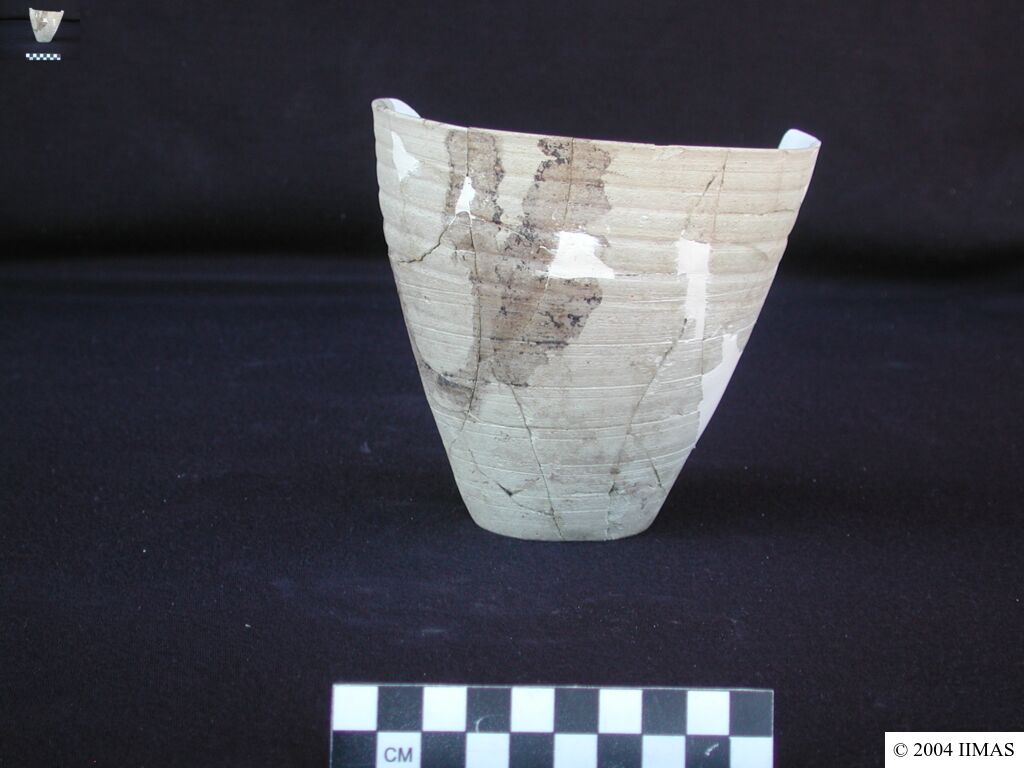 A14.119 |
The first two levels refer to an exclusively modern perception, while the other two refer to a modern perception of what we assume to have been the ancient perception as well. This may be summarized graphically as follows, building on the chart given for referentiality:
recovery reference perception 1 stratigraphy fixed place modern typology 2 morphology extra-cultural standards 3 semiotics function and use modern and
ancient4 hermeneutics meaning
Back to top: Perception
Semiotics and hermeneutics
Back to top: Perception
Organization of space
Perceptual topography
Within the framework of our grammar, and on the limited basis of what I have called contextual archaeology, we will focus on the spatial arrangement of features and items that can, under certain conditions, be understood as having been the stimulus for specific perceptions by the ancient observers. These perceptions can be argued and assessed, with procedures that are outlined below.
This is especially so in view of the quality of permanence that shared perceptions develop, so that they become as if reified over space and time. I consider these procedures to be in line with, and in some ways alternative to, the goals of cognitive archaeology.
There are recognizable ways in which space is organized, on at least three levels:
- collocational analysis: architectural spaces are seen in terms of the impact that coordinated volumes have on perception;
- taxonomical analysis: the aggregation of objects in distinct formal classes is perceived in its typological coherence;
- environmental analysis: the built environment is seen in its wider natural setting.
Perceptual analysis simply pays attention to patterns of correlation in these various areas, which may be interpreted as reflecting choices made by the ancients, and I will give in what follows a few examples for each of these three areas. The fundamental theoretical presupposition is that the analysis be based on clearly definable formal patterns: pointing these out will always retain a primary value, even if further interpretations built on the initial recognition may be questionable. In other words, we may safely attribute intentionality to the formal patterns, even if we may be less certain as to the intended perceptual goal underlying the initial intention.
It may be noted that this approach is especially useful when there is coherence of the built environment over a large urban scene. This is often lacking in the archaeological context, but to the extent that it is available, we must develop the appropriate sensitivity for recognizing its presence. Baroque architecture is one of the best example of architecture conceived as on a stage, whereby this very aspect of “staging” calls for an audience properly located, i.e., so placed as to allow the best possible view of the architecture.
Back to top: Perception
Objects in space
The placement of objects in space is less likely to be preserved as it was originally intended. Short of clear cases of a destruction not followed by attempts at retrieval, it is mostly the moments of abandonment and discard that cause the arrangement we find in the ground today. Additionally, we do not find perishable items such as rugs, tapestries and wooden items that would have substantially modified the appearance of interior spaces.
Still, it is worth paying attention to cases where the arrangement of non-perishable elements suggests an intentional organization of items, one that has implications for the perceptual response this would have evoked. Take for examaple the location of bread ovens (tannurs) and andirons, which would have served as focal points in directing the attention of people in the room. Or the rows of stones parallel to the revetment wall of the Temple Terrace (= BT), which I have called “curtain walls” (though only two or three rows high), on the assumption that they served to establish a symbolically inaccessible buffer in front of the wall itself, thus setting off the wall as the unsurmountable barrier this side of the divine world.
Even patterns of discard may be meaningful. In the service wing of the royal Palace of Urkesh, the floor in room B1 was strewn with discarded pieces of sealings that had been broken when opening containers such as jars. These fragments are embedded in the soft accumulation that piled up gradually on the thinly plastered earthen floor. It appears additionally that the matrix of these accumulations varies in color between a buff pink and a dark grey, an alternation that correlates to the presence or absence of door sills. My interpretation is that as the accumulations rose, new doors were set in place with new door sills: following each such new installation, the room was more tightly sealed, and little or no ash could come into the room from the adjacent courtyard (hence the pink strata, resulting from the deposition of “clean” dust); as the door became less effective, more ash would instead filter into the closed space and be deposited on the ground. We may accordingly reconstruct a perception of the room as being heavily used, with such constant activity that no amount of cleaning could eliminate all discards, which would instead become firmly embedded in the ground through a process of heavy compaction.
Back to top: Perception
Perceptual geography
Perceptual geography has been defined as the way in which factual geographical features are recomposed in the vision of the onlooker, through perceptual registers that are not only proper to a given individual, but are also explicitly transmitted within a given social group. The built environment is always a part of its wider geographical setting, and we must be mindful of this dimension as well within the purview of perceptual analysis.
In Mozan, the landscape still reflects the situation that obtained at the time of Urkesh. Other sites in the area are not so fortunate. As a result we can include today’s geographical scene in our attempt to identify appropriate points of view of the built environment which we are slowly bringing to light.
The most apparent dimension is that of the northern highlands, which form a splendid backdrop to the city as one approaches it from the south. This applies in particular to the monumental Temple Terrace, which is indeed approached from the south through the wide open space of the Plaza (= JP). I have suggested that the triangular pattern along the face of the revetment wall of the Temple Terrace may represent an explicit ideological reference to the mountains. This would represent an intentional expression of a precise perceptual dimension. In any case, the Temple Terrace, this major monumental embodiment of religious ideology, emerges as an even more unified whole when framed against the high ridge which dominates, at not a great distance, its northern horizon.
Back to top: Perception
The grammatical dimension
Back to top: Perception
The role of virtual reality
An important contribution of virtual reality is that it allows to project reconstructions of the built environment in precisely the sort of manner that I am advocating for perceptual analysis. An unlimited number of points of view are available, which is the ideal situation for testing alternative perspectives of the urban space. The relative ease with which one can view not only the extant evidence, but also a projected reconstructed whole, means that one can consider at one and the same time multiple possibilities.
This is one of the major scholarly potentials of virtual reality, because it can influence very substantially the very strategy of excavation. The intellectual value of virtual reality was one of the principles that guided us since the beginning of our work, as I had the opportunity to stress in the first volume of our reports (section 9.2.1). To truly make this ideal operational, the use of three-dimensional models must become embedded in the very moment of excavation, and not remain just an extrinsic product coming long fter the close of the excavations. The PhD dissertation by Federico A. Buccellati, submitted in 2014 and published in 2016, addresses just this problem.
Back to top: Perception
Limitations vis-à-vis a broken tradition
Back to top: Perception
The inferential process
Back to top: Perception
The role of grammar
Back to top: Perception
Limitations within a living tradition
Back to top: Perception
Social breadth
A given item that would have carried meaning for a person in the royal court of Urkesh might not have elicited the same response in a farmer living at the same time in a remote village of the kingdom. The “reference” would not have been operative, just as it would be for us – were we not to have the supporting evidence of the assemblages and the seal impressions from the palace context.
It is the very diversity and richness of any given culture that is bond to create what we may call “referential gaps.” The referential import of a champagne flute would resonate quite differently today in different levels of socity. Similarly, a type of music that is familiar to a given sub-group may be wholly alien to another sub-group.
Back to top: Perception
Chronological depth
Within a living tradition the passage of time is another factor that inevitably affects the referential register of the community. We may look here at two contrasting examples from Urkesh.
(1) On the one hand there is continuity, for which we may mention two parallel cases.
The great Temple of the lion and its terrace lasted with its major structural elements essentially in place for some two millennia (Buccellati 2019). This continuity meant that the referential diension, the cult of Kumarbi, remained the live focal point with a substantial identity of purpose and of means to make this purpose explicit.
Then there is the phenomenon of the potters’ “community of practice” (Kelly-Bucellati 2019 Emulation) which has been defined as “a group of craft producers, with no organizational structure, but held together horizontally across space and vertically across time by shared technical and stylistic expertise” (p. 357). Particularly significant in this case is the phenomenon of emulation (p. 356f), where potters sought to imitate elements of an earlier tradition which had not survived within the “community of practice” but was documented by vessels and sherds found at the site, back then as theu are today. This gives evidence for a real awareness of the break and for the deliberate attempt at mending it.
(2) On the other hand, there is the recognition of a break which can create a ,loss in the intuitive referential “inventory”. A classic example in Mesopotamian archeology is that of the beveled rim bowls, which were ubiquitous in the Early Dynastic period but disappeared altogetehr in the later periods (Hopkinson 2023 Experiment)
Back to top: Perception
review
see https://urkesh.org/02/314perc.htm
see constructional
heuristics
epitemic process: (to separate page?) inclusing trajectories as example?
- referent as the thing
- perception of the thing
- referring concept
- referring formal element (word, picture)
Back to top: Perception