Back to top: Chronicle of work
The initial definition of zone J
The initial topographical survey of the High Mound had highlighted the peculiar nature of the central depression: a uniformly flat surface, surrounded on all sides by five hillocks. This had prompted the definition of this depression as a separate zone, which in the pre-set system of labels for the various zones was called “J”.
Two additional factors helped to further define the speciic character of this zone.
(1) The area was sufficiently flat and large to be used as a soccer field by the local youth.
(2) The vegetation was more sparse than in the other parts of the tell, which could be attributed to a different type of subsoil (not just to the use as a soccer field). We assumed that it might have been an open space even in antiquity, possibly linked with the Temple, which was the first structure we excavated in 1984.
When it became clear that most of J was indeed a plaza facing the Temple, we reserved the label JP for te area JP (Mallowan Plaza).
Back to top: Chronicle of work
Between Temple and town - the excavations of the DOG
In 1998, the Deutsche Orient Gesellschaft (DOG) entered into a three-year cooperation agreement with IIMAS under the direction of Peter Pfälzner and Heike Dohmann-Pfälzner. The aim of the DOG excavation was to investigate the topography of the central and south-eastern parts of the high mound, with a particular focus on the residential area of Zone C.
The agreement not only defined the excavation area, but also defined the methods for a uniform documentation system that would allow all excavation data to be entered into the system used at Tell Mozan. However, the logistical difficulty of having both teams present at the same time during excavations prevented this objective from being achieved, so the DOG team used a different documentation system that was incompatible with the UGR.
A long trench in B6 was dug to connect Unit C2 with Units B1-B5, to provide a stratigraphic link with the temple that had been excavated earlier. This resulted in the exposure of parts of the Plaza and the Temple Terrace.
The trench, labeled B6, was 1.5m wide and 100m long. It ran from north-east to south-west, starting from what turned out to be a residential area (unit C2) and continuing to Temple BA. Small parts of a mudbrick surface in unit B6, the monumental staircase in units B6 and C2 and a space free of structures (unit C2) were exposed in this trench.
Geophysical prospections undertaken in 2001 and 2006, yielded evidence of the existence of what was supposed to be a wall, possibly enclosing the Temple Terrace and showed, to the south, an area free of structures. The geophysical survey and excavations in Area C2 confirmed the assumption that Zone J was an area free of structures. From that point on, Zone J was named the Plaza.
In 2001, trench B6 was widened by up to two metres to gather more information about the mudbrick construction and staircase. The existence of stone walls was proven by several trenches.
image from Bianchi 2014 Abb. 2d p. 6 Excavations of the DOG
The results of the DOG excavations were published in four volumes, one of which focused on architecture and stratigraphy.
Area C2 was extensively excavated, and the extensive excavation of buildings within their stratigraphic context provided valuable insight into the urban development of that particular area of the city of Urkesh.
The excavation of the Plaza and Temple Terrace was indeed accomplished into trenches. The long trench in B6 provided an indispensable view of the terrace supporting Temple BA. However, the limited exposure of the terrace and staircase fronting the plaza did not provide enough information to understand the nature of the structure, which was initially interpreted as a massive mudbrick platform similar to those found in southern Mesopotamia.
Extensive excavations conducted by IMAAS revealed the stone architecture of the southern part of the Temple Terrace and parts of the Plaza.
Moreover, excavations in J3 revealed that the terrace is not a freestanding mudbrick platform. Rather, the rise supporting the temple is a stratified sequence of structures and buildings starting at least from the Late Chalcholithic period. Their nature is sacral.
Back to top: Chronicle of work
Definintg the structural elements
TEXT TO BE WRITTEN
Does the revetment wall have a curved or a polygonal configuration? While the geo-physical survey suggested an oval, the current exposure, especially in J1, suggested otherwise. This was confirmed, with the excavations exposing two obtuse and one very sharp angle, thus revealing a polygonal configuration that is in line with the current understanding of the Chuera “Steinbauten.”
We assume the elevation of the third millennium Plaza to be at 485.00 (georeferentially, this is the absolute elevation in meters above sea level), and we assume the escarpment at the base of the revetment wall to present a sharp slope linking the wall with the Plaza. We expected to reach this goal in J1, but were only able to reach the early second millennium levels.
The western end of the second apron, to the extent that it was exposed in earlier seasons, was tantalizingly complete and near the surface, so it was decided to complete this portion of the excavations. As we did this, we realized that this component of the staircase is really not an apron after all, but rather a reduced monumental access added in the latest phase of the sacral use of the area.
In 2005 we had found in J3 ceramic material dated to Late Chalcholithic, but we interpreted this evidence onservatively as an isolated pocket, possibly a fill brought in from elsewhere. This season we wanted to obtain a larger exposure, to gain a fresh insight into the nature of the deposition and to secure a broader inventory of ceramic types. In the process we saw that this early material is found wherever we excavate below the third millennium surface, leading us to the conclusion that there is indeed an earlier fourth millennium Temple Terrace on which the third millennium version we know sits.
A small sounding carried out by the German team, as well as the general configuration of the staircase, suggested that the staircase as exposed last year was only one half of an even more monumental complex. Reasonable though such an assumption was, it proved to be incorrect. Symmetry was clearly not part of the stylistic preferences of the Hurrians.
Back to top: Chronicle of work
2006
2006 excavations yielded the surprise of a massive Mittani period deposit against the revetment wall and the monumental staircase of the Temple. We have now revised the pertinent stratigraphic sequence (Tables 1-3) to accommodate the larger amount of data. The main changes are two.
First, we have added stratum 14, and have in the process proposed an explicit correlation to the known kings of Mittani (on this see below, 6.4).
Second, we have a much earlier, fourth millennium, phase which for now we have labeled as phase 0, expecting to revise the entire sequence once the earlier strata become clearer.
Also of interest are the Khabur levels which we have reached in two areas. In J4 a large bin-like structure is paved with pebbles and sherds which are exclusively Khabur. And in J1 we now have a sherd and pebble pavement which overlays the earlier escarpment we found in 2005. The levels in J1 are lower than those in J4, and this is significant because it supports our general understanding of the sacral use of the area. In the east (J4) we envision a service area that had built up even before the ED III Temple terrace (the one currently visible) came into existence, and that accordingly was built up at a faster rate. In the west (J1), on the other hand, the Plaza was kept clean throughout the third millennium, and only started to build up beginning precisely with the Khabur period.
A three day geo-physical survey completed the picture for the Plaza and the Temple Terrace. As in the past, this was undertaken by Christian Huebner and Stephan Giese. A ground penetrating survey was added to the magnetometric survey, and the results confirmed in detail what had already transpired from earlier work, with particular reference to three points (see Figs. 39-40).
First, the Plaza continues to the south and the southwest and shows the same lack of any structure as for the remainder to the north. This is what we have called an “inert” deposit.
Second, the western part of the Temple Terrace is devoid of any structural buildup, in contrast with the eastern part. This confirms our understanding that the this portion of the Terrace conformed to the situation of the Plaza itself, with regard to its having remained a privileged area throughout the centuries, and in contrast with the situation of the eastern portion of the Terrace.
Third, a large building seems to close the Plaza in its northern extension, where the space between Temple Terrace and Palace is at its narrowest. This building also matches the sharp corner to the north taken by the Terrace wall.
Back to top: Chronicle of work
This version
The version published here is up to date as of December 7, 2009. Following updates will indicate additions.
At regular intervals, given versions will be archived and their data publihsed in the
Ephemeris portion of the Urkesh website.
Back to top: Chronicle of work
Projects 1
6. The surface of the glacis
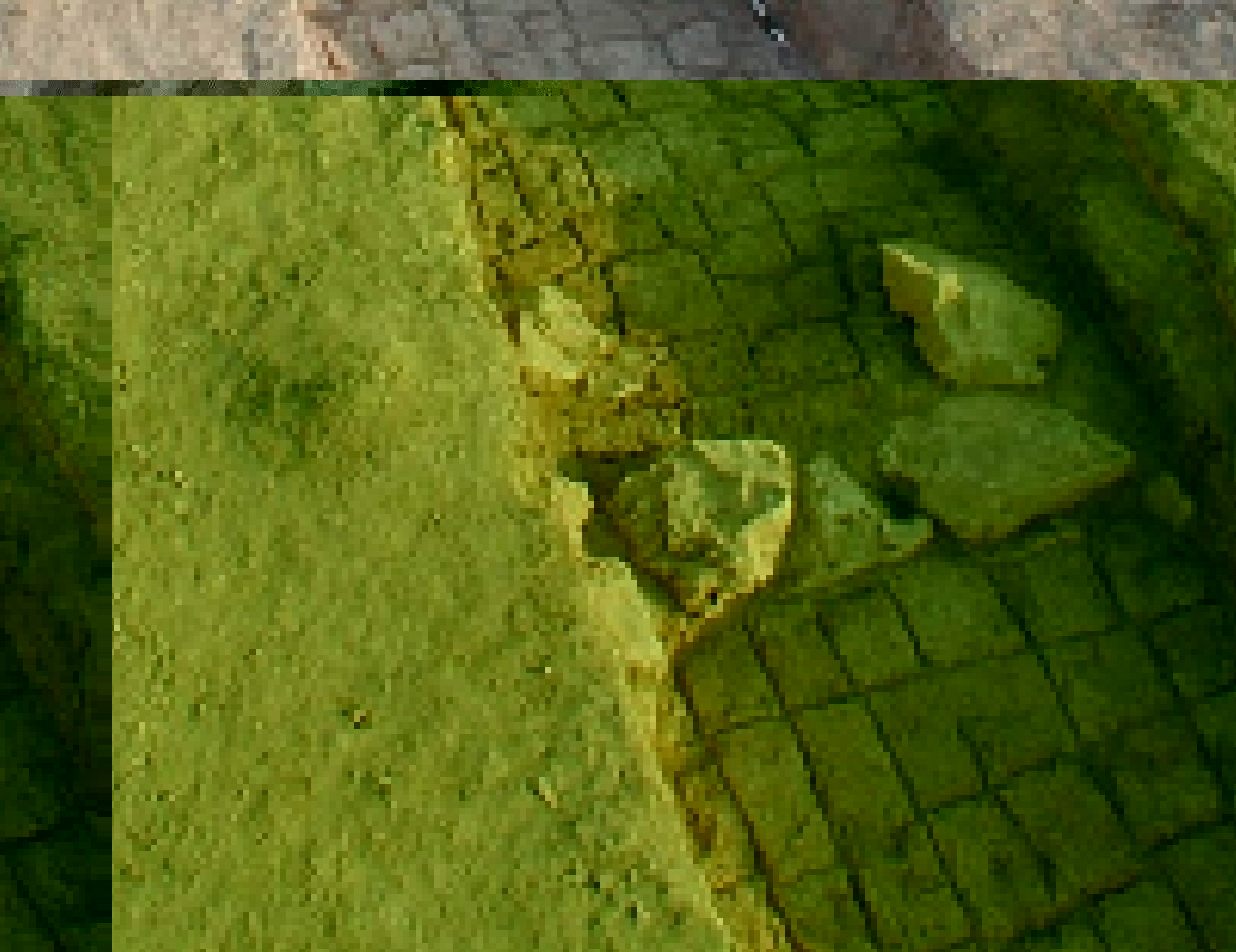
The initial sounding carried out by the German team in B6 exposed the surface of the glacis, consisting of mudbricks, with rows of stones. The material in the original trench has completely disintegrated. We may want to expose what we expect to be more of the same and to preserve it.
|
|
 |
Back to top: Chronicle of work
Projects 2
7. Special projects
a. The Global Record programs are now fully functioning. We will expect to complete the full documentation by the end of the fifth week of excavation, so that we can devote the three weeks of the study period to complete the narrative portion.
b. We will expand the ceramic analysis project to deal with even more of the material excavated during the season, and to tackle the backlog.
c. We will have a new position as graphic registrar, in order to integrate more promptly than in previous years the graphic record (phots and drawings) into the global record.
d. We may have a continuation of the geo-physical survey in part of the Plaza and of the Outer City.
e. We will attempt to integrate more effectively the results of previous GIS work in the Global Record.
|
Back to top: Chronicle of work
Introduction
move to chronicle



A small sounding carried out by the German team (B6), as well as the general configuration of the staircase, suggests that the staircase as currently exposed is only one half of an even more monumental complex.
We have already opened up part of this area, and will continue in the hope of obtaining a full view of the staircase as projected in the next slide…
Back to top: Chronicle of work
Projection

Here is an alternative projection, flipping the photo of the staircase as seen from the south.
Whether or not this will indeed be the view at the end of the 2006 season will remain uncertain until we carry out our excavations. It is possible that the organization of space may have been asymmetrical…
Back to top: Chronicle of work
Articles
| The Great Temple Terrace at Urkesh and the Lions of Tish-atal
|
Framing the question
|
The earlier history of the research and the research strategy in 2005. |
### 1.1.3 Aims and results
At the end of the 2005 season, we had prepared a detailed request to the Directorate General of Antiquities and Museums with our reasons for recommending the use of mechanical means to clear the massive inert deposit overlaying the ancient Plaza. The main thrust of the argument was that we have convincing evidence to the effect that there are no structures in this deposit, and that manual excavation cannot possibly bring back to light one of the most remarkable architectural monuments of third millennium Syro-Mesopotamia. Our recommendation was not accepted, so as a result we had to commit more seasons of excavation to clearing up the remaining points of archaeological interest, using of course manual excavation only. These questions are listed below, in an order proceeding from west to east (
Fig. 1).
#### 1.1.3.1 The articulation of the revetment wall
Does the revetment wall have a curved or a polygonal configuration? While the geo-physical survey suggested an oval, the current exposure, especially in J1, suggested otherwise. This was confirmed, with the excavations exposing two obtuse and one very sharp angle, thus revealing a polygonal configuration that is in line with the current understanding of the Chuera "Steinbauten."
#### 1.1.3.2 The level of the Plaza
We assume the elevation of the third millennium Plaza to be at 485.00 (georeferentially, this is the absolute elevation in meters above sea level), and we assume the escarpment at the base of the revetment wall to present a sharp slope linking the wall with the Plaza. We expected to reach this goal in J1, but were only able to reach the early second millennium levels. The evidence we have obtained strengthens our expectations of last year.
#### 1.1.3.3 The upper apron
The western end of the upper apron, to the extent that it was exposed in earlier seasons, was tantalizingly complete and near the surface, so it was decided to complete this portion of the excavations. As we did this, we realized that this component of the staircase is really not an apron after all, but rather a reduced monumental access added in the latest phase of the sacral use of the area.
#### 1.1.3.4 The fill below the top surface of the Temple Terrace
In 2005 we had found in J3 ceramic material dated to Late Chalcholithic, but we interpreted this evidence onservatively as an isolated pocket, possibly a fill brought in from elsewhere. This season we wanted to obtain a larger exposure, to gain a fresh insight into the nature of the deposition and to secure a broader inventory of ceramic types. In the process we saw that this early material is found wherever we excavate below the third millennium surface, leading us to the conclusion that there is indeed an earlier fourth millennium Temple Terrace on which the third millennium version we know sits.
#### 1.1.3.5 The eastern portion of the staircase
A small sounding carried out by the German team, as well as the general configuration of the staircase, suggested that the staircase as exposed last year was only one half of an even more monumental complex. Reasonable though such an assumption was, it proved to be incorrect. Symmetry was clearly not part of the stylistic preferences of the Hurrians.
## 2 The new stratigraphic sequence of the Plaza area (JP)
Last year’s excavations yielded the surprise of a massive Mittani period deposit against the revetment wall and the monumental staircase of the Temple. We have now revised the pertinent stratigraphic sequence (
Tables 1-3) to accommodate the larger amount of data. The main changes are two.
First, we have added stratum 14, and have in the process proposed an explicit correlation to the known kings of Mittani (on this
see below, 6.4).
Second, we have a much earlier, fourth millennium, phase which for now we have labeled as phase 0, expecting to revise the entire sequence once the earlier strata become clearer.
Also of interest are the Khabur levels which we have reached in two areas. In J4 a large bin-like structure is paved with pebbles and sherds which are exclusively Khabur. And in J1 we now have a sherd and pebble pavement which overlays the earlier escarpment we found in 2005. The levels in J1 are lower than those in J4, and this is significant because it supports our general understanding of the sacral use of the area. In the east (J4) we envision a service area that had built up even before the ED III Temple terrace (the one currently visible) came into existence, and that accordingly was built up at a faster rate. In the west (J1), on the other hand, the Plaza was kept clean throughout the third millennium, and only started to build up beginning precisely with the Khabur period.
Back to top: Chronicle of work