Back to top: The Glacis
Introduction
A glacis is a prepared slope on a rampart or mound intended to improve defensibility and prevent weathering and erosion.
Glacis are usually constructed from durable materials such as plaster or stone.
The initial sounding, carried out by the German team in B6, exposed the surface of the glacis, consisting of mudbricks, with rows of stones and a clay glacis. After more exposure of the surface of the Terrace, carried aut by the american team, several glacis were found.
These glacis were constructed from the Late Chalcholithic 3 to the Mittani Periods onwards, to protect and seal the older sacral structures below. This created a uniform surface that was not designed for walking on, due to its steep slope. Due to the slope, there was no chance for water to collect and cause erosion. (->solutions for water problems at the revetment wall and other parts of the temple terrace in another chapter)
Several clay and baqaya glacis were exposed in Units J3, B6 and B7 in the southern portion of the Temple Terrace, north of the EDIII revetment wall. A mudbrick surface was found beginning north of the monumental staircase in Unit J2, continuing up to the summit where the Temple BA is located. One particular example is the secondary apron, a structure made of stone, which was found directly north of the revetment wall in units J3 and J2.
Back to top: The Glacis
Synopsis
In the sheet below is a list of all Glacis of the Temple Terrace:
Below are described the glacis chronologically from the earliest one.
Back to top: The Glacis
Late Chalcolithic 3
Back to top: The Glacis
Early Glacis
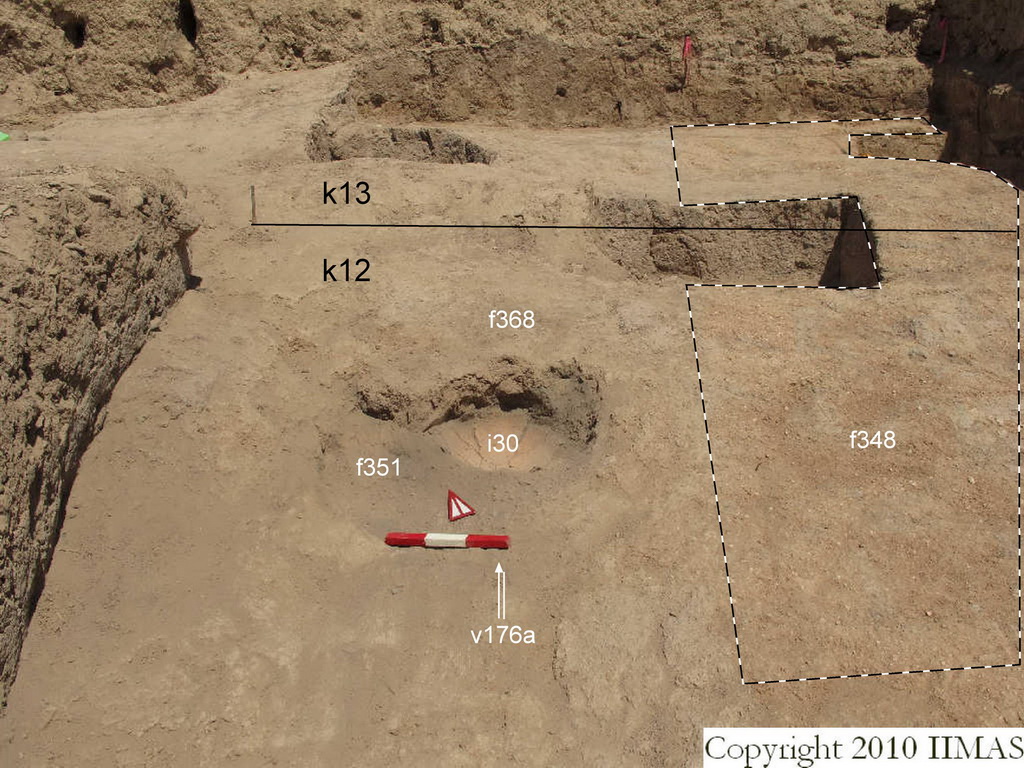
The earliest glacis was exposed in Unit J3, directly north of the EDIII Revetment Wall JP^wl5. JP^gl2 was formed by a thin crusty bricky surface, with a steep slope from north to the south, which sealed the structures and deposits below.
The top of the LC3 mudbrick wall JP^wl19 was cut to the desired heigth and a slope was created. The empty spaces were filled with mudbrick residue (J3f351 and J3f352) coming from the removal of the to of the wall. This was covered with glacis JP^gl2.
here would be good to have a section
|
|
|
Back to top: The Glacis
EDII-EDIII
Back to top: The Glacis
Clay Glacis
JP^gl3 was exposed in Unit B6, Trench T16, directly west of and under the second apron JP^apr2.
It consisted of a smooth and hard clay surface B6-Inst 39 with a pronunced slope from north to southeast. The deposits directly above the surface contained only ceramic material with the typical “excised/incised” decoration Nivivite V pottery. The surface abutted mudbrick wall B6-Inst 53, which proves the wall was constructed before or during the Ninivite V Period (Bianchi et al. 2014, p. 93-94, Fig. 57 p. 92). The top elevation of the glacis was found at 9220m.
Above B6-Inst 39 was laid a layer of bricks or melted bricks of about 10 cm in height and above it another clay smooth surface B6-Inst 34, which is a further glacis.
Back to top: The Glacis
Mudbrick Glacis

JP^glacis1 is a solid mudbrick construction with a marked north-south slope covering the eastern part of the Temple Terrace, beginning southeast of Temple BA and ending at the ^Apron1, reaching a length of about 27 m north-south. The complete width was not exposed in the north, were is visible in the 1-2 m wide trench in unit B6. In the southern portion, were it is at its widest, it is retained to the east fromJP^wl1 and to the west by JP^apr1.
Under the upper steps of the staircase, where some stones are missing, mudbricks of the glacis can be seen. This indicates that the glacis was built before the steps. In other portions of the terrace we did not encounter a massive mudbrick construction, but rather several structures as described under terrace core.
|

|
The height of the glacis can be estimated being 0.50 m. This height was recorded in the west section of trench of unit B6.
The mudbrick glacis is dated to the EDII-EDIII Period in deposition
|
|
Back to top: The Glacis
The stone installations/rings
gB: Jean.
walls are in BT. Craete BT specific labels.
To the north, in area BT and southeast of Temple BA, there are several shallow stone walls embedded in the mudbrick glacis B7f10.
Only part of the walls are visible along the width of the trench, but it is clear that they run from east to west. Due to their limited exposure, the purpose of these structures remains unclear. They could be concentric rings with a decorative function or to frame the mudbricks of the glacis and drain off water or create low steps. See also interpretation and function.
Beginning from the north, the first stone wall B7f2 is located directly to the south of staircase B7f19. The wall is located at the elevation of 96.3 m, it is built from medium and small angular stones, it is 1.5-2 m wide and it is exposed for 3 m in length in east northeast and west southeast direction. On top of the stones there is a layer of sherds and pebbles. This wall probably marked the southern edge of the terrace summit.
Wall BTw2 is located 2.5 m south of B7f2, at the elevation of 96.11 m and consists of three rows of stones, exposed for a length of 2 m, the wall is two stones high, made of medium angular stones. A channel of 0.35 m in width separates the first and second row of stones and on the bottom of this channel are visible the mudbricks. The channel could have the purpose of collecting water and drain it out of the glacis to the east, since the terrace has here a light inclination to the east.
Wall BTw3 is located three meters south of BTw2, at the elevation of 95.19 m. It is made up of one row of stones. The stones are undressed and one is flat angular.
|

|
Back to top: The Glacis
Baqaya Glacis
JP^glacis4 (B6-Inst. 38 in T17 and T16) is a hard clay surface with a marked slope from North to Southwest. It covers a layer of melted mudbricks dating to the Ninivite V Period. The surface is dated to the late EDII-Early EDIII (Bianchi et al. 2014, p. 95) found at the elevation of 9300 m.
An extremely hard and homogeneus reddish grey surface (J3f50, J3f109) was exposed in J3. It was 5 m thick and sloped down from north to south. It was made from clay and baqaya, the local virgin soil. A Fill J3f346 was foud directly under the glacis. This fill consisted of clay, baqaya, bricks and randomly scattered sherds.
The fill was thicker in the south and thinner in the north and was covering the LC3 glacis J3f368. The fill was placed on top of the older glacis, which was steeper, in order to shape the surface for the new glacis, which abutted the backside of the Revetment Wall J3f11. Elevation: 9295 m
The function of the glacis is to provide a homogeneous cover that facilitates the flow of rainwater.
The two surfaces appear to be the same since they are located at approximately the same elevation. Note the marked 30° northeast-southwest slope. Both surfaces are hard and made of clay (the Baqaya was not observed in B6-Inst. 38), and are located on top of a mudbrick fill. The difference is that in B6, Ninivite V is below, whereas in J3, we encounter LC3 material.
Back to top: The Glacis
The top surface of the Terrace
The summit of the Temple Terrace is a flat, open space where Temple BA and its service buildings are situated. Units B3, B4 and B5 were excavated in 1984.
Unit B7, the northern expansion of B6, is located directly south of the temple and was opened in 2009. The excavated area around Temple BA is flat, unlike the sloped glacis. This wide open area was where temple activities took place, and a series of installations and service buildings were located next to the temple.
A terrace surface was found in B7, to the west of the B7f1 staircase, covering the lowest visible step at an elevation of 95.70 metres.The Terrace proper and Temple BA with its service buildings is discussed in Temple Terrace
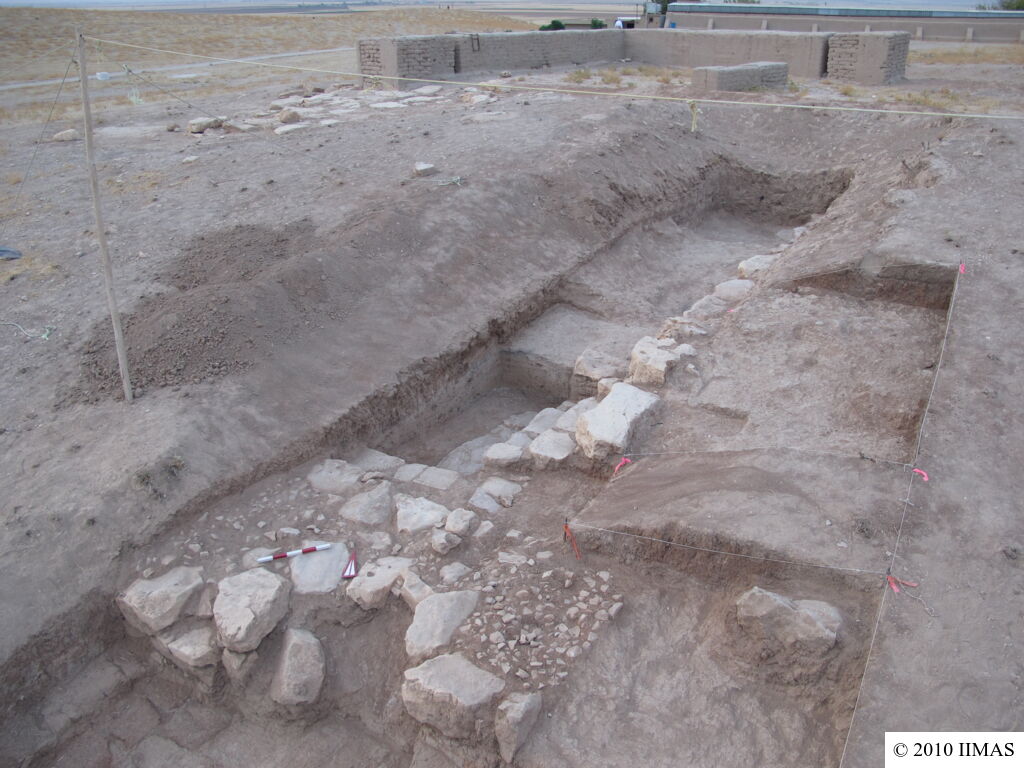 staircase and floor southeast of Temple BA
Back to top: The Glacis
Mittanni
Back to top: The Glacis
Secondary apron
The lower surface of the Mittani Temple Terrace was covered by stones arranged in a trapezoid shape on a sloping surface. The function of this structure was to cover and protect the slope of the mound, as a glacis. Further aspects of this structure are discussed in apron.
Back to top: The Glacis
Clay Glacis
In our search for a clearer definition of the glacis, we have identified a later (mid second millennium) hard mud surface JP^glacis5 (J3f123) that follows closely the slope of the original (third millennium) baqaya glacis, and which seems to be the latest moment of the sacral use of the Terrace (stratum 122).
In the glacis are embedded a line of stones J3a16, the latest construction phase of the Revetment Wall. Immediately above it, there are outdoor floor levels with a tannur and pits that belong to the subsequent, non-sacral phase (strata 6-8, Figs. 9-10).
|
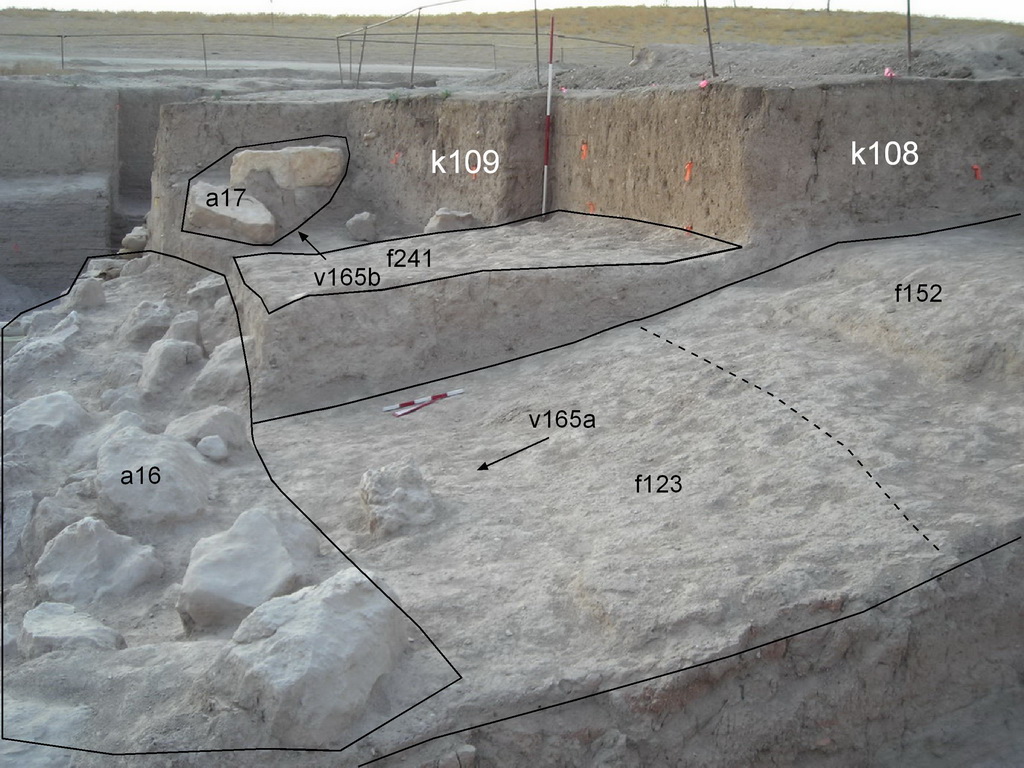 mittani mud glacis in J3 mittani mud glacis in J3
|
Back to top: The Glacis
The final tell surface
The reduced monumental access (secondary apron) rests immediately above the slope of the (third millennium) glacis
Eventually, even the memory stones were covered by the sedimentation generated by wind and rains, and the tell assumed the shape it has today. The hinge between the ancient Plaza and Terrace was now represented simply by the difference between the sloping and the flat area. The Terrace had simply become the topmost hill on the tell, with no sacred meaning attached to it any longer. But – for our good fortune – the situation that followed the main use as a sacral area was such that no intrusion ever took place. Abandonment did for the site after 1250 B.C. what sacrality had done for it before that date.
Back to top: The Glacis
The upward rise
Fully preserved top to bottom.
Back to top: The Glacis