Back to top: The Revetment Wall of the Temple Terrace
Introduction


Following the early excavations (1984-89) of the Temple, a long trench was excavated (1999-2001), by a German team, with the purpose of linking the Temple with a new excavation area to the south. This trench brought to light a small portion of the Terrace wall and of the staircase. The excavations of 2003-10 exposed more fully both the Terrace wall and the staircase. We will focus here on these excavations of the wall and of the Plaza in front of it.
|
to replace
|
to replace
|

The revetment wall served as a face for the glacis that sloped up to the Temple. The definition revetment wall is given for the function of covering the outer side of the terrace core and not being a terrace retaining wall.
The revetment wall bounding the southeastern and eastern side of the mound and covering its outer face for an overall east-west length of about 63 m. The wall borders the mound from the plaza, so that standing in the plaza the wall appears as a vertical barrier.
Back to top: The Revetment Wall of the Temple Terrace
Early Walls
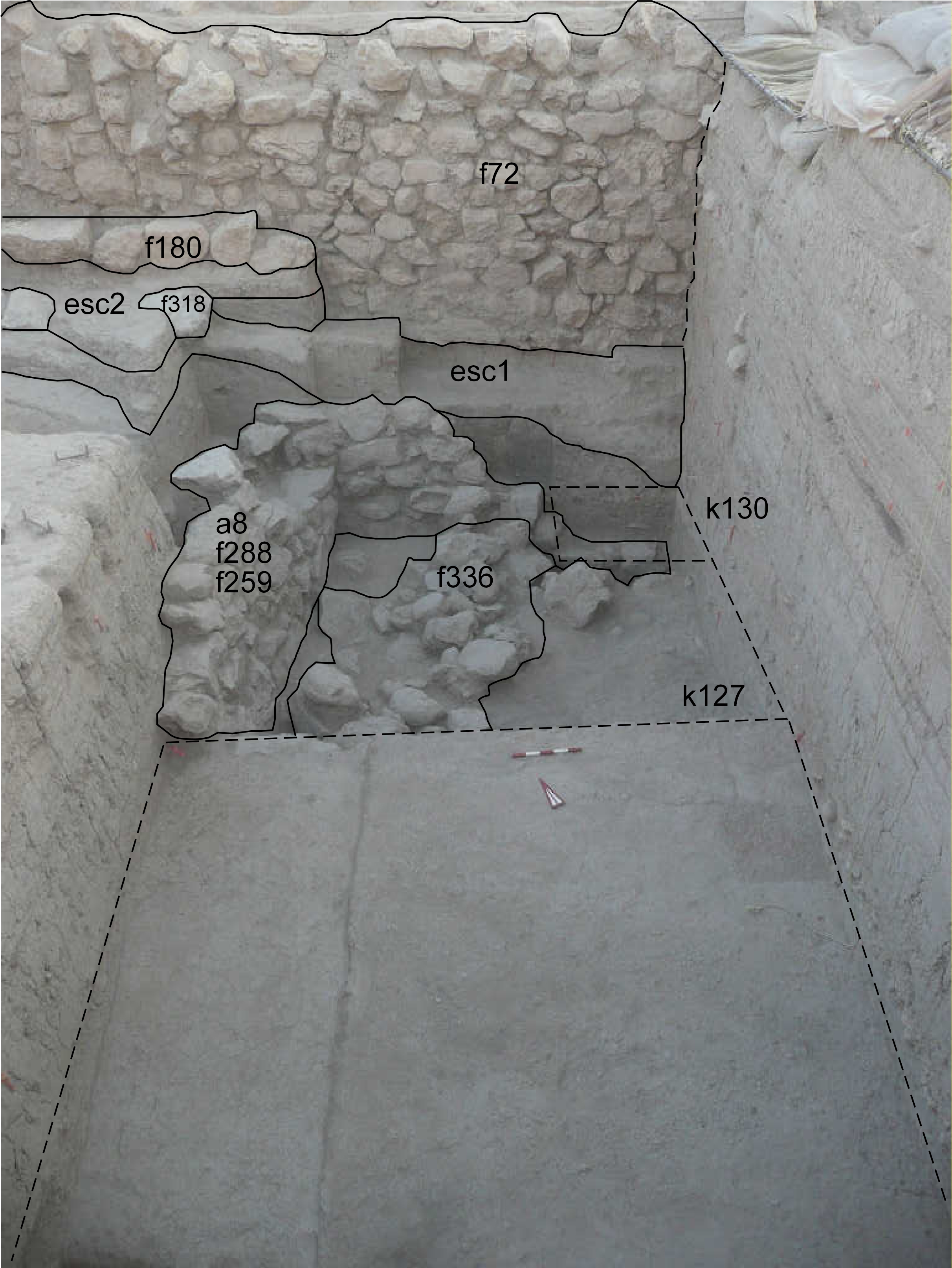
The deepest excavated stone architecture in all JP is located in Unit J1, 7 m under the topsoil (at 8500m) under EDII levels. See also chronology and constructional history. These walls may represent an early version of the revetment wall.
wall6 is located in the Plaza in Unit J1, directly south of wall5, the EDIII Revetment Wall, 10 cm deeper than the first course of wall5, while maintaining the same orientation as this wall.
wall6 consists of two stone walls, bounded and set perpendicular to each other. The western wall runs in a south-west, north-east direction and is for the excavated portion 4.45 m long, one stone wide and 6 courses high for a preserved maximal height of 1.5 m.
The northern wall runs from north-west to south-east and is 4.55 m long for the exposed portion. Consisting of six courses, the wall has a maximum height of 1.55 metres and is only one stone wide. The first course consists of large stone blocks set on top of mudbricks (Pl. 22b). The walls are not straight, but lean against the soil. The back of the walls is irregular, i.e. the visible face is the southern and eastern side. The walls lean against the soil, which indicates that they were constructed after the soil was laid down. This means they have a retaining function and are not freestanding.
The walls are built from large, rectangular undressed stones set in irregular courses. The joints are uneven and filled with a mixture of mud, mortar and small stones. The walls have partly collapsed, as can be seen in the northern part of the western wall and the eastern part of the northern wall. Several large stones, probably from the collapse of JPw7, were found during the excavations in front of the walls, which suggests that the walls were originally much higher.
|
 LC3 wallsin J1 LC3 wallsin J1
|
wall7 is a wall segment located directly under JPw6 in unit J5 (Pl. 20). It is a stone wall with a north-west, south-east orientation. The visible portion is 0.40 m in height (at least 2 courses high) and 0.50 m in width. It runs almost straight for 4.40 m, and consists of at least two medium stones set next to each other. The wall has a slightly different orientation from JPw6. The stones of JPw8 are angular and parallelepiped in form with the flat face showing on the visible side, so that the wall appears ordered and similar to JPw13. The joints are narrow and filled with mud mortar and small stones. Escarpment JPe2 touches the first visible western stone (Pl. 20b). The wall continues to the east under earth escarpment JPe3 (Pl. 20d). JPw8 can be the eastern continuation of JPw13, which at a certain moment collapsed and was rebuilt as JPw6 or JPw8 is, similar to JPw7, related to a previous situation of the Temple Terrace.
Back to top: The Revetment Wall of the Temple Terrace
EDIII Revetment wall
The revetment wall defines the western, southern and eastern edges of the terrace core/mound, and is exposed for about 70 metres in an east-west direction. Not all portions of the wall have been exposed uniformly. The southern section (JPw6) has been fully excavated at the top and partially at the base, reaching a maximum height of 3.05 m. Only a small piece of the western (JPw13) and eastern (JPw1) sides has been exposed.
|

The width of the wall can be determined in the central part of JPw6, in Unit J3, where a sounding behind the wall revealed how it was constructed. Here, the top reaches a maximum width of three large stones, which is about 1.80m.
|
|
 wall width in J3 wall width in J3
|
The first western visible piece of the revetment wall is wall JPw13 (Pl. 23a). JPw13 is found under JPstaircase3 where the wall gently bends towards south-east for 9 m. The situation of JPw13 at the wall curve remains unclear, since a wall JPw11, which is a repair intervention of JPw6, and a thick accumulation cover the original wall. The base of the revetment wall reappears after about 4 m as wall JPw8, which is preserved only for one course under JPw6. JPw6 is the continuation of JPW11 and it runs for 52.73 m without interruption to the east up to JPstaircase1 (Pl. 79).
The revetment wall is interrupted here for 9.93 m by JPstaircase1, and begins again as two different walls. The southern wall is JPw3, which runs in line with wall JPw6 and the northern is JPw1, located parallel and 4.90 m north of wall JPw6. Wall JPw1 starts north of flank wall JPw2 of JPstaircase1 and runs to the east for 8.10 m curving to the north, where after 6.50 m it disappears under the soil.
Back to top: The Revetment Wall of the Temple Terrace
The articulation
While originally understood as an oval, it is now clear that the revetment wall of the Terrace is polygonal in shape. The bend in the revetment wall at its southwestern end shows clearly (Fig. 3) as it takes a sharp bend northward. The top of the wall is at the same elevation as the rest of eastern portion, showing that the degree of preservation remains the same as excavations proceed westward. We consistently have the top of the wall as originally constructed.
At the northern and northeastern sides of the Temple Terrace, the existence of the wall has not been investigated through excavation, but an anomaly is visible surrounding the Temple Terrace (Geophysical prospection 2006).
Back to top: The Revetment Wall of the Temple Terrace
The foundation

| The revetment wall is built on top of an uneven ground. This is due to the previous situation of the ground before construction, and to the presence of other structures, on top of which the wall is built. The wall is built without foundations or footings. The base of the wall is visible in two portions. Firstly in Unit J5, where the first course of JP^wall6 rests on top of a previous JP^wall7. |

|
Back to top: The Revetment Wall of the Temple Terrace
The construction
TEXT TO BE WRITTEN
Back to top: The Revetment Wall of the Temple Terrace
Manner of construction
Central large stone.
Piling up in triangular fashion.
Back to top: The Revetment Wall of the Temple Terrace
The inner plaster
TEXT TO BE WRITTEN

It was important to find out how the glacis was built, and how it interface with the inside of the revetment wall.


In J3 we found that the original surface of the glacis was well preserved: it was made of a very hard and compact red clay layer, with large white calcite nodule.
This material is known locally as baqaya. It is literally the “remainder” of the virgin soil after it has been quarried for stones and pebbles.
The baqaya layer served as the support for a layer of mudbricks that coated the top surface of the glacis (either entirely or in part).
Back to top: The Revetment Wall of the Temple Terrace
The outer look
TEXT TO BE WRITTEN
Back to top: The Revetment Wall of the Temple Terrace
Triangular motif: typology
Ways of identifying it – refer to images-triangular.
Contrast with alignment of horizontal faces in AP.
Back to top: The Revetment Wall of the Temple Terrace
Triangular motif: meaning
Logogram AND ethnography.
Back to top: The Revetment Wall of the Temple Terrace
Stylistic mannerisms
Diamond patterns.
Back to top: The Revetment Wall of the Temple Terrace
Preservation
Fully preserved top to bottom.
Back to top: The Revetment Wall of the Temple Terrace
The Mittani “memory stones”
When the sediments above the Plaza reached the top of the revetment wall, (in the latter part of the Mittani period), there was no attempt at raising the wall itself. This may be indicative either of a lack of resources to undertake a major renovation project, or of the fact that raising the wall would have lessened the visual impact of the slope leading up to the Temple, or of course both. Whatever the case, the flat surface of the Plaza came at one point to coincide with the base of the slope of the glacis. At this juncture, individual stones were placed in a loose row just within the perimeter of the revetment wall, to mark the boundary between the flat area and the slope, as if a symbolic hinge that retained the ideological, if not the structural, valence of the boundary between the two spheres. These we have called “memory stones” (Figs. 8-10), referring to the memory of the ancient revetment wall.
Back to top: The Revetment Wall of the Temple Terrace
Chronicle
The second main objective for J1 is to reach the third millennium floor of the Plaza. To accomplish this, we had to widen the total area of excavation in order to have sufficient space to open an area of about 5 x 10 meters to the base of the wall (Fig. 2).
This expanded the excavation area to such an extent that in the end we were not able to reach the desired depth. Another important reason for the delay was the fact that as we reached the earlier second millennium levels, the accumulations became more significant. While in the later periods (Mittani) we have primarily a series of sediments that have washed down from the built up areas surrounding the Plaza, in the earlier periods (Khabur or Old Babylonian) we have a more distinct cultural buildup of the strata, with better defined floor surfaces and heavier concentrations of sherds and animal bones. Fig. 4 shows details of such surfaces in the late Khabur period.