[TOC]
TEXT TO BE WRITTEN”
Back to top: Emplacement
Monumental Access
Stair1, Stair2, Apron, flank walls. Description of architecture in other section.
Deposition and construction phases in other section.
it better fits in deposition
specific labels for JP are Floor 1, Floor 2
Back to top: Emplacement
Surfaces
The area in front of the staircase is characterized by a general southward slope of approximately 50 cm. Sediment accumulated more rapidly immediately in front of the steps, leading to the gradual cover of the lower stair treads and requiring the repeated construction of new floor surfaces.#
Further to the south, the surfaces become more even; however, at a distance of approximately 10 m the ground level rises again. Here, the presence of structures in Area C2 contributed to a more rapid accumulation of deposits (Bianchi et al. 2014, 104).
Sections showing the surfaces are:
Below are described all surfaces found in front of the monumental access. They are described in term of deposition from the earliest (pavements 1-4) to the latest.
Back to top: Emplacement
Pavements associated to the first stair - Phase 3h-3l transition EDII-EDIII
A series of pebble pavements are related to the use of stair1
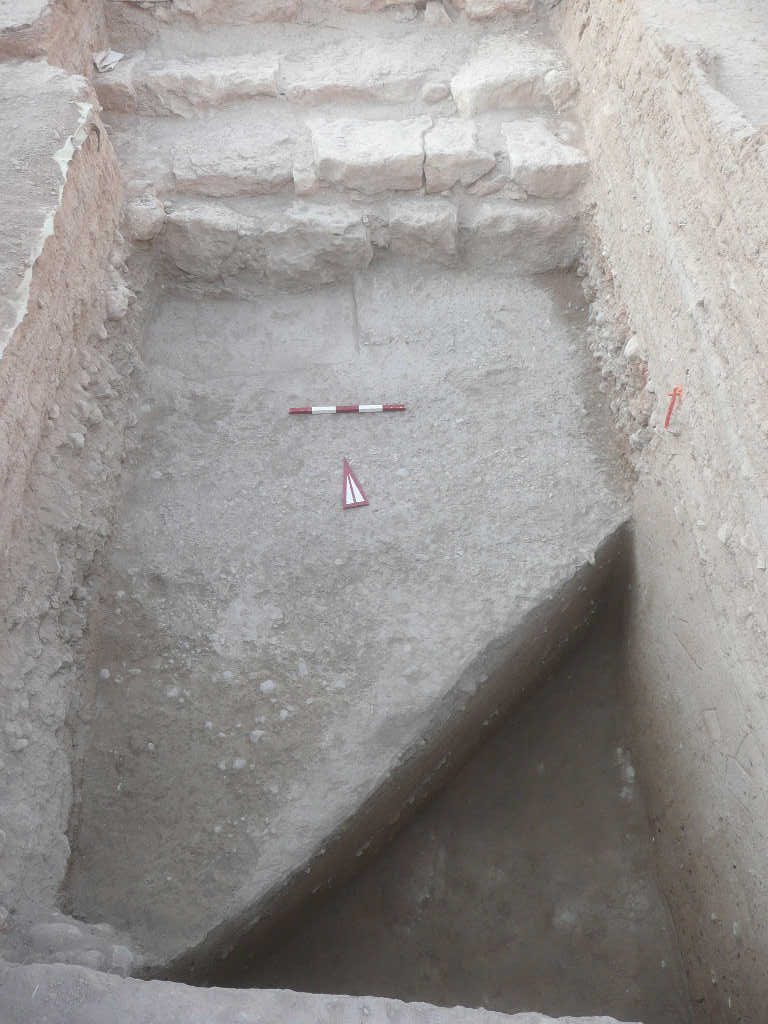
Pavement 1 consists of a sequence of pavements of small sherd, bone and pebbles, abutting the substructure of stair1 and suggesting to its initial phase of use.
Each pavement is covered by a thin accumulation.
No particular objects were found, but the ceramic are Ninivite V, some Metallic ware and early EDIIIA pottery (Phase 3h, see especially J2f388).
|
pavement 1 |
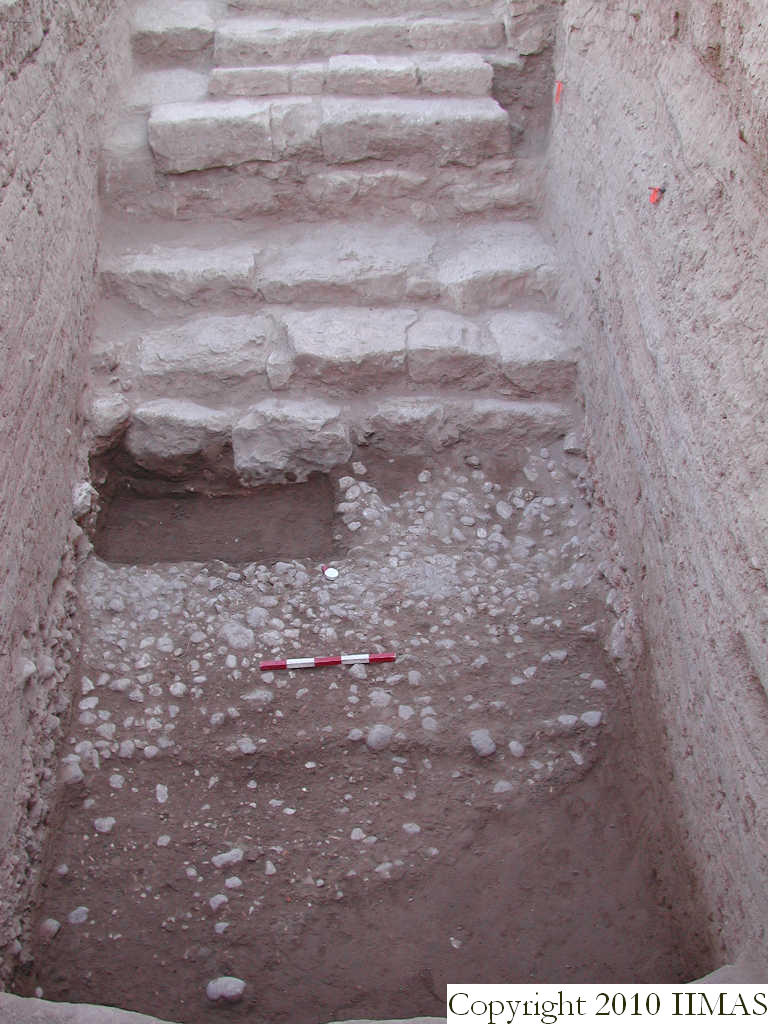
Pavement 2 is a second seqence of pavements made of large pebbles embedded in soil running up against the substructure and the real first step of the staircase, suggesting a second use phase (Phase 3j).
The pavements were covered by thin accumulations. The pottery is EDIII mixed with Ninivite V.
|
pavement 2 |
|
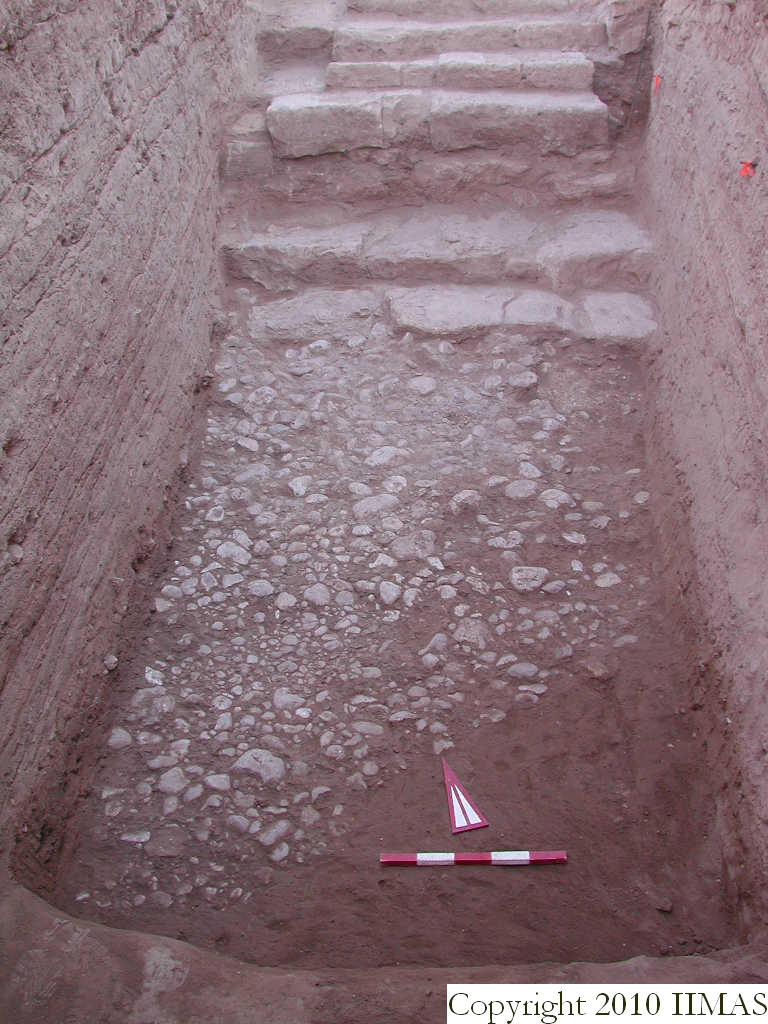
A third series of pebble pavements suggest the use of the upper step of stair1. At the end of this pavement sequence, the staircase is compleatly covered (phase 3l). The pottery is early EDIII.
|
pavement 3 |
|
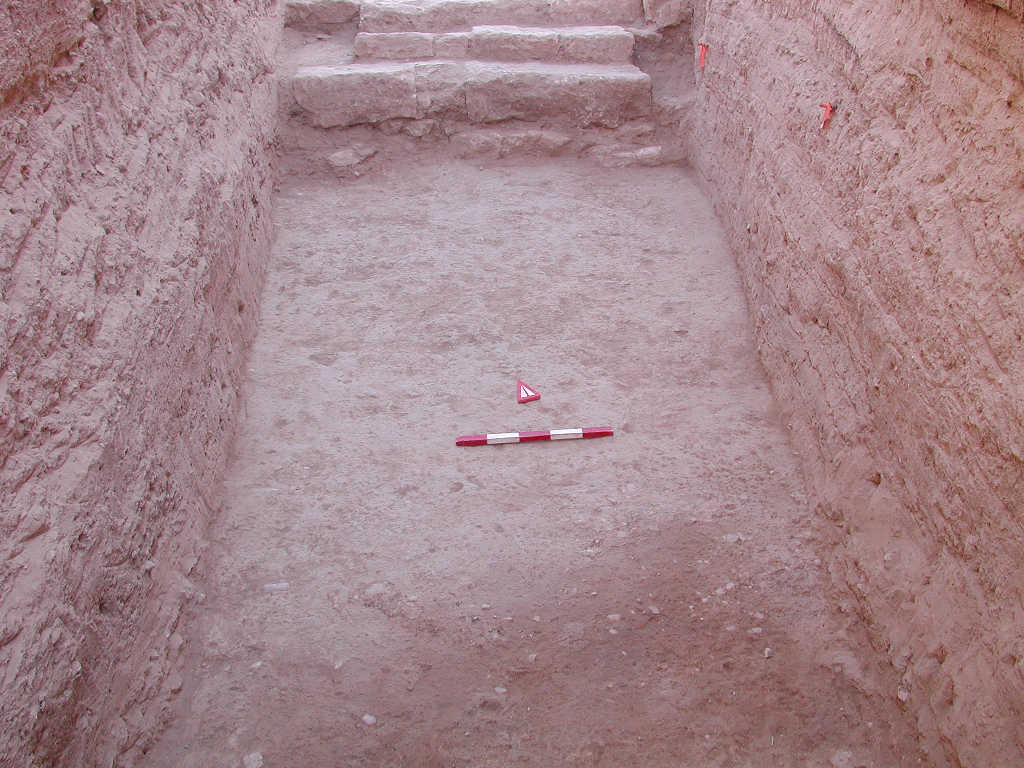
Pavement 4 abuts the stones under stair2. This pavement is a pebble and brown reddish mud surface. On top of the step of stair1 is thicker and toward south gets thinner.
|
pavement 4 |
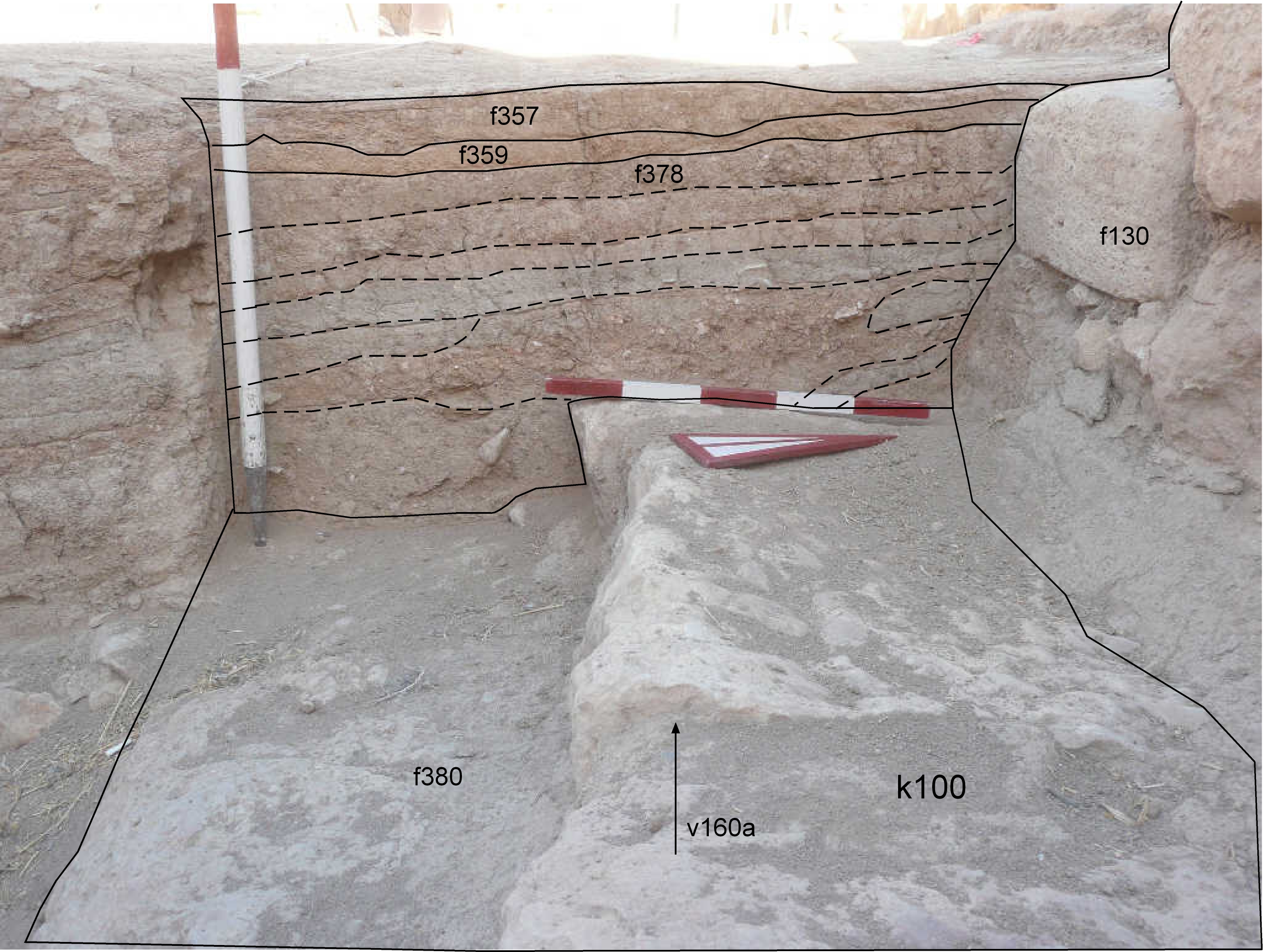
west section J2k100 |
Back to top: Emplacement
The earliest floor associated with the Apron - Phase early EDIII
The first floor associated with the lowest visible step of the Apron and the row of stones under stair2 is a very well defined surface, documented in section and in plan.
The row of stones could be the continuation of the step of the apron or a step of st1. The floor is a compact gray surface incorporating small pebbles and ceramic sherds.
This surface was first identified during the 2001 excavation season in Trench C2 and was recorded as Inst. 918. It extends approximately 16 m to the south. It covers pavement4.
In the published east section (see above, Bianchi et al. 2014, Beilage 7, Tafel 1), the floor lies at an elevation of 8720 m immediately adjacent to the step, descending to approximately 8700 m at a distance of 6 m to the south, then rising again about 20 cm. The section clearly shows a gentle southward slope away from the staircase.
Excavations were resumed in the same area (J2k100) in 2005. The uppermost feature exposed was J2f179, which sealed J2f194 at an elevation of 8721 m. Feature f194 is a brown-yellowish hard soil containing gypsum and pebbles. It abuts the same staircase stone as Inst. 918 (see photo to the right and J2v90).
Further excavation in 2009 revealed a gray layer J2f392 in the western section of J2k100 at an elevation of approximately 8720 m. This layer extended up to the patch stone located between the second staircase and the Apron. On the basis of its stratigraphic position, characteristics, and spatial relationship to the architectural elements, floor1 is the earliest surface associated with the Apron.
|

Plan J2k100

Foto DOG 2001, Floor1 |
Back to top: Emplacement
The floor associated with the construction of the western flank wall
Salmon floor J2f359, J6 f312, Inst 879 and Inst 880 Elevation 8750m in the east section, 8750m in the west section, in plan in front of the Apron 8743m. This floor abuts the lowest portion of the betili to the east and to the west. It may be the floor associated to the construction and first use of the west flank wall
Back to top: Emplacement