Back to top: Staircases
The monumental staircase
This staircase is the most monumental, and best preserved, portion of the Temple Terrace. It includes a number of different elements, that show great architectural sophistication. Just as remarkable is the fact that the structure lasted for more than one thousand years, from at least 2400 B.C. to about 1350 B.C.
Because of the engineering skill with which it was built, it survived the test of time with little damage. And because of its sacrality, it was respected at all stages of its history. Only few stones were removed in later periods for other uses.
The staircase is a monumental structure made from different architectural elements:
Each component of the staircase is described below an in detail in the specific labels.
Back to top: Staircases
Early stair
An early version of the stair2 is located under apron1/stair2. Two steps have risers of 20 cm, making them relatively easy to ascend. Benealth the first step are four stones laid parallel to it. This element is 40 cm high and 20 cm wide and is interpreted as the foundation for the staircase.
The staircase continues beneath later accumulations to both the east and the west, indicating that only part of the original structure has been exposed.
In front of the staircase, a well-preserved sequence of pebble floors was excavated, attesting to the repeated use of both the Plaza and the staircase. A more detailed discussion of this sequence is provided in the section on chronology.
Back to top: Staircases
The stairs and apron
The staircase is located at the north-eastern edge of the plaza. It projects outward from the revetment wall, interrupting it over a distance of approximately 10 m, and is flanked by two stone walls. As a result, the revetment wall meets the staircase at approximately its midpoint.
The staircase follows a northeast orientation; however, each step is laid with a slight eastward offset relative to the step below, creating a subtle eastern lateral shift along the staircase.
From the plaza, the staircase ascends through 25 steps to the mudbrick glacis1, rising from an elevation of approximately 8750 m to about 9300 m and overcoming a height difference of approximately 5.50 m.
|
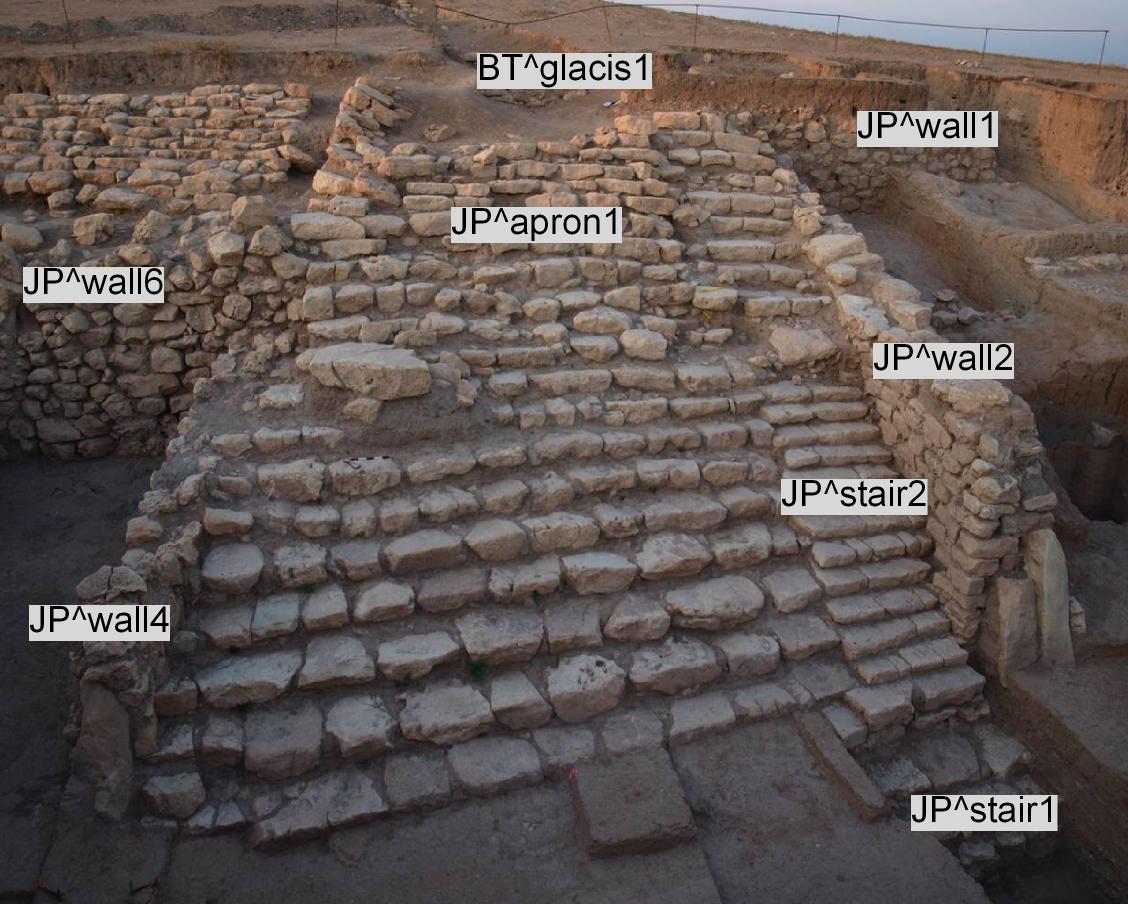
the monumental staircase
|
The staircase is well preserved in the lower portion, whereas in the upper part several stones of the steps are moved or are missing.
The staircase is built, at least in part, on top of a mudbrick substructure. Mudbricks are visible under the northern upper steps of the apron (see J2v57) and between the stones of the last five steps and on its eastern side, under the steps of the stair (see J2v57).
The staircase measures 15 m in length, and 11.36 m in width in the lower part, but only 10.37 m in the upper part.
It is composed of two different stair arrangements set next to each other, keeping the same orientation but differing in appearance and construction.
apron1 is a wide stepped structure with steps approximately 30 cm high. Running alongside it for its entire length is stair2, a narrower stair whose steps measure 15-20 cm in height.
The two structures are constructed directly adjacent to one another, sharing the same axis and orientation. They are flanked on both the eastern and western sides by stone railings and are buttressed to the south by large obliquely set stones, the betili. Together, these elements create the impression of a single, integrated architectural composition.
In the lower portion, the pitch of stair and apron is almost the same. The stair is set one step ahead of the apron.
The upper portion of apron and stair are set at a different elevation and therefore the pitch is different. The apron rises above the stair by approximately 30 to 45 cm.
For the lower portion of the stair2, a great deal of effort was required to build it. The blocks are fairly regularly cut and laid in regular steps, contrasting with the apron, where the stones are poorly dressed even if they are set regularly.
A large stone block is positioned across the 8th and 9th steps of the apron. It is the largest stone used in the staircase and was emplaced after the lower portion of the apron had been covered by deposits. A corresponding large stone occurs beside stair4, where it occupies a similar position, probably having a similar function (see function/offering tables).
Back to top: Staircases
The flank walls
The western and eastern sides of the staircase are flanked by stone walls. These walls protect the edges of the steps from erosion, reinforce the stability of the staircase, and define its boundaries, and guide those ascending toward the temple precint.
The eastern wall2 flanks the entire length, extending from step 1 to step 24, of stair2, reaching the southern face of wall1.
It is constructed of medium-sized angular and irregularly shaped stone blocks laid in 8 fairly regular courses, reaching a maximum height of 2.85 m. Both the eastern and western wall faces are visible. The regular masonry, the careful workmanship, and the use of angular stones closely resemble the construction of the lower portion of the stair.
The southern end of the wall is marked by two obliquely set stones interpreted as decorative betili. These emphasize the entrance to the staircase. This emphasis is further reinforced on the western wall face, where the wall projects outward at the level of the second step, creating a buttress. As a result, the first four steps are narrower then the other upper steps (see J2v137b).
The uppermorst course is composed made of large stones.
|
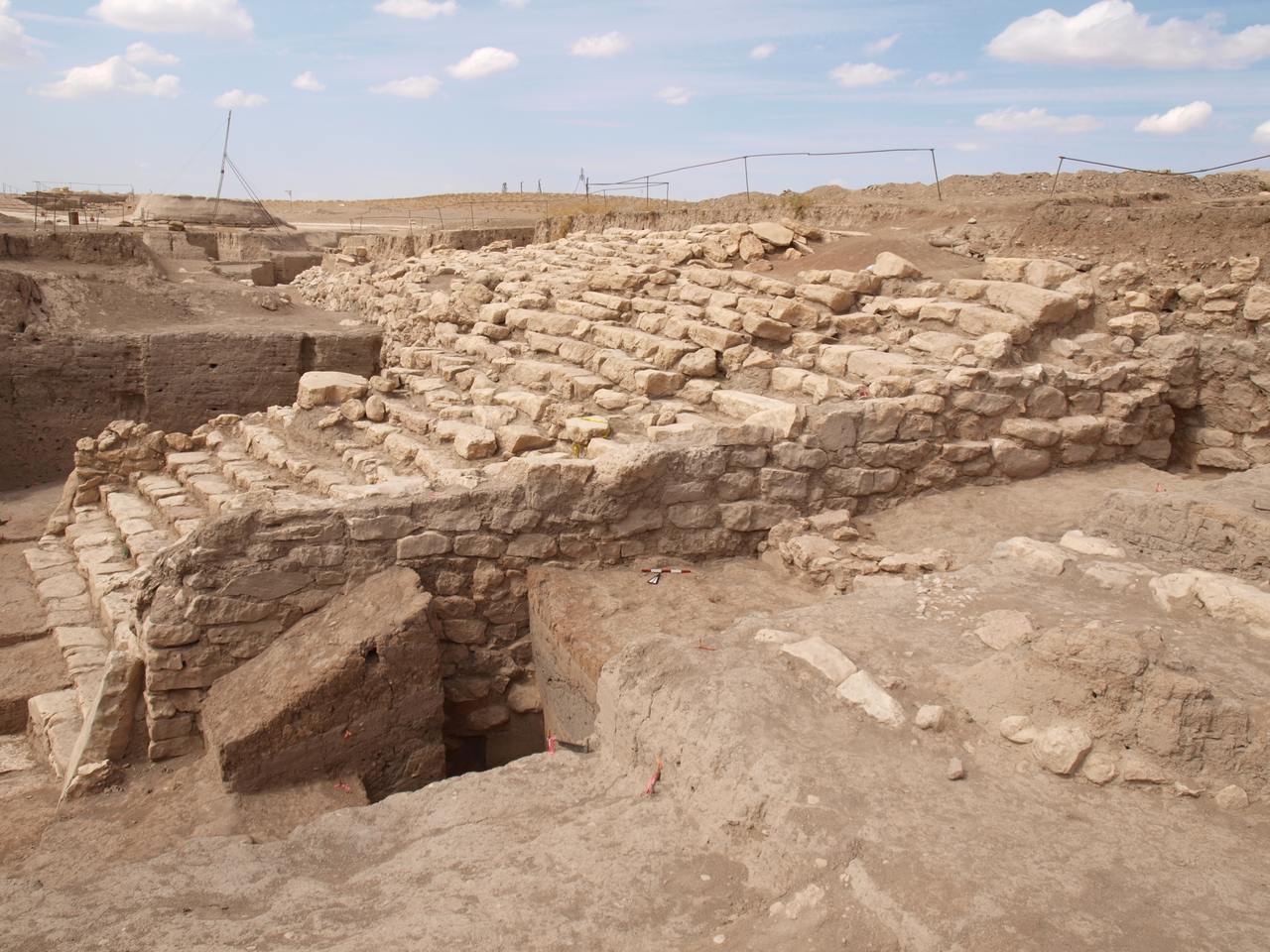
the eastern flank wall
|
The western wall4 flanks the lower portion of apron1, extending from step 2 to step 12. Its construction differs markedly from the of wall2. The wall is built of large, medium-sized and small undressed stones laid in six irregular courses, reaching a maximum height of 1.80 m. The wall abuts the southern face of the revetment wall6.
The masonry indicates that wall4 represents a repair to the western side of the apron. Evidence for this intervention is also provided by the westernmost stones of the first two steps of apron1, which likewise show signs of repair. A more detailed discussion of the damage to the apron and the associated repair works is provided in Chronology: Erosion.
The southern end is marked by a single obliquely set stone, the betili mirroring its counterpart on the eastern side.
|
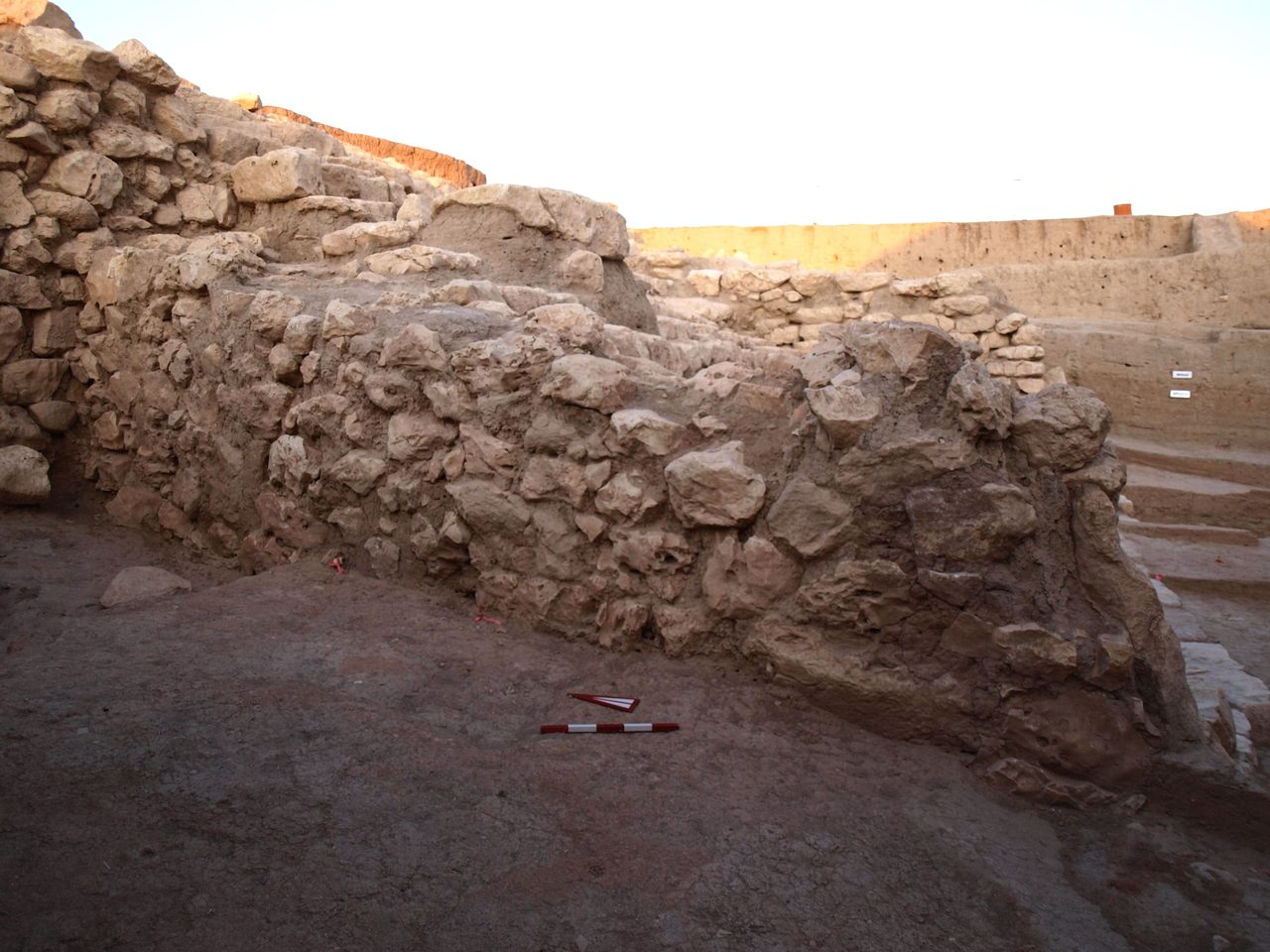
the western flank wall.
|
The upper portion of the apron is not flanked by a wall. Instead, its steps rest on a stone substructure, 20-50 cm in height in the exposed part.
This substructure continues to the north under later accumulations. Here it functions as retaining wall for the mudbrick glacis in Area BT. The western side of the structure has a well-defined edge, whereas the eastern side is irregular and has subsided eastwards, due to the mudbrick material underneath has settled and eroded. The structure is set on top of accumulations and mudbricks visible in the western side of the apron. |
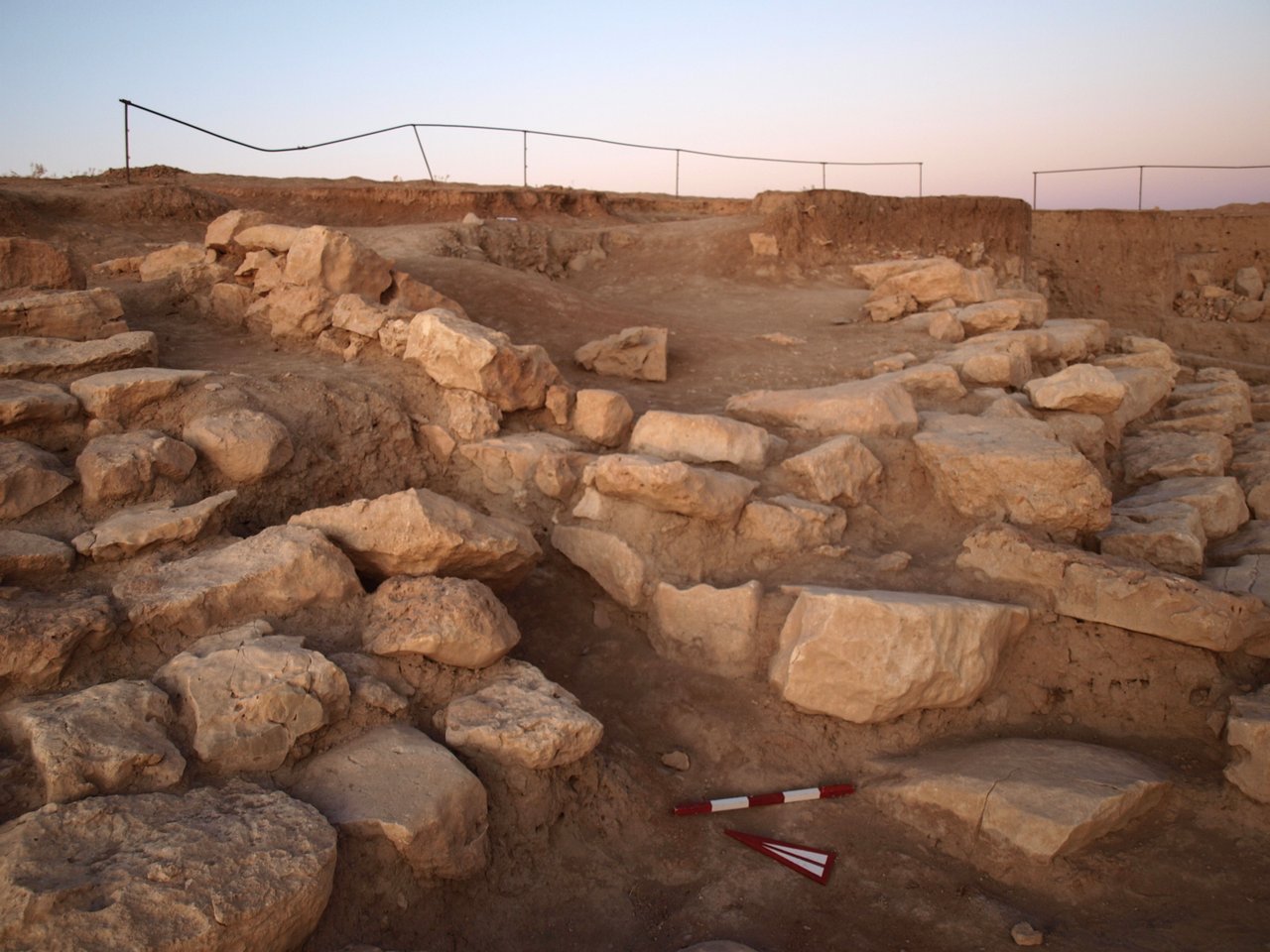
substructure under apron.
|
Back to top: Staircases
The betili
Three large stones mark the entrance to the staircase, defining the southern ends of the flank staircase walls. Each stone is set in oblique fashion against the southern face of the repective wall.
Their primary function appears to be decorative and symbolic rather than structural. They are therefore interpreted as betili, reflecting the strong symbolic significance attributed to these stones.
The stones differ in appearence, reflecting the material obtained from different quarry sources. The western stone of wall2 is relatevly rough, with a white surface with reddish and gray tones. By contrast, the eastern stone is smooth on all sides and its upper part has been shaped into a triangular form. Its colour ranges from white to bluish-grey (Buccellati G. 2010b, 93). Both stones abut the southern wall face.
The corresponding stone to the west, associated to wall4 is rougher in finish and is integrated in the masonry of the wall.
Back to top: Staircases
Asymmetry and disaxiality of the staircase
As one looks at the configuration of staircase and apron in relationship to the revetment wall and the Plaza, a curious pattern emerges, with
conflicting orientations (Buccellati 2010b, 105).
The stairs (stair1 and stair2) as such and the flanking apron1 are two parallel structures which share a very unique orientation, through what we have called a phenomenon of “disaxiality”. By this we mean that while the revetment wall6 is roughly parallel to the long axis of the Temple, and the side of the staircase is roughly orthogonal to the revetment wall, the longitudinal axis of the flight of steps is not parallel to the revetment wall, hence is not orthogonal to the sides of the staircase complex. This results in a curious perceptual phenomenon, whereby the staircase and the apron, seen
from below as one faces the Temple Terrace from the Plaza, appear to have a trapezoidal shape.
We cannot specifically say that we have the very top of the staircase complex, partly because of the reshuffling that took place in the Mittani period. But since there is evidence that the surface of the glacis1, also datable to ED III, consisted of mudbricks immediately to the north of the staircase, it would appear that indeed the staircase complex, like the revetment wall, is also preserved pretty much in its integrity. Buccellati Kelly-Buccellati 2014, 444.
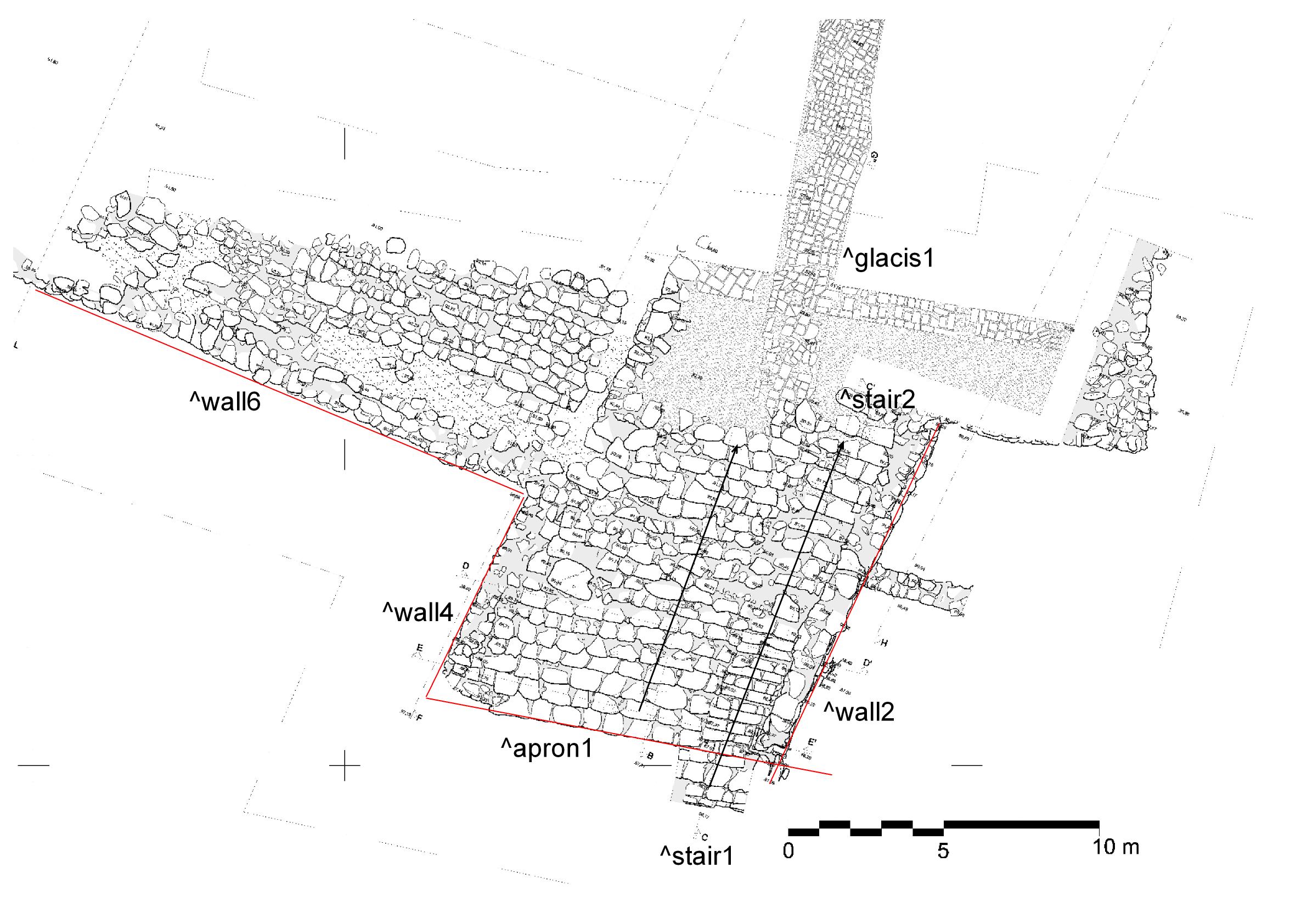
plan of the staircase with axis |
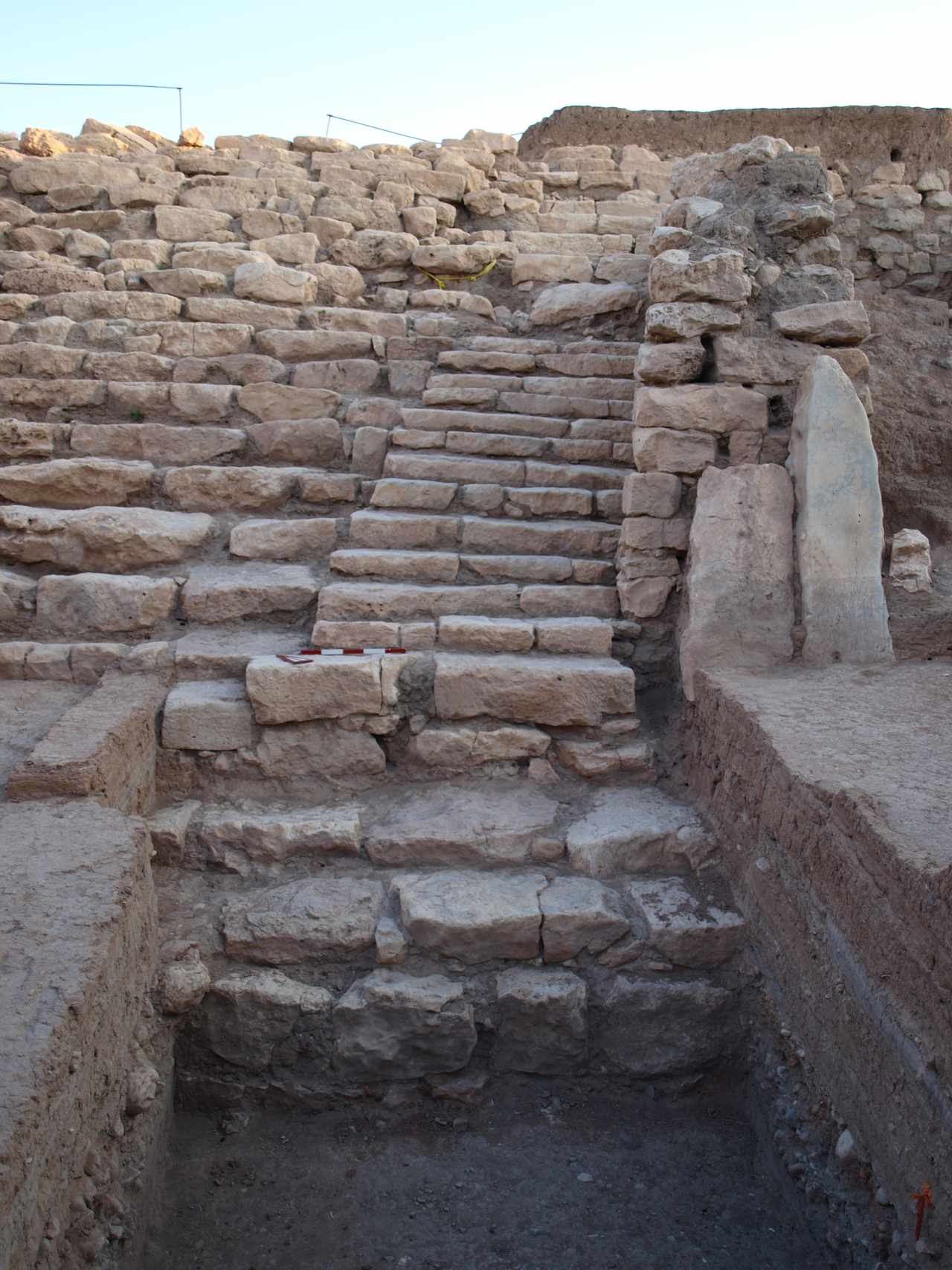
staircase coming from the plaza |