Back to top: Terrace Core
Introduction
The Temple Terrace occupies a large part of Mound B, which is the second highest hill of the seven of which Tell Mozan is made. In fact the site developed at least from the early 5th millennium BC and rose and expanded in dimensions. Mound B is an artificial hill, which in the corse of the Millennia grew up to 22-25 m from virgin soil.
It consists of a gradual buildup of structures, which during the centuries were built, abandoned and collapsed, filled and covered by other buildings. We have evidence in Mound B of this development from the LC3 period. In this early phase the documented structures are already sacred (see interpretation).
During the EDIII Period these structures were covered by the glacis.
A stone revetment wall enclosed the core.
The “core” refers to the compact and solid mass under the Third Millennium BC Temple Terrace. While the evidence is currently limited, a number of mudbrick structures dated before the ED III Period (the structures we have date to the LC3 Period) were exposed so far at a considerable height (about 20 m above the plain level and 23 m above virgin soil).
Back to top: Terrace Core
Synopsis
In the sheet below is a list of all walls of the terrace core:
Back to top: Terrace Core
Late Chalcholitic
the layers, floors, objects, ceramics must be described in other sections, like emplacement and deposition
Floor plan of LC J3f348+J3f363
The earliest evidence of a LC3 phase is the mudbrick platform JP^wl23 supporting a red mudbrick wall JP^wl19 with a buttress in the southwestern corner in Unit J3.
After the structure was no longer in use, the top bricks were cut and contoured and the structure was filled with J3f352, J3f356 and J3f346.
A crusty bricky surface JP^gl2 formed the earliest glacis, sealing the structures and deposits below.
Deposits of ceramics and sealings in the fills are LC3 in date. These were sealed by the EDIII glacis JP^gl4. The elevation of the LC3 (3500 BC) structure is only half a meter below the EDIII (2600 BC) glacis.
|
|
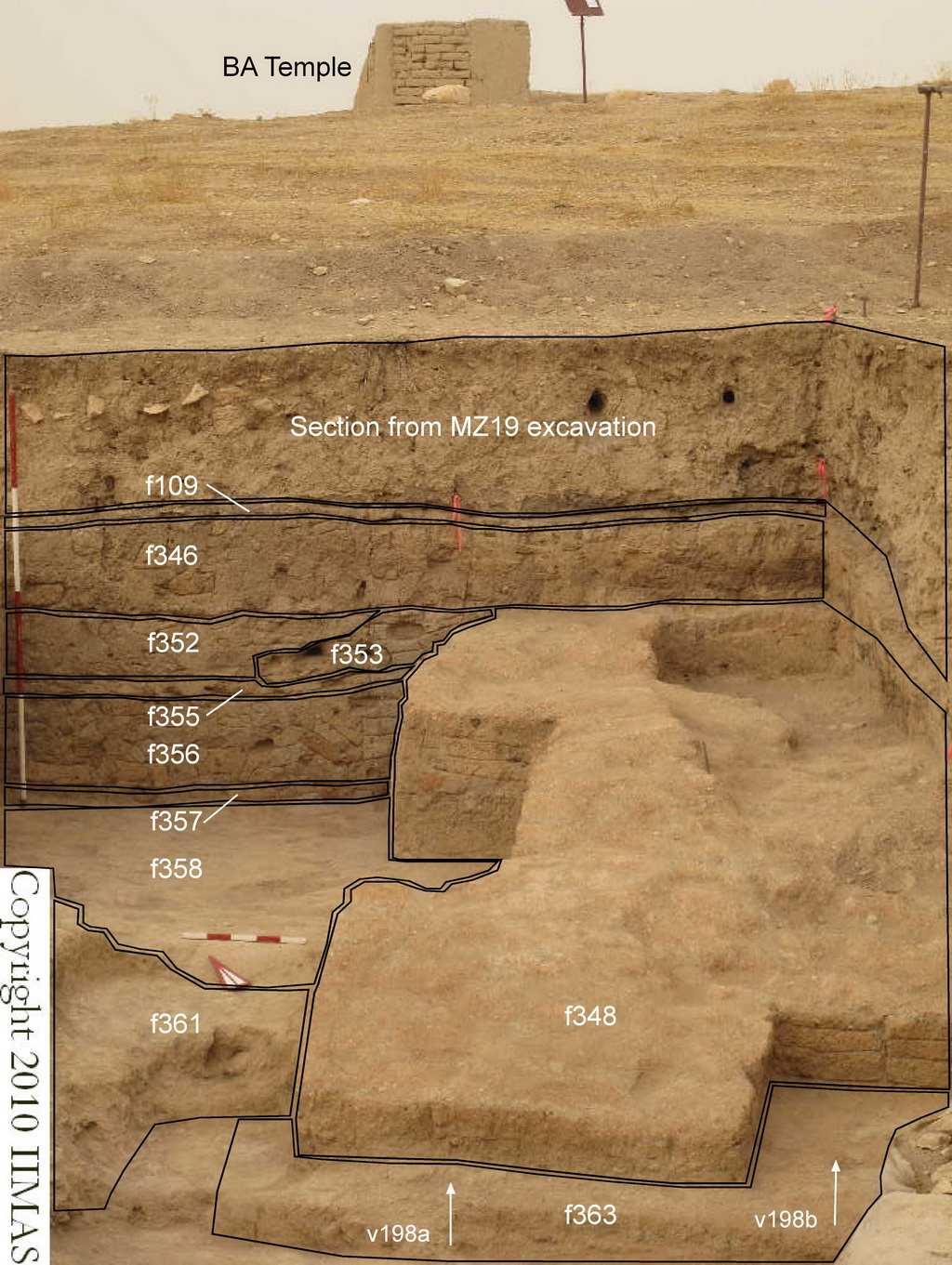 LC3 Structure LC3 Structure |
|
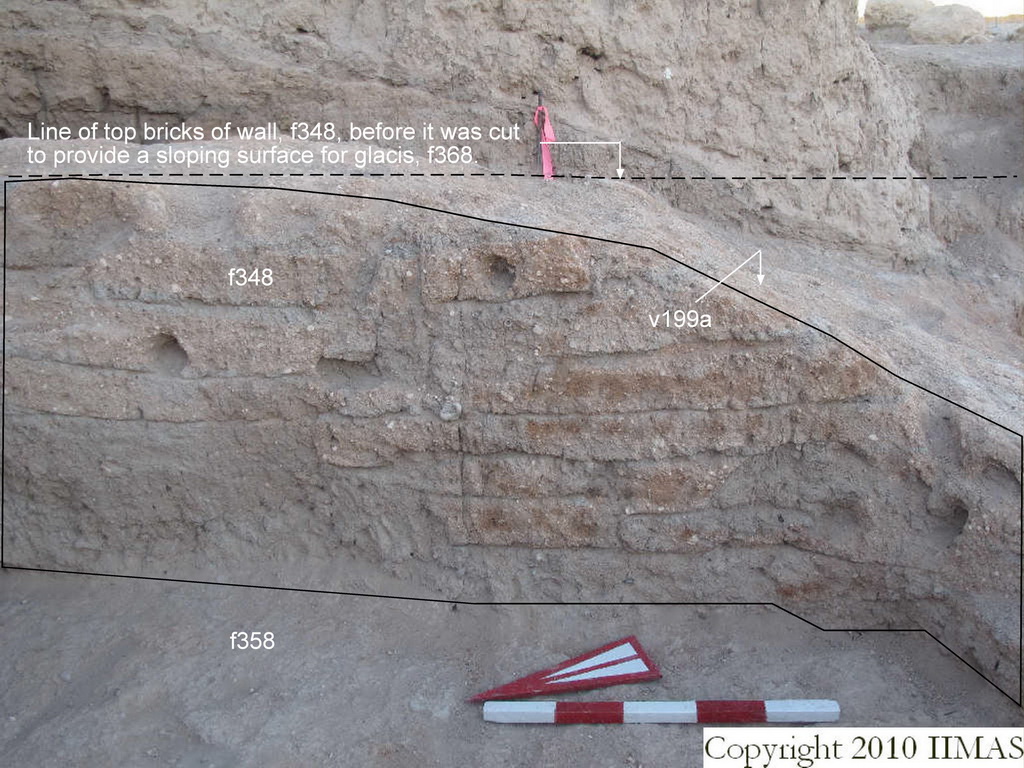 LC3 Structure, visible the cut LC3 Structure, visible the cut
|
Back to top: Terrace Core
Ninivite V
In the western end of trench T17 excavated from the german team of the DOG in 1998 in Unit B6 (see chronicle) a heavily eroded mudbrick wall JP^wl20 was exposed. It was preserved to a height of approximately nine courses and was abutted by glacis B6-Inst. 38. The function of the wall remains unclear. The top elevation of the wall is located at 9200 m.
The wall is located only 10 m east of the the LC3 wall in J3. The deposits covering the wall date to the Late Ninivite V Period (2700 BC). Since the wall is so eroded, presumably was exposed for a long period.
|
|
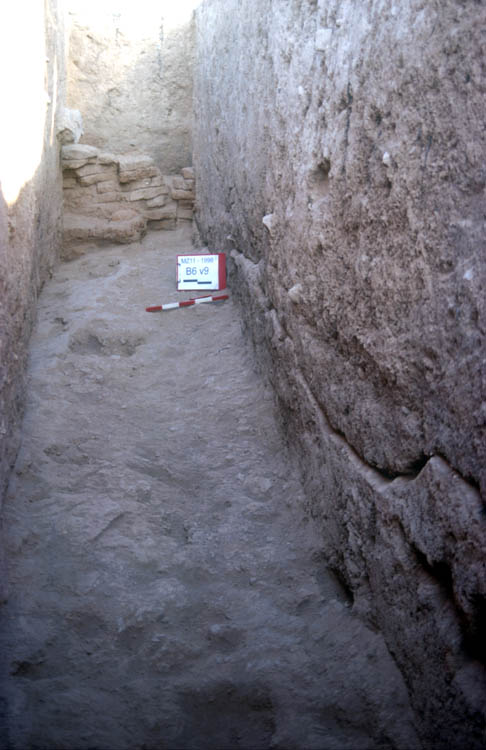 excavation DOG 1998 excavation DOG 1998
|
A mudbrick wall B6-Inst. 53 was recorded in the center of Trench T16 excavated from the german team of the DOG in 1998 (see chronicle). Only its western edge was exposed. It extended in a north-south direction. The wall was overlaid by the western edge of the apron J2f131.
It consists of 12 layers of bricks. The two lowest layers slope slightly to the south. Above these are three poorly preserved layers of bricks. These are in turn overlaid in the northern half by three layers of mudbricks that slope slightly to the north. This was done to correct the slope of the underlying layers. Two layers abut wall B6-Inst 53 and date to the Ninivite V period (see also chapter glacis). The top elevation of the wall is 9350 m and the wall is located at about 18m to the east of wall B6-M35.
|
|
 excavation DOG 1998 excavation DOG 1998
|
Back to top: Terrace Core
Structures of uncertain date
|
In Unit J6 under the staircase flank wall J6f129, a mudbrick wall J6f324 was exposed. It consists of 6 courses of reddish-brown mudbricks. Like the mudbrick wall B6-Inst 53 in Trench T17, wall f324 is located under the EDIII Period stone structure. Furthermore, the similarity of the mudbricks suggests that they could be part of the same structure or contemporary, therefore dating to the Ninivite V or LC3 periods. See also chronometry in J6. The top elevation of the wall is 9150 m and is located about 12 m to the east of wall B6-Inst 53.
|
|
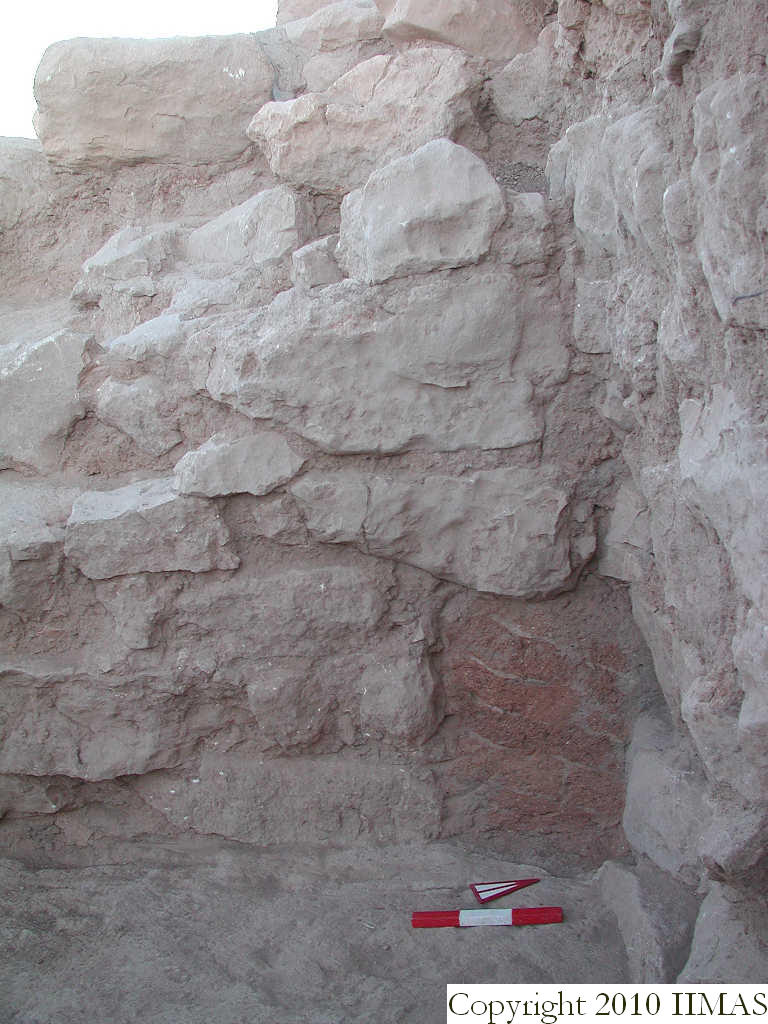
|
Back to top: Terrace Core
Assumptions
It can be observed for the EJ II period a difference of elevation between the surfaces in B6 and J2 of about 8 m within a distance of about 15 m north-south, so that an artificial rise existed in area BT already in this phase and a flat open space was located in area JP.
is dated to the EJ II period.
Back to top: Terrace Core