Back to top: Phase 65MZA within Unit J4
Stratigraphy
|
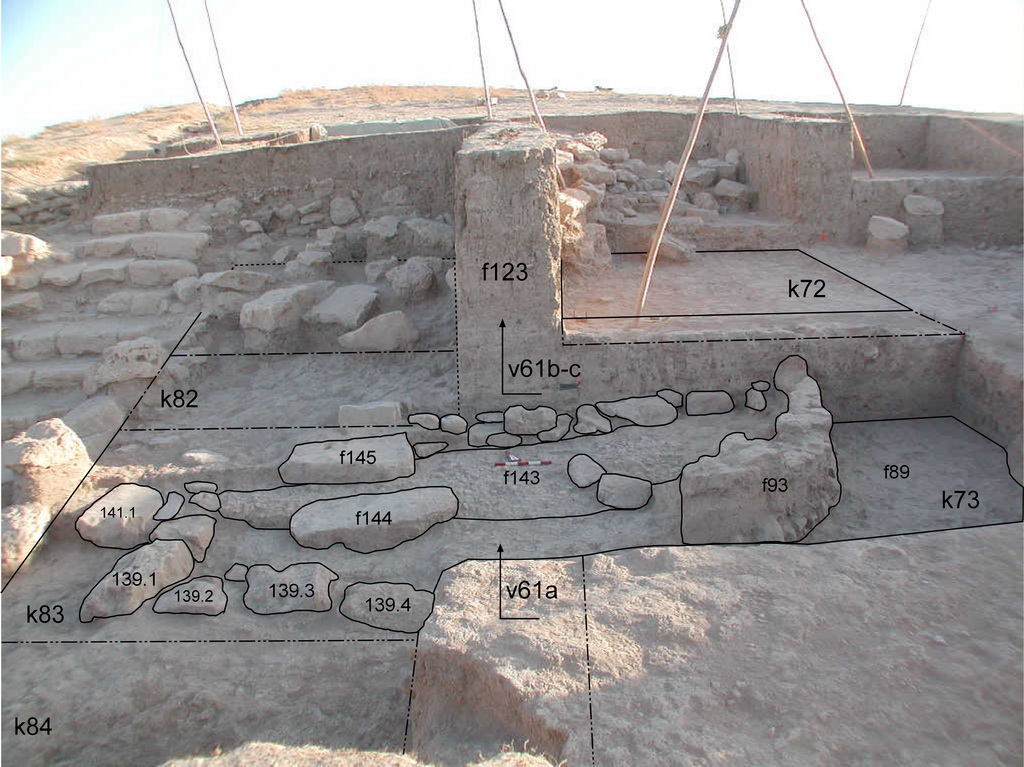
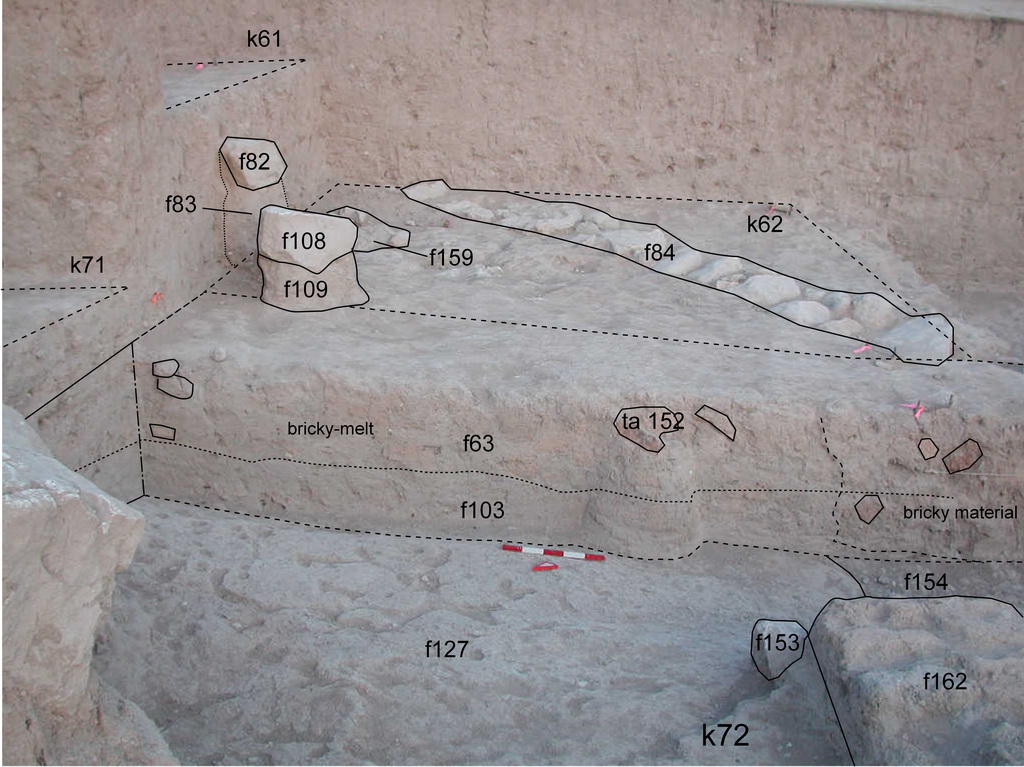
After phase 67 where no human activities are attested in J4, some activities began to take place. However, this rebuilding phase in J4 is on a smaller scale compared to other areas around the monumental staircase. The area began to gradually buildup and then erode, before some building activities took place through the construction of some stone and mud brick structures (f93, f84, f159, f170). However, the south of J4 affected by the brick fall ^bf2 in J6, was not used. |
|
|
In fact, the entire area of J4 goes back to not being used in the later stratum of this phase as a consequence of the fire that followed the brick fall in J6.
Back to top: Phase 65MZA within Unit J4
Accumulations
Many natural accumulation layers were excavated in this phase, especially before and after the re-building stratum in this phase (s14c MZA).
Back to top: Phase 65MZA within Unit J4
walls
During the re-building phase many walls were constructed (f84, f159, f161, f162, f171) . The function of these walls (apart from f161 and f162 which are related to in f93) is not very clear, since they consist of one or two rows only and are not connected to floors, pavements or other installations. They could be partition walls in function with the service area.
Back to top: Phase 65MZA within Unit J4
Cuts-pits
In consistency with the nature of the area during this phase, two pits were dug. f136, a shallow pit of an unknown function, and f85, a pit that contained the bones of a Salouki dog i5 and frogs i6.
Back to top: Phase 65MZA within Unit J4
bin
During he period of the heaviest use of the area, and in addition to constructing the aforementioned walls above, a bin f93 installation was constructed. The most plausible interpretation would be that it served for storage purposes, considering its location and the nature of the area during this phase. However, the lack of any material culture within the bin makes assigning a function difficult.
Back to top: Phase 65MZA within Unit J4