For full bibliographical information see Front Matter.
Back to top: Preface
From Mozan to Urkesh
Short of wholesale reconstruction, a Mesopotamian archaeological site is rather opaque to visitors. Yet the authenticity of the ruin, that is, the remnant of a long-abandoned living environment as revealed through excavation, has a strong appeal if presented in a way that not only explains but also involves the visitor.
At Tell Mozan, we have endeavored to achieve precisely this, and the response of visitors has been consistently warm and gratifying. Our aim has been to provide a simple yet comprehensive presentation, one that would speak to visitors from all cultural backgrounds – our workmen and their families in the first place, and then others coming from the region and from far away without talking down to them. The intention was not merely to communicate information, but to engage visitors in an experience that would enable them to appreciate the site in its full archaeological and historical complexity.
Back to top: Preface
An archaeological task
Such was our goal since the very beginning of excavations.
From this perspective, it was important to include subjects that might not ordinarily be expected in a presentation intended for the general public, particularly those that might appear too difficult or abstract, such as the relevance of stratigraphic sections as a basis for chronological attribution. Properly explained, however, these subjects proved to be a source of wonder and enjoyment.
Another essential objective was to introduce a sequential dimension that would give a sense of unity to the path followed by visitors. This developed into a narrative intended to elicit a sense of expectation while providing continuity to the experience. The visit was thus conceived not merely as a story of the ancient past, but also as an opportunity to understand what the site, exposed in selected areas through excavation, continues to hold for future exploration.
The title The Site as a Book summarizes these diverse goals. It is the site itself that is expected to speak to the visitor, while our written words serve as if they were spoken by the fragments of ancient life that our intervention has brought back to life. In this perspective, stratigraphy proved to be not merely an abstract concept, but a dynamic dimension that transformed the “ruin” into a true interlocutor.
In keeping with these objectives, it was important to ensure that the signage system be both simple and flexible, allowing for easy updating as excavations progressed from year to year. This principle was implemented in two principal ways. The physical supports consisted of iron stands that could be produced and maintained locally, while the texts themselves were printed in the format of ordinary pages and mounted on these stands. This approach made it possible to modify and update the information without having to replace the supporting structures.
Back to top: Preface
This website
This website describes the theory underlying our effort and gives the full details of the system as implemented.
The present digital monograph brings together the various dimensions of this effort. It views site presentation not as an activity separate from archaeological excavation, but as an integral part of the broader research project. Its purpose is to show how the physical remains, their interpretation, the associated collections, and the historical development of the presentation system together contribute to a coherent understanding of Urkesh beneath the modern site of Tell Mozan.
Back to top: Preface
Impact
The website documents the project in detail, and shows the unique value inherent in an effort aimed at integrating the public in the archaeological process. A proper understanding of the site, as communicated by our presentation system, elicited a profound sense of belonging, which helped to give people a sense of meaning and comfort at a time when all around them was crumbling.
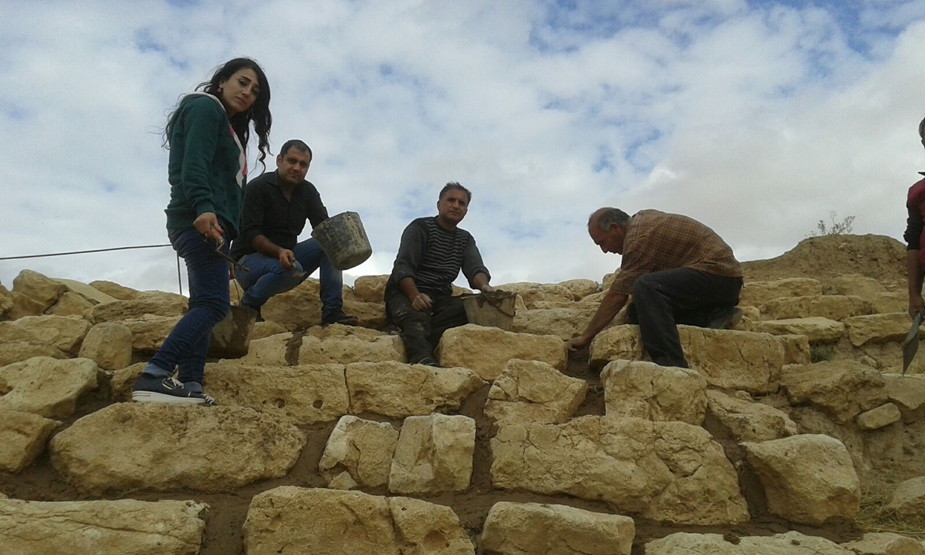
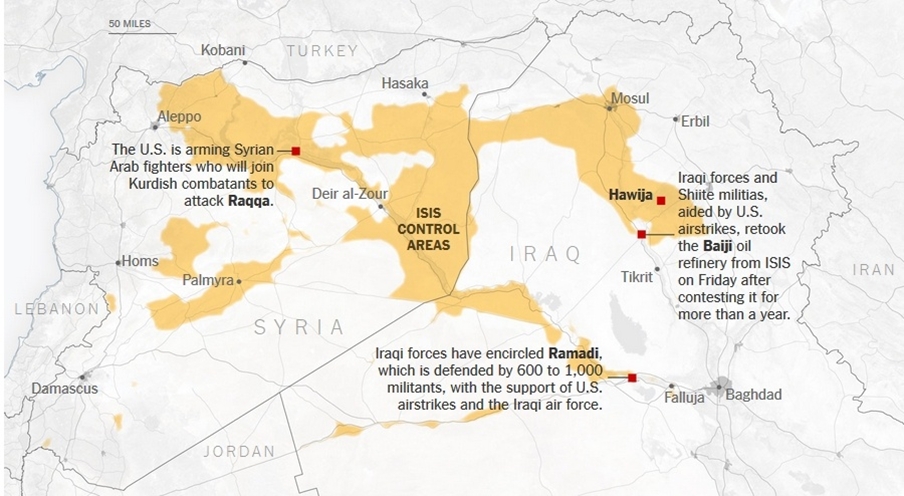
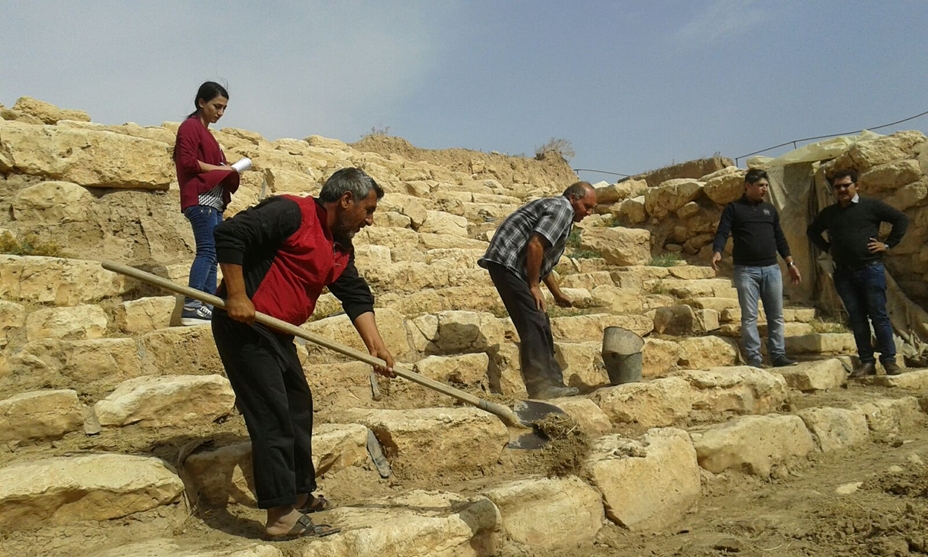
The images below give witness to this: on the same day in which the New York Times published a map showing that ISIS had reached to within 37 miles of the site, members of our staff were preparing the site for vistors!
| 
| 
|
Back to top: Preface
Two phases
Started in 1984, the site presentation project at Tell Mozan has continued uninterruptedly until today – while excavations lasted until 2010, and since then during the long pause forced on us because of events. This makes it one of the longest lasting projects of its kind.
Much of the material contained in this website was completed by 2010, which was our last excavation season at Tell Mozan, before the onset of the war in 2011.
In the subsequent years there were no additions, but we maintained the presentation system in its original format, to be available to visitors at the site. The main addition to the original material has been in the form of a documentation of this preservation effort, which has kept the site alive for the local inheritors and for the other occasional visitors. This is fully documented in the right hand site bar.
Back to top: Preface
A new beginning
During excavations, the presentation effort was subsumed under the general project budget. Since the suspension of excavations beginning in 2011, we had to find different sources of support, some that were specifically interested in the value that heritage has on both the intellectual and the social level. We were fortunate to find two foundations that enabled us to continue both the conservation and the presentation efforts.
- The The J.M. Kaplan Fund provided funds specifically earmarked for these tasks, sharing with us a deep concern for heritage under threat of war – as so well expressed in their mission statement: “The Heritage Conservation program is currently focused on … efforts to ensure that remarkable heritage resources play their role in wide-ranging recovery following conflict or disaster.”
- The Balzan prize gave us a major incentive as they recognized our “success in site preservation by actively involving local populations, via widespread cultural education and participation in conservation work, extended to younger generations.”
More details are given in the section on the history of the project.
Back to top: Preface