Back to top: Maintenance
Introduction
Back to top: Maintenance
Needs and limits
Maintenance is a critical dimension of the project. Mechanisms set in place at the moment of the initial conservation loose all their effectiveness very rapidly if they are not attended to on a regular basis.
It is therefore imperative to understand well the recurrent problems, to identify the needs that must be addressed, and to set up explicit routines that may be followed even when the Expedition is not in session.
Back to top: Maintenance
Steps in implementation
Until 2010, I waited to implement maintenance procedures until the return of the Expedition in summer time. This was for two reasons:
- first, I wanted to inspect de visu the problems that would arise during the winter months, in order to gain some insight in the causes for deterioration;
- second, I was not sure what might be the best way to intervene to resolve the individual problems.
In 2010 I set up a protocol for review during our absence, with specific tasks assigned to three individuals. One of our guards, Muhammad Omo, was responsible for a general oversight and for minimal interventions, such as the removal of unwanted vegetation. Ibrahim Khellu was responsible for keeping a written record of the situation during the year, outlining special problems. Diadin Mustapha was the photographer who would document the situation on a regular basis and especially in moments of distress. Photographs and reports would be communicated to me via the Internet. With the assistance of Stefania Ermidoro in Italy and Yasmine Mahmoud in Damascus, I relayed to the three individuals in Mozan instructions on how to proceed with additional work, particularly with regard to the repair of torn side panels. The effectiveness of this approach will be reviewed upon our return to the site.
Back to top: Maintenance
Cleaning
One of the basic tasks of maintenance is cleaning. Tell Mozan is a popular site in the area, visited by many locals and foreigners for tourism and outings. For this reason, the site was equipe with trash cans in numerous spots, designed to blend in with the surrounding as they were built using mud bricks. These bins are empties periodically of course.
It is extremely difficult to control the cleanliness of the site especially if visited by large groups of children who might be less attentive to his issue.
| 
|
Therefore, one of our local collaborators keeps a close eye on the site and performs a periodic cleaning, even in the winter when the site is less frequented, this cleaning process is important as the wind blows trash into the site.
Back to top: Maintenance
Repairs
The repairs that take place in Tell Mozan can be considered periodic repairs designed to ensure the stability of the excavation areas and the various structures. The following is an overview of these repairs.
Back to top: Maintenance
Removing vegetation
The vegetations that grow in all seasons in Tell Mozan can cause significant problems. Starting from the roots which can extend deep into the soil and cause the destabilization of the surface which effects in turn the stabilization of the excavated structures and the structures that are still underground. And while these vegetations give the site a beautiful look, especially in the spring time, they do block the view of the ancient architectural elements and can become a nesting area for some animals such as snakes and rodents, in addition to being a fire hazard in the summer when they are dry.
| 

|
Therefore, the removal of these vegetations is performed periodically 1) by hand, by plucking the plants from the roots and removing them to an area far away from the site, and 2) by spraying the excavation area with a herbicide which slows down the growth rate of these vegetations.
Back to top: Maintenance
Water control
As a result of the excavation process, multiple layers are created on the tell depending on the levels where the excavation stopped after deeming the stratigraphic layer worthy of preservation. This introduces a water control issue in rain season where the water would naturally cascade from the higher levels to the lower ones causing damages along the way and then ends up gathered in one of the lowest points reached in the excavations, which effects significantly the excavation area. In order to control these water caused damages, a water barriers and channels have been created in specific places chosen to channel the rain water away from the excavation areas. The process is simple and effective where a channel is dug around the excavation area and the dirt from digging is piled on one side of the channel (the side closer to the excavation area) forming a mound, hence guarantying that even in heavy rain fall the channel would flood away from the area we are trying to protect. The channels, when on higher grounds, they lead to the edge where a large pipe is installed to guaranty that the water falls down away from the face of sections to avoid the loss of the soil and therefore the loss of important information, and preserve sherds and items that might wash away with the water flow.
| 

|
Back to top: Maintenance
Plastering
Plastering takes place in two cases in the site, the stone structures and the mud brick walls of the Tupkish palace, in two different forms.
Plastering the stone structures: The joints between the stone structures are affected by weather elements, mainly water. The heavy rain fall causes the mortar to dissolve which affects the stability of the structures and cause the dislocation of stones which poses a great risk on the integrity of the structure. The plastering process, which is performed whenever is deemed necessary, ensure the safety of these stone. It begins by placing a strip of thick cloth on top of the ancient mortar in between the sones, and it is then covered by a mixture of mud and hey. This ensures that the ancient mortar is not lost and not mixed with the new mud layer where the piece of cloth acts as a buffer between the two.


Plastering the palace walls: despite the fact that the palace walls are protected with a functioning system of metal shelters and burlap curtains, humidity and dry weather can still affect these vulnerable structures made with friable mudbricks. The systematic and periodic monitoring of these walls reveals sometimes a slight deterioration in the condition of some walls, where mud bricks are lost especially on the sides, or the appearance of some cracks which jeopardize the entire structure. To enforce these week area, a layer of thick mud plaster is laid on top of the affected area, and renewed or replaced when necessary, hence ensuring that the deterioration does not worsen.
| 
|
### Palace walls
The palace walls are the element that probably constitute the largest portion of the repairs on the site, considering the fact that they cover a large surface area, and they are fragile and very significant. These repairs can be divided as follows:
Covering walls with plastic: The walls of the palace are covered with a metal protective shelter, where the roof of the shelter is covered with fabric followed by a hick layer of mud and hey. Despite this coverage, an extra protective step is taken to ensure that in the case of water leakage, the walls are not affected. This step is covering the walls with a thick plastic cover secured with sand bags as weight so it won’t blow off with strong wind.
| 
|
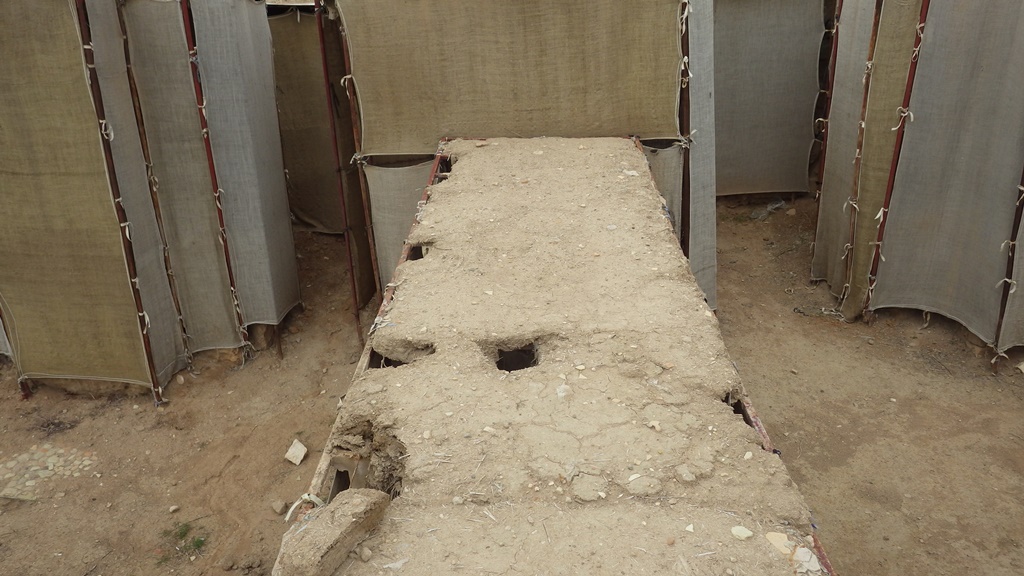
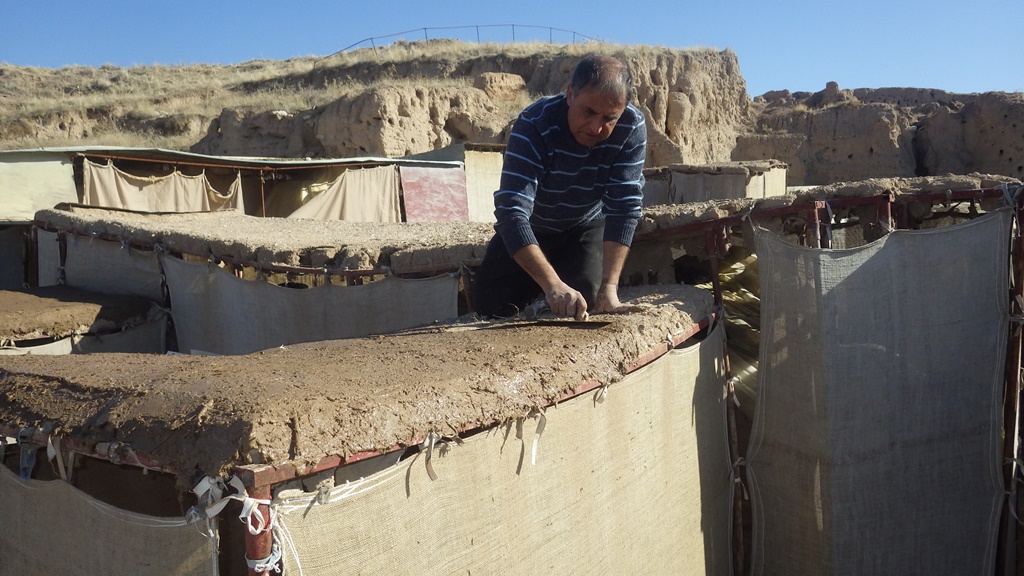
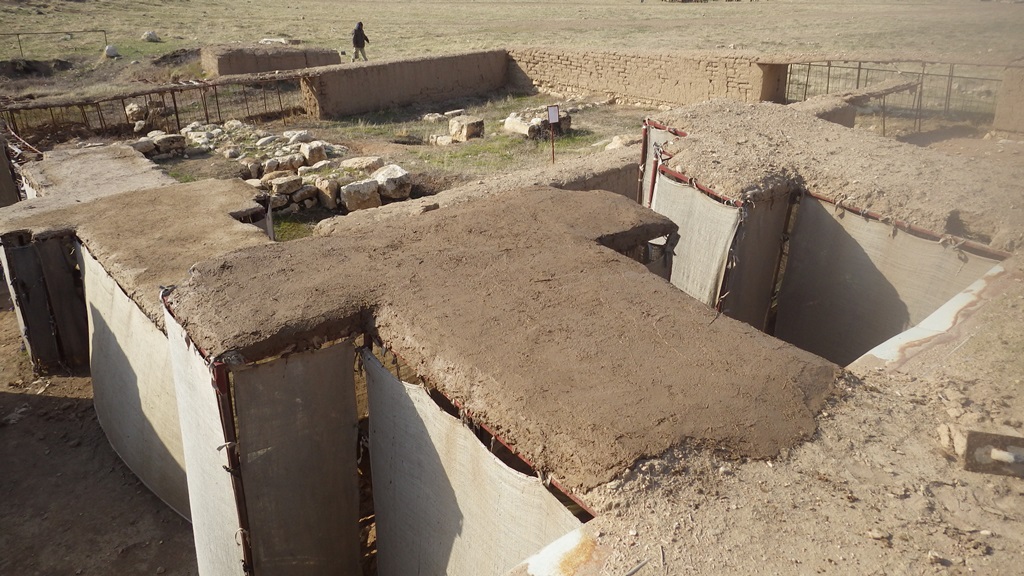
Replacing the mud layer on the protective shelters: The metal protective shelter’s roof is equipped with a thick layer of mud and hey plaster. This layer acts as a barrier between the weather elements, rain in particular, and the palace walls. After a few rain seasons, the layer requires maintenance and replacement after sustaining various levels of damage. This process usually takes place at the end off summer to avoid exposing the walls to harsh weather elements.
| 
| 
| 
Fixing and replacing burlap curtains: The main component of the protective shelter system is the curtains that shield the face and sides of the walls from weather elements and keeps the birds away as well. As it is the case with all the repairs that take place in Tell Mozan, this step too relies on local material, available at reasonable prices, which is burlap. Through the periodic monitoring, our local collaborators determine which curtains need repairs and maintenance after being affected with heavy wind. When fixing a hole or a torn ribbon is possible, then it is done on the spot. When the state of the curtain does not allow for a quick fix, measurements are taken an a new burlap curtain is made and installed.
| 

|
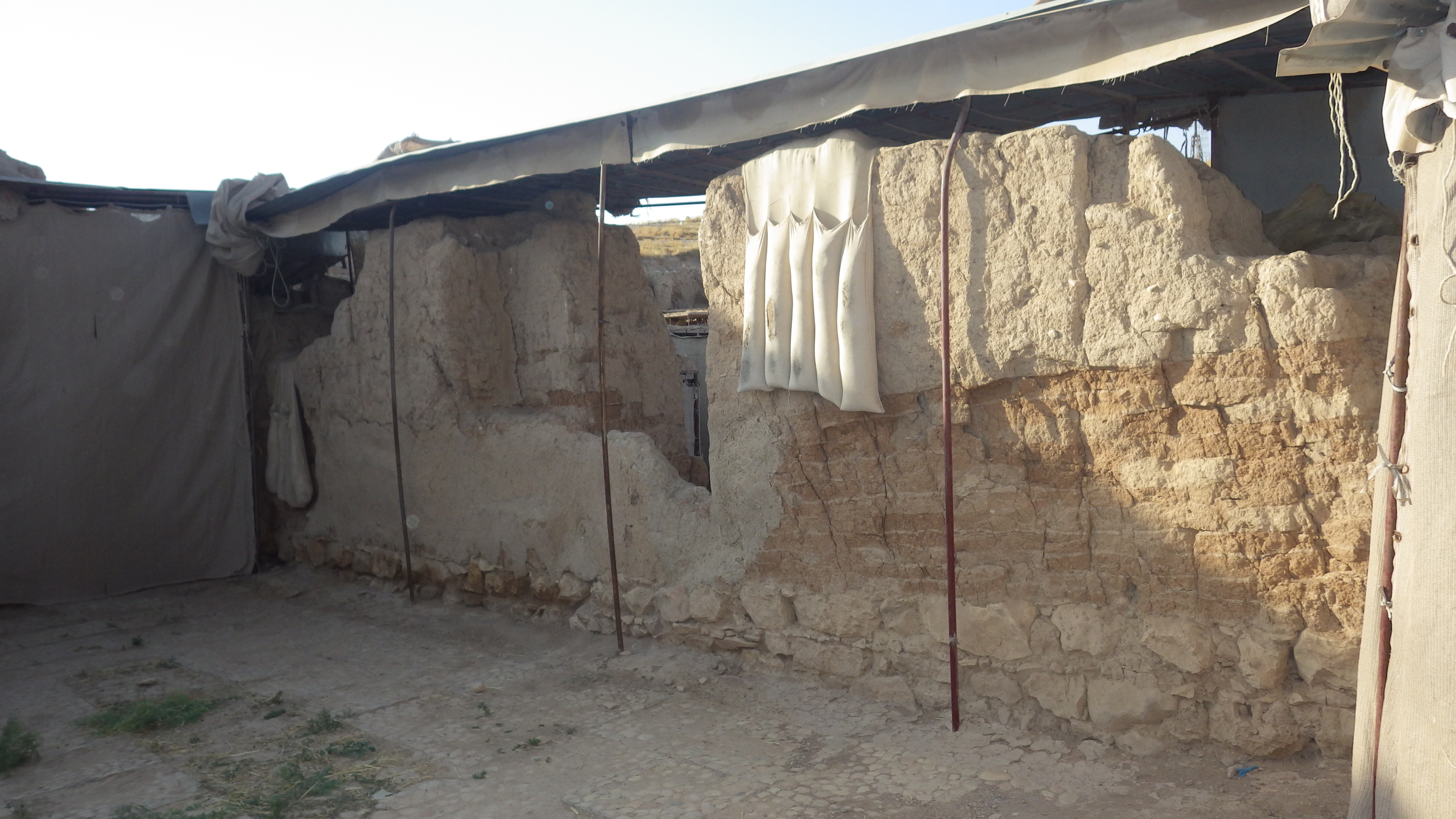
Saddle bags: As mentioned before, despite all the protective measures taken to ensure the safety of the palace walls, some damages are unavoidable. Such damages can sometimes be in the form of a vertical crack that jeopardizes the entire wall. In this case, the bandage method is very effective where the wall is wrapped with thick fabric.
The other forms of cracks that might affect the walls is when the crack happens along the width of the walls, causing the mudbricks to separate, forming a gap in the internal part of the wall all the way to the top. To stop the deterioration in this case, a saddle like cloth piece is installed on the wall where both sides contain a good amount of sand to form a weight that holds the wall togeher.
|   ### Repairs in the Abi
The Abi, being one of the most significant structures in Urkesh, receives its fair share of care and repairs, which could be summarize as the following:
### Repairs in the Abi
The Abi, being one of the most significant structures in Urkesh, receives its fair share of care and repairs, which could be summarize as the following:
The Abi cover: The Abi is covered with a metal dome which replicates what we assume as the original shape which did not survive. The narrow entrance of the Abi is also covered with metal sheets. These metal sheets were a part of a majorrestoration operation. These sheets are under constant monitoring and a fresh rust proof paint coat is applied whenever necessary, emphasizing on a non-obtrusive color in order for the structure to blend with the surrounding landscape.
| 
|
Entrance curtain: The entrance of the Abi is treated similarly to the mudbrick walls of the palace. A burlap curtain protects the entrance from weather elements and birds. This curtain is replaced when torn or damage.
| 
|
Plastering: Giving the fact that the Abi is a stone structure, and despite the fact that it is constantly covered, it does get the same treatment as the other exposed stone structure in terms of applying mud plaster in between the stones to maintain its stability. In the case of the Abi the extreme heat during the summer and humidity, plays a major factor in the deterioration of the mud plaster, hence the "less frequent" treatment.
|
|
### General repairs
The general repairs are also periodic repairs that entail fixing the iron fence around the excavation area, paving the itinerary path and replacing and/or fixing the modern steps created to facilitate reaching the lower excavation area.
|    ## The Approach
The approach to conservation in Tell Mozan is not just embedded in the excavation strategy from the beginning, meaning that we excavate to conserve, but it is also designed to be unique in its approach relying on two key concepts. The first is staying local. We chose from the beginning to rely on simple, inexpensive an locally available material, in order to maintain the sustainability of the process. And along the same line, it was a deliberate choice to rely on local expertise and labor. The second is the reversibility. All the interventions for conservation and repair are reversible, as they do not intervene with the ancient structures and elements in an intrusive irreversible way. The local protective shelters of the palace walls are a great example. In addition to serving the purpose of conserving the walls, they also give the sense of the ancient architectural volumes while being completely un-invasive to the structures. They are removable, e,I reversible.
## The Approach
The approach to conservation in Tell Mozan is not just embedded in the excavation strategy from the beginning, meaning that we excavate to conserve, but it is also designed to be unique in its approach relying on two key concepts. The first is staying local. We chose from the beginning to rely on simple, inexpensive an locally available material, in order to maintain the sustainability of the process. And along the same line, it was a deliberate choice to rely on local expertise and labor. The second is the reversibility. All the interventions for conservation and repair are reversible, as they do not intervene with the ancient structures and elements in an intrusive irreversible way. The local protective shelters of the palace walls are a great example. In addition to serving the purpose of conserving the walls, they also give the sense of the ancient architectural volumes while being completely un-invasive to the structures. They are removable, e,I reversible.
Back to top: Maintenance
|