Back to top: Apron
Main Apron as a stair?
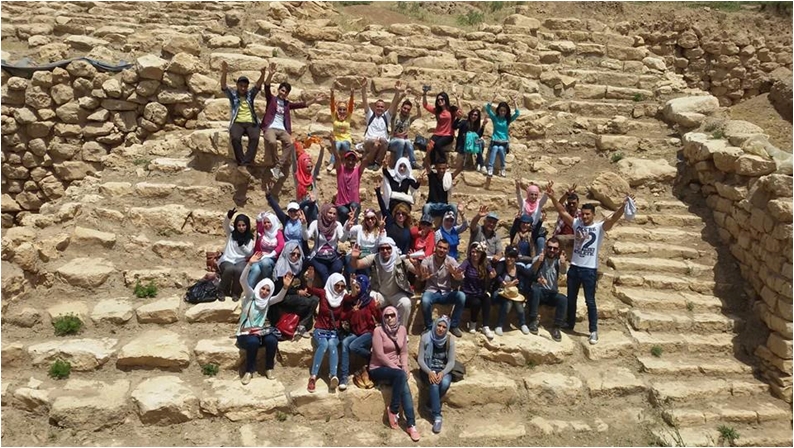
The main apron has steps height of about 30 cm, which is not a tread easy to ascend. People visiting Tell Mozan, use istintively the lower steps of the stair to ascend and the steps of the apron to sit.
Back to top: Apron
Main Apron as a seating area?
It is then conceivable that the “apron” may have served to provide seating for people looking down towards this sector of the Plaza, in a seating arrangement that has a parallel (structural and presumably functional) in the (later) Minoan palaces, as an embryonic antecedent of the later theaters.
Considerations such as these guide our strategy in a very practical sense, for instance by suggesting that there may be traces, however ephemeral, of Plaza
installations that would have made sense when viewed from the top of the apron looking down, rather than just as markers along a possible processional way leading across the Plaza to the staircase and the Temple (<Buccellati 2010b, 106)
What I called the “apron” was cut in half (longitudinally) because of the loss of its lower portion as a result of the filling in of the Plaza. This loss was made up by the construction of what I had called the “secondary apron.” I suggest, now, that this is instead a widening of the top half of the original apron to maintain, topologically11, the same carrying capacity, so to speak, of the structure. I am assuming, here, that the function of the “apron” was indeed to serve as a seating platform for some event that was taking place at its base, as if a cavea. If so, the eastern portion of the Temple complex served a dual function from the mid-third millennium until Mittani times: for access and for display. By mid-Mittani times, the disassembling of the
staircase disassociated the two functions: while access was moved to the W, display was retained in the E. Thus the eastern staircase was partly dismantled, in a way that would serve seating more than walking, and the original cavea (the “primary apron”) was widened, in such a way that both “aprons” could retain the original display function, in the eastern portion of the Temple complex (Buccellati 2010b, 95)
the eastern flank wall
Back to top: Apron