Back to top: Building Materials
Introduction
The materials that people used for their buildings depended mostly on environmental circumstances and from the availability of building materials. In north-eastern Syria, such materials are mostly mudbrick and stone. Wood was available, but in a much smaller quantity. Mud, stone and earth were the main materials used in the construction of the Temple Terrace. The earth came from the natural ground or from the settlement. Following, each of these materials will be described in more detail.
Back to top: Building Materials
Stone
In Urkesh, limestone was the most common type of stone used for construction. Basalt was used for door sockets and grindstones. In the Temple Terrace only limestone is employed.
Limestone is a sedimentary rock which occurs naturally in stratified beds. There is a great variety of limestone types, depending on the presence of other material and consequently it differs greatly in its physical proprieties. Some types of limestone are very durable and hard, while others are very soft and easily broken. Limestone has the characteristics of having structural strength, it is durable, easy to quarry and dress, and it was generally available at not too great a distance.
A petrographic analysis was been undertaken for the Tell Mozan stones and stones collected from the surface near the Dara quarries. Both are petrographically very similar. The samples are composed of calcite with traces of quarz (the study was made by E. Frahm in 2010, Buccellati F. 2017, 88).
Back to top: Building Materials
Stone sources and transport
Flat angular stones with plane surfaces, more or less parallelepiped, are a good form, since they make for excellent bond and less mortar is needed. This type of stones is generally not dressed and can be found in limestone outcrops in the foothills north of Mozan. These are located at about 10 km north of the site and could have served as the source of the stones used in Urkesh.
In this area, a few kilometers east of the Turkish city of Nusaybin, the ruins of the Byzantine town of Dara are located, and limestone quarries are situated east and west of Dara. It is not known whether the quarries used in the 6th century A. D. were also used during the Bronze Age.
The ancient city of Urkesh controlled the Tur Abdin Mountains: sources speak about the city of Urkesh and Nawar (Buccellati-Kelly Buccellati 2007, 147, and the latter could be the Tur Abdin area, where the stone and metal sources are located.
|
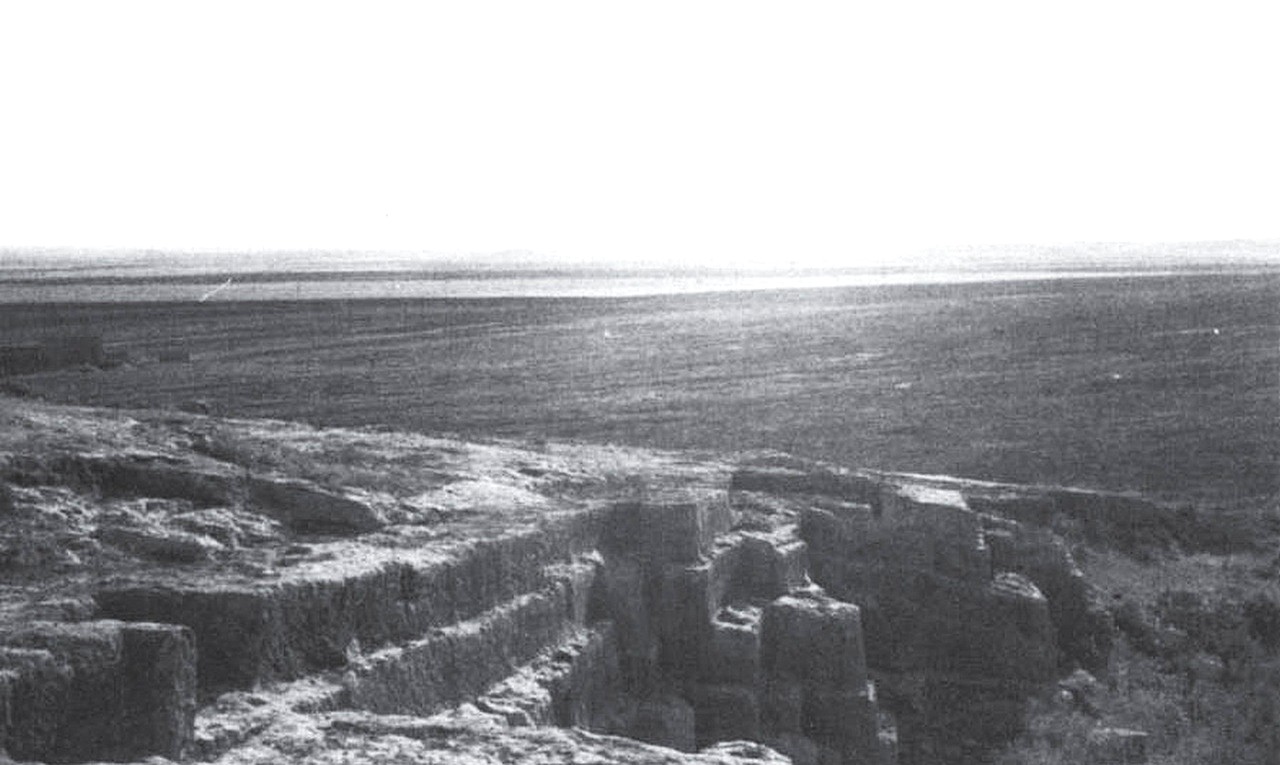
Quarries of Dara
|
Most of the stones used by prehistoric cultures were gathered from outcrops, rock bodies that stick out at the surface of the earth. Quarrying blocks of stone from outcrop beds requires organized labor and technical competence. In quarrying, the miners often made use of natural vertical joints in the rock. Firstly, the block has to be detached from its surroundings by cutting a peripheral channel and then splitting the isolated block away from its bed through chisels or by driving wooden plugs or wedges into the rock and wetting them so that they expand under great pressure.
Limestone in the outcrops is frequently so stratified that it can be split into blocks whose faces are so nearly parallel and perpendicular, that they do not need to be dressed. If there is need to dress the stone, it may be broken by hammering and stone may be detached with more precision by a metal tool with point or edge, like a chisel.
The process of using the natural vertical joints and fractures of the rock is well documented in the outcrops that were used as a quarry for the buildings of Göbekli Tepe, near the modern city of Şanlıurfa in the south-east of Turkey. The unfinished stone T-pillars used to construct the 'Special Building' have been found 300m from the site to insert in MEL Kurapkat 2010.
|
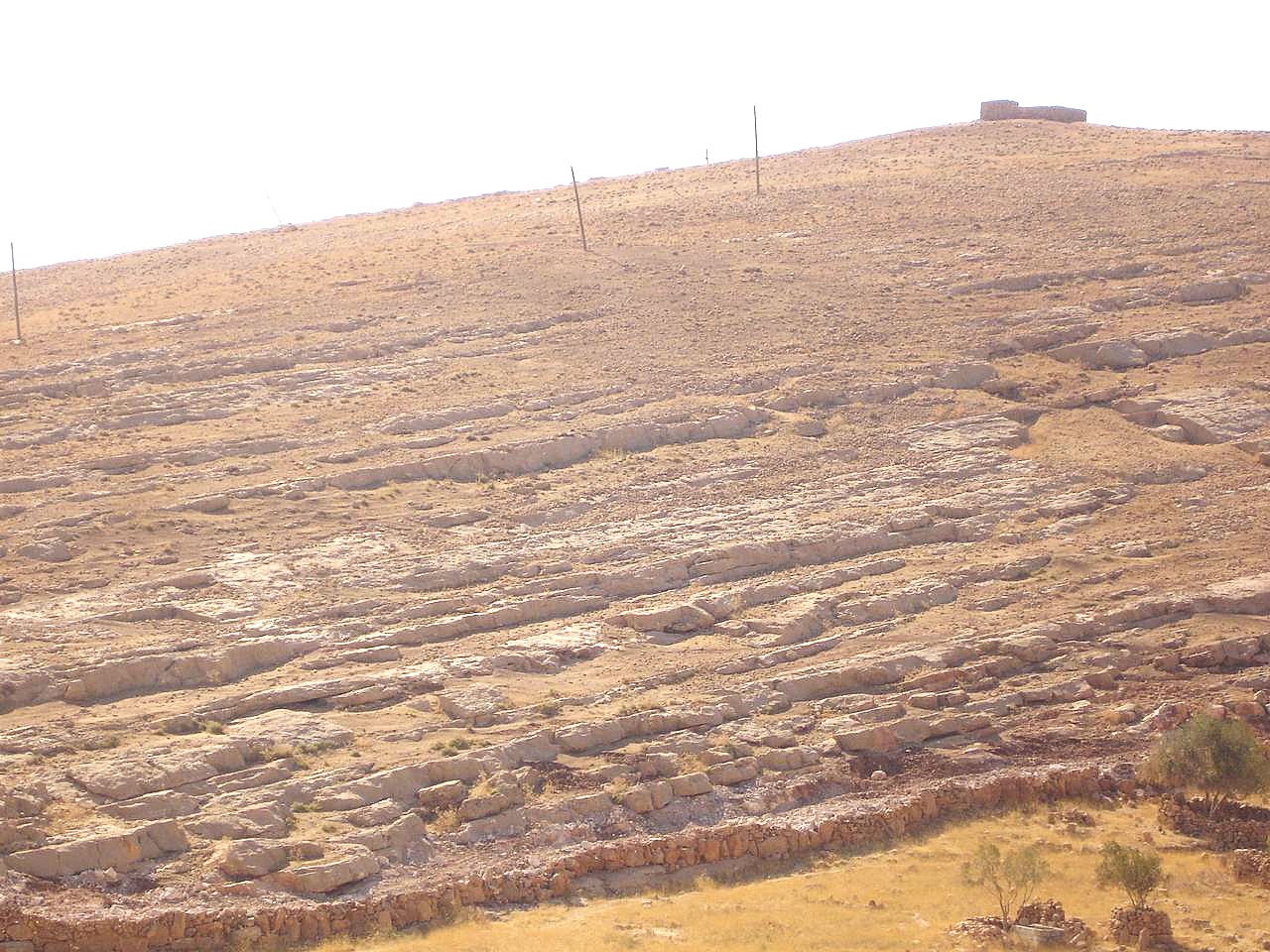
Outcrops in the Tur Abdin mountains
|
Small stones (10-30 cm thick) can be found in wadis, in hill sides and in the fields. Water in streams brings gravel and other lithic material from the point of origin in the mountains. The size and shape of stones transported depends on the velocity of the water. Mostly it consists of small stones, pebbles and particles. Such small stones can easily be gathered and lifted by a single man. The shape of these field and wadi stones is rounded and this form has to be set in a thick bed of mud mortar if used in the construction of walls.
The stones could be transported on rafts down the rivers or carried by oxen all the way to the ancient city of Urkesh. The way from the quarries to the site of construction was not too far (5-15 km) and there are several wadis flowing from the limestone outcrops to the ancient site, one of them flowed in the low mound.
Back to top: Building Materials
Stone dimensions
Stones used at the Temple Terrace of Tell Mozan vary in dimension and quality. From the variety and quality of stones used, it can be assumed that different sources and quarries may have been employed by the ancient builders of Urkesh.
Large and medium stones are preferred for building walls and small stones are used as fill stones in large joints.
The largest stones documented at the Temple Terrace measures 2 x 0.50 x 0.30 m, for a weight of about 783 kg (limestone solid is 2611 kg/cu.m.), see J2f154. Generally, the structures of the Temple Terrace are built up of large to medium stones of 1 x 0.40 x 0.30 m in size, for a weight of 313 kg, which can be transported by an ox.
A variety of stone types and shapes are used, most of which are unworked or have a naturally flat, smooth surface. Only in a few examples are chisel or hammer signs visible (J2f130).
There are few stones of the steps of the staircase at the Temple Terrace presenting these signs: this is due to the need to create a regular step front. A different type of construction can be seen in another building at Tell Mozan. The foundation and substructure of the mud-brick walls in the Palace AP of Tell Mozan were made of roughly squared stones. They appear to be more shaped and worked than the stones of the temple terrace Buccellati F. 2017, 92-93).
In Area C an administrative building with stone walls (Building XV) was excavated south of the Plaza JP. The walls are made of large, roughly shaped rectangular or square limestone blocks, so that the outer surface of the wall was regular. No mortar was used between the stones, but small stones were used to fill the joints. The construction technique used for the substructures of Palace AP and Building XV in Area C is the same. However, the construction of the enclosure wall of the temple terrace is different. The stones used for the revetment wall are irregular.
The stones are chosen very carefully depending on their use and function. For staircases and the ramp of Temple BA, the stones used are naturally smooth with flat plain surfaces and irregular or regular parallelepiped in form (Pl. 41-43).
The walls are made of undressed stones of irregular shape and size. They are laid in irregular courses, so that the thickness of the joints varies. The joints are filled with mud mortar J1f72. To reduce the amount of mortar, small stones are placed between the larger stones.
The stones of the Temple Terrace have the following dimensions:
|
type
|
diameter
|
weight
|
provenience
|
transport
|
use
|
|
small
|
>30 cm
|
>100 kg
|
littering fields, hill sides, wadis
|
1-2 man
|
fill, leveling
|
|
medium
|
30-50 cm
|
100-700 kg
|
outcrops, quarries
|
2-5 man
|
wall
|
|
large
|
>50 cm
|
<700 kg
|
outcrops, quarries
|
<5 man, ox
|
staircase, apron, escarpment
|
Stones of all sizes are used on the temple terrace. Small undressed stones are generally used as fill stones in walls between large and medium sized stones and under steps as a levelling course. Medium sized stones are the most commonly used, both for walls and steps. Large stones are more commonly found in the staircases and less commonly in the walls next to the medium sized stones.
Back to top: Building Materials
Mud
Mud has always been the most common building material used in the Near East. The tells result from the disintegration of buildings made of sun dried bricks, which are commonly called mudbricks. Houses, public buildings as palaces or temples, city walls were constructed in mudbricks. Even floors, roof coverings but also the furniture were built from mudbricks or pressed mud. The proprieties of mud as construction material is of being elastic and having crack resistance and bond strength. These characteristics are due to the quantity of clay present.
Even in regions where stone was largely available, mudbrick was always the primary building material. This is due to the traditional construction technique of Mesopotamia and to the availability of mud, which can be found directly on the building site in Mesopotamian plains and remains cheap, adaptable and easy to use. It has extraordinary insulating qualities and can be cut and shaped easily.
At the Temple Terrace mud was used for filling older structures, was used as packing against the base and footings of stone walls or to cover surfaces. There were a series of glacis which were smooth mud surfaces covering the mound. The mud of these constructions had different colors, components, and characteristics, depending on the origin of the mud and on whether it was mixed with other soils.
For example, the various escarpments laid at the base of the revetment wall had at least three types of mud mixture. One was mostly made from pure clay (JPe1, Pl. 35d). There was another escarpment made of gray mud, which was coming from the settlement and therefore rich of cultural material, as sherds, mudbricks, pebbles (JPe3 Pl. 33a). Another escarpment consisted of mud mixed with red mudbricks, giving to it a red coloration (Pl. 49a).
The many glacis covering the mound were also made of mud, rich of small pebbles of less than 1 cm in diameter and had the characteristic of being a very hard clay (JPg1 Pl. 27).
Back to top: Building Materials
Mudbrick
Mudbrick is made of soil, which is a mixture of clay, gravel, sand and silt. Sun dried mudbricks, if protected by roofing and plaster, can be a durable building material. As mudbricks are exposed to water and wind, they melt very quickly.
Mudbrick making does not request special skills, since villagers in modern Syria and Iraq make them ordinarily using the same technique as in the past. The procedure is easy but it has to follow a series of rules. Firstly, soil must be collected from the fields for red-brown bricks. Soil collected from the tell is rich of cultural deposits and has the quality of being more elastic and the coloration of the brick is grey. The mixture is put inside a pit with chaff or straw as temper; water is added in order to avoid cracks, and all is kneaded with the feet: it is estimated that 100 bricks require about 60 kg of straw (bibl. Moorey 1994, Oates 1990).
Afterwards, the mixed soil is embedded into rectangular wooden molds, open at the top and the bottom. The surplus of the mixture is cleaned off by hand, the mold is removed and the brick is dried in the sun with regular turning for an appropriate period of at least two weeks. When bricks are sufficiently hard, they are ready and can be used to construct walls. A brick of 0.40 x 0.40 x 0.12 m in dimensions weights 22 kg (bibl. Atkar 2007 http://www.alalakh.org/mudbricks2008.asp).
All these procedures need to be carried out next to water sources. Generally, brick production was done in the building place and probably also in the ancient city of Urkesh this was possible, due to presence of water. Now, as in ancient times, the preferred month to manufacture bricks is May-June, when the temperatures are hot (45° in north east Syria) and immediately after the spring rains, when water would be plentiful and chaff or straw is easily available after the harvest. July-August is the month of building, when the dryness of the ground would facilitate foundation lying (bibl. Buccellati F. 2017:153, Moorey 1994: 304.
At the Temple Terrace mudbricks were used in the construction of ^BTglacis1. Both grey and red bricks were used and are of different dimensions.
Back to top: Building Materials
Mortar
The mortar employed is made of the same composition as bricks, often with the addition of ash which gives a grey coloration. Mud mortar is very plastic and has a very good adhesive quality.
Back to top: Building Materials