NOT FINISHED- WORK IN PROGRESS
Back to top: Production technique
Techniques
Two different manufacturing techniques are attested in Urkesh so far, free hand molding and mold made figurines and plaques. For more details, refer to the designated page for
production techniques | in the typological book on human figurines.
Back to top: Production technique
Freehand molding
There are two recognized diverging technical and cognitive approaches in the construction of clay and terracotta figurines, which are core forming and dual forming techniques. In core forming, the sequence started from an inner core on which other plastic elements (legs, arms, head) were gradually added. In this process the basic cognitive model is radial symmetry, the limbs being applied as radial appendages to the solid core. For dual forming, the torso and more generally the body is made by joining two elongated slabs or lumps along a central axis of symmetry, while the rest is applied in bi-lateral or concentric patterns (Vidale et al 2015). This is the general approach which then takes a more specific form by shaping the body in the envisioned manner.
A good example from JP area is figurine TFH^u3 | .
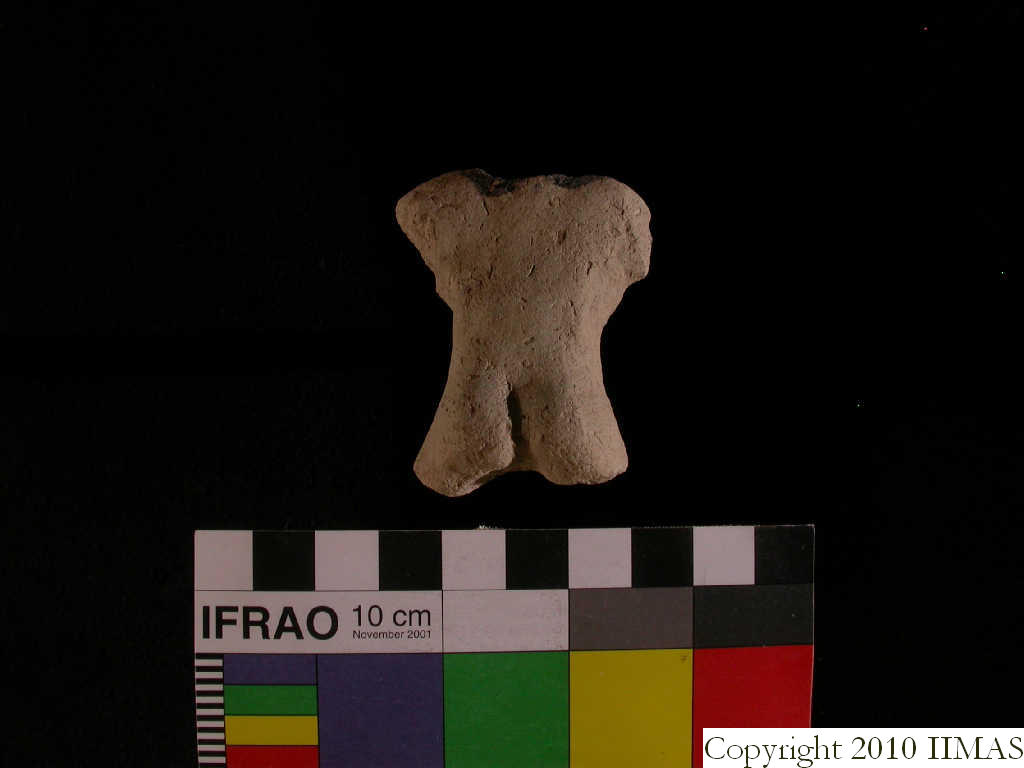
|
Back to top: Production technique
Flattened bodies
|
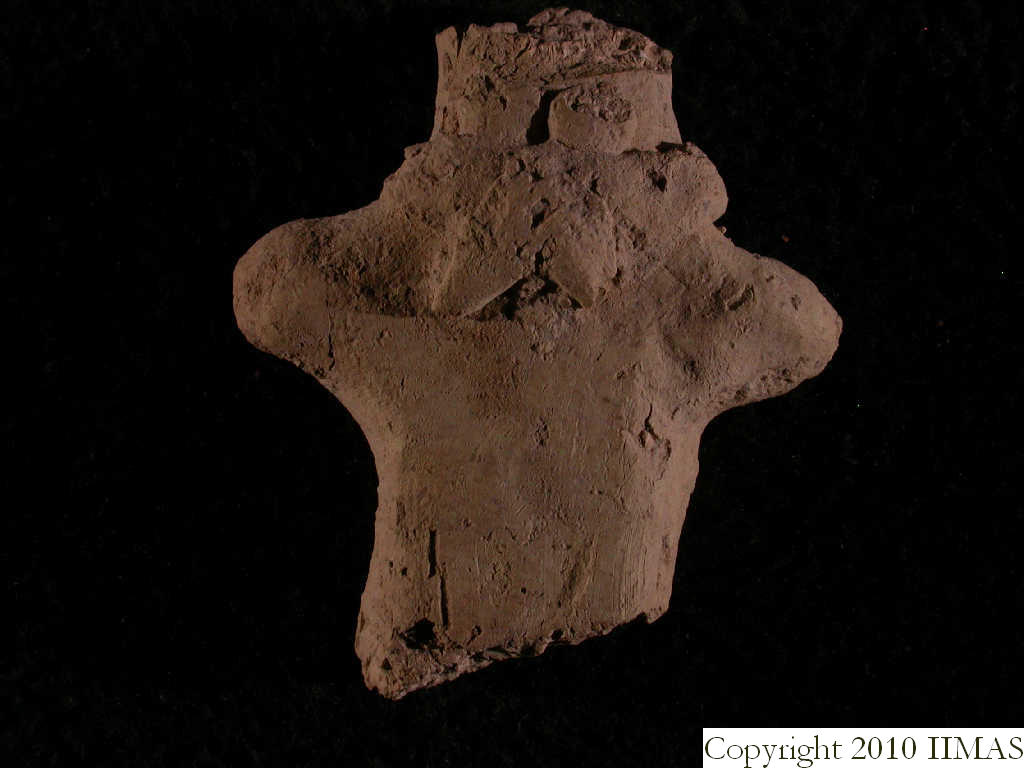
The flattened body shape is achieved by roughly shaping the clay in between the hands to the desired shape before placing the clay on a flat surface, applying even pressure on the piece to give it the required thickness, then finishing the shaping and smoothing the clay.
| 
|
Back to top: Production technique
Cylindrical bodies
|
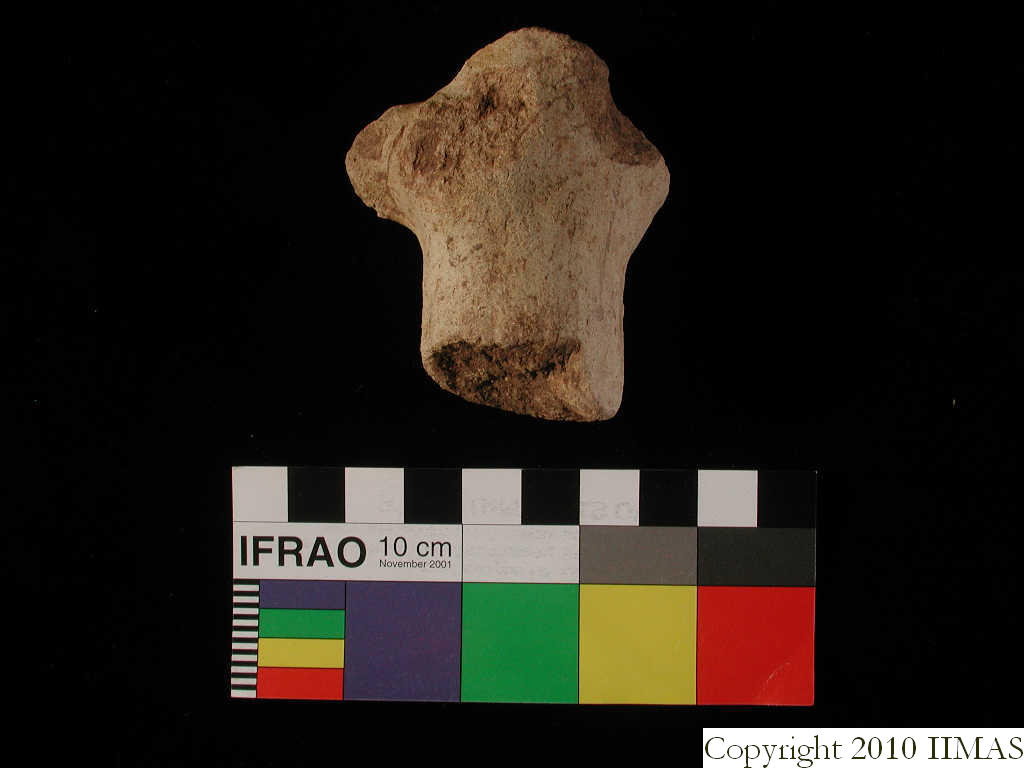
The cylindrical bodies are shaped in between the hands where the clay is worked to the desired shape, then, in some cases, the clay is placed on its round base to give the artists two free hands to add the details of the arms and face and any other features.
| 
|
Back to top: Production technique
Hollowed figurines
|
The reason for making hollowed figurines is quite unclear when the hollowed inside was not being used to store a liquid or a substance. One possibility is molding the figurine on to a wooden slab for example, and removing it after acquiring the desired shape, hence leaving an empty space inside. Another possibility could be the use of a mold to shape the front and the back separately and then joining them together.
| 
|
Back to top: Production technique
Mold made figurines
Back to top: Production technique
Clay plaques
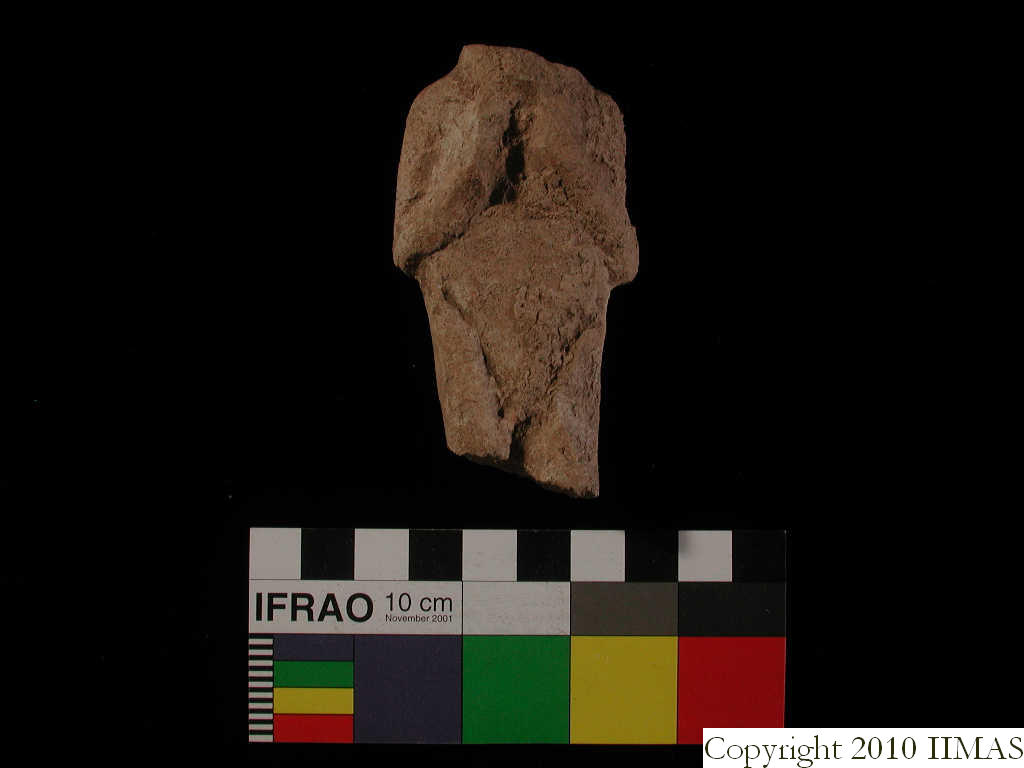
Clay plaques are very common all over Mesopotamia. the use of a one-piece mold appeared in Babylonia in the late third millennium and migrated into Syria in the second quarter of the second millennium (Badre 1980: 22-23, Barrelet 1968: 86-90).
A possible exchange of techniques and ideas between terracotta plaque figurines and metal figurines is strongly suggested, although “lead figurines belong principally to a Syro-Anatolian milieu and Old Babylonian plaques are very much a southern specialty” (Heffron 2017: 292).
To make terracotta plaques, two sets of skills are required just as in the case of metal figurines. The first set of skills is carving the stone mold. This step requires a knowledge of popular motifs, an artistic skill and a knowledge of the best stone for the job. The second set of skills is one that a potter or figurine maker has. It requires knowing how and from where to source the clay, how to prepare it and how to bake it. This meant two different workshops, one for the mold and the other is the potter’s workshop. In some cases, further applied details were added after the plaque was extracted from the mold as it was the case for some terracotta from Tell Brak (D. Oates, J. Oates, McDonald 1997: 132).
| 
|
Back to top: Production technique
Decorations
Several different techniques and instruments were used to decorate the anthropomorphic figurines and add details. In some examples, numerous techniques are used on the same figurine to achieve the final look. The following are the decoration techniques used in making the anthropomorphic figurines of JP area.
Back to top: Production technique
Application
The application of extra pieces of clay is used to add body parts, such as breasts, navels, eyes, male genitalia or decorative features such as head dresses and necklaces. This technique is used very often in Urkesh for breasts and necklaces and less often for the eyes.
A good example from JP area is figurine TFH^u2.
Back to top: Production technique
Incising
|
Probably the most popular technique of all. It is used to add decorative lines, texture, facial features like a smile or eyebrows, and to schematically render pubic hair or beard hair. The application is very simple by using a sharp pointy tool (metal or wood) that can vary in thickness, and applying it to the wet clay before baking. In some cases, it is possible to make the incisions on the air-dried clay before baking.
| 
|
Back to top: Production technique
Smoothing and polishing
It is almost impossible to determine which smoothing or polishing techniques the ancients used, especially when the smoothing takes place while the clay is wet before baking which leaves no traces of smoothing. Several techniques might have been implemented to smooth the surface of the clay. Scraping is a technique that is applied on the air-dried clay before baking where a sharp flat tool (wood or metal) is used on the surface to even the irregularities and smooth the surface before wetting the clay again and smoothing the traces that the previous devise left. However, it is extremely difficult to know whether this technique was used on an artifact or not because of the smoothing process that follows. The simplest of the smoothing techniques is wetting the hands and smoothing the surface with the fingers. Another method is by smoothing the surface with a piece of wet cloth.
As for polishing, I observed the potter polishing the ceramic cups she had made and baked with a very fine type of sand paper to eliminate any irregularities and give the vessel a very smooth and shiny surface. Since there was no such paper in antiquity, we tried to achieve this result by scraping the surface of the baked clay with a very smooth stone and the results were very good.
Back to top: Production technique
Painting
|
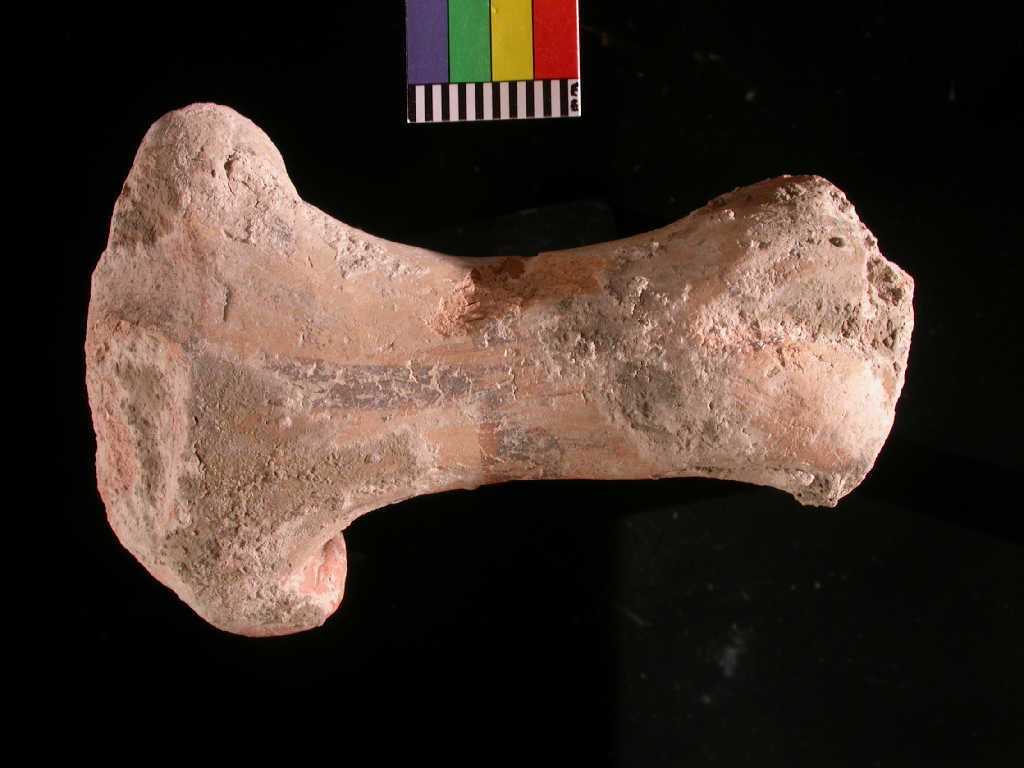
Applying paint to the figurines was done post the initial baking process, where the paint would be applied on the entire body or in specific areas, before firing the piece again to make the paint permanent. Shades of grey, green and red are the most common colors, and they were applied either as decorative line, or to give depth and texture, or to depict a certain feature like the cross band, or highlight a specific area such as the pubic triangle.
| 
|
Back to top: Production technique
Testing the techniques
The chief of the local potters in Damascus was consulted on the techniques used to produce the anthropomorphic figurines of Urkesh. a replication experiment was conducted and the following is a summery of the results obtained. For more information, refer to the designated page for
replication experiment | .
Two figurine that belong to JP area was replicated in the experiment,
TFH^u2 | and
TFH^f1 | . Creating these two figurines required different approaches as
TFH^u2 | was shaped by adding the arms as knobs to the torso, while
TFH^f1 | was shaped from the same piece of clay.
Back to top: Production technique
• The experiment was done using a pre-prepared clay.
• An industrial oven was used to bake the figurines, hence controlling the temperature and timing.
• The challenges of the experiment can be summarized as lack of experience on the part of the apprentice (the author) which resulted in some cracked surfaces, smoothing and finger print traces, and ending up with figurines that are much heavier in weight than the original ones.
Back to top: Production technique